
 By Neng Nana
Federal Bureau of Investigation agents have arrested the co-founder of a prominent Canadian cybersecurity firm in Pennsylvania, marking a significant escalation in the ongoing, high-stakes federal investigation into the notorious ShinyHunters hacking collective. The arrest comes on the heels of a devastating cyberattack attributed to the group that compromised sensitive data belonging to thousands of law enforcement personnel, according to multiple sources familiar with the federal probe.
The New York Times reported that federal authorities apprehended a Canadian man in Pennsylvania on suspicion of providing assistance to the ShinyHunters cybercrime syndicate. While neither the initial newspaper report nor a public statement released on social media platform X by FBI Director Kash Patel explicitly named the individual in custody, sources close to the unfolding investigation confirmed his identity to security journalists.
According to individuals familiar with the matter, the Canadian executive was visiting Pennsylvania to attend a prominent cyber insurance and risk conference. Investigators note that his professional background specialized in navigating the complex landscape of ransomware negotiations, advising corporate victims on how to manage communications and extortion demands from cybercriminal organizations.
Publicly available records and conference schedules indicate that the Cyber Risk Summit was hosted at the Loews Philadelphia Hotel. While the annual event featured numerous industry sponsors, conference documentation shows that its primary financial backer was a Canadian cybersecurity enterprise known as Cypfer.
Corporate registries and professional networking profiles confirm that Cypfer was co-founded by a Canadian security professional named Edward Dubrovsky. In the wake of his tenure at Cypfer, Dubrovsky became associated with CyberSteward, another Canadian security firm that also maintained a sponsoring presence at the Philadelphia summit. Approximately one month prior to his arrest, Dubrovsky shared updates on social media expressing anticipation for attending the conference alongside his colleagues from the CyberSteward team.

In that promotional post, Dubrovsky highlighted his ongoing professional focus, writing that he looked forward to continuing strategic conversations centered around compliant-driven coercive and ransomware advisory, negotiation, and settlement services operating on a global, platform-agnostic scale.
Federal court documentation indicates that an individual named Edward Dobrovsky—reflecting a slight spelling variation of the surname—was taken into custody in Pennsylvania on October 8, facing federal charges related to cyber extortion and conspiracy. While a substantial portion of the judiciary record, including the foundational criminal complaint, remains under seal by the court, several dockets have been indexed publicly via digital legal repositories.
Among the accessible documents is a summary of the criminal complaint filed against the defendant, which formally accuses him of participating in a conspiracy to threaten the confidentiality of proprietary and sensitive information with the explicit intent to extort money, alongside charges of interference with commerce through threats.
Inmate locator databases maintained by the U.S. Bureau of Prisons reflect that a 54-year-old individual named Edward Dubrovsky is currently detained within a federal correctional facility in Philadelphia. However, court docket entries show that the legal proceedings were officially ordered to be transferred to the U.S. District Court for the Eastern District of Texas. Sources indicate that this federal judicial district has now become the central operational hub and epicenter for the expansive FBI investigation into the ShinyHunters network. Representatives for the FBI have declined to make public comments regarding the ongoing judicial proceedings.
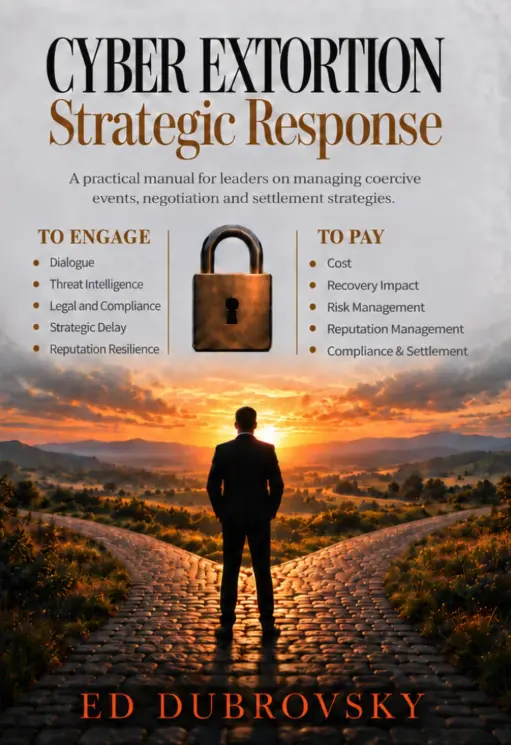
Beyond his operational advisory work in corporate boardrooms, Dubrovsky’s professional background includes authorship within the specialized field of incident response. His published literature includes a comprehensive volume titled Cyber Extortion Strategic Response, a manual marketed toward guiding organizations through the intricate decision-making processes required when facing ransomware incidents, corporate recovery operations, and data confidentiality threats.
Promotional material for the text emphasizes a core strategic philosophy that differentiates communication from compliance. The excerpt notes that establishing dialogue with a malicious actor does not equate to negotiating a monetary payment, and that entering into negotiations does not constitute an ultimate commitment to satisfy a ransom demand. Instead, the literature posits that active engagement can serve alternative tactical objectives, such as validating threat actor claims, gathering vital intelligence, buying operational time, and preserving institutional options while leadership evaluates subsequent defensive postures.

Mr. Dubrovsky could not be reached immediately for direct comment regarding the federal allegations. Inquiries directed to co-founders and representatives at CyberSteward have likewise yielded no immediate responses. Initial filings and available court records indicate that the defendant has not yet retained private legal counsel, nor has the court formally appointed a public defender to represent his interests in the federal proceedings.
The ShinyHunters hacking syndicate has long established a reputation within the cybersecurity community for utilizing sophisticated phishing campaigns and compromising stolen user credentials to infiltrate corporate environments, particularly targeting cloud storage and software-as-a-service providers. Once inside corporate networks, the group typically exfiltrates large volumes of proprietary and confidential data, subsequently issuing ultimatums threatening to publish the stolen records on public forums unless substantial cryptocurrency ransoms are fulfilled. Federal estimates suggest that the collective has successfully extorted in excess of $70 million from corporate and institutional victims over the course of the year.
The apprehension of the Canadian security executive builds upon a mounting wave of law enforcement pressure directed at the syndicate and its associated facilitators. Sources indicate that federal investigators have spent recent weeks meticulously analyzing electronic devices and digital infrastructure seized last month during an international operation conducted by Dutch law authorities, which resulted in the arrest of convicted cybercriminal Pepijn van der Stap in connection with the broader ShinyHunters probe. Furthermore, intelligence sources suggest that criminal charges against principals and operatives at other commercial entities specializing in ransomware mediation and negotiation may be imminent.
The urgency surrounding the federal investigation intensified significantly in the wake of Van der Stap’s arrest. Following that law enforcement action, another prominent figure within the ShinyHunters hierarchy, operating under the alias "Rey," assumed leadership and control over the group’s public channels. In a bold escalation, the operative began openly taunting federal authorities, leaking sensitive data pilfered directly from an online recruitment portal utilized by the FBI. The compromised personnel records included detailed information regarding operational units, professional specializations, and confidential medical and psychiatric evaluations of federal agents.
International reporting revealed that the individual operating under the alias Rey was identified as a teenager named Saif Al-din Khader. Authorities successfully detained the young hacker, who has since reportedly engaged in cooperation with federal investigators. Law enforcement operations culminated as the cybercrime collective allegedly attempted to execute an extortion campaign targeting a specialized digital aviation and navigation unit that had been divested by aerospace manufacturer Boeing.
As federal authorities continue to execute search warrants, analyze seized digital assets, and trace the flow of illicit cryptocurrency proceeds across international borders, the federal case remains an exceptionally active and rapidly developing national security investigation.
 Nila Kartika Wati
 Sagoh
 Dwi Wanna