
 By Lina Irawan
Federal Bureau of Investigation agents have arrested the co-founder of a prominent Canadian cybersecurity firm in connection with a sprawling and high-stakes federal investigation into the notorious ShinyHunters hacking group. The syndicate recently managed to infiltrate federal systems and relieve the bureau of sensitive personal and professional data concerning thousands of agents.
According to multiple sources, the federal arrest took place on Thursday, though official announcements have remained tight-lipped regarding the specific nexus between the suspect and the cybercriminal outfit. The New York Times reported that federal authorities apprehended a Canadian man in Pennsylvania on suspicion of providing assistance to ShinyHunters. Neither that initial report nor a public statement published on social media by FBI Director Kash Patel explicitly identified the individual in custody.
However, sources close to the unfolding investigation told reporters that the Canadian national arrested this week had traveled to Pennsylvania to attend a prominent cyber insurance conference. Investigators discovered that the suspect’s professional background heavily involved navigating complex ransomware negotiations and mediating between victimized corporations and aggressive cybercrime cartels. Additional sources indicated that command and control over the broader ShinyHunters investigation has now been officially centralized at a key FBI field office located in Texas.
An online review of industry events confirms that the Cyber Risk Summit took place at the Loews Philadelphia Hotel from October 5 through October 7. While the conference featured numerous sponsors and exhibitors, official event documentation reveals that its largest financial backer was a Canadian cybersecurity enterprise known as Cypfer.
Public corporate registries and professional networking profiles show that Cypfer was co-founded by a Canadian man named Edward Dubrovsky. Dubrovsky is currently affiliated with another Canadian security firm and conference sponsor called CyberSteward. Approximately one month prior to his apprehension, Dubrovsky published a post on LinkedIn announcing his travel plans to attend the Philadelphia Cyber Risk Summit alongside his colleagues from the CyberSteward team.

In that social media post, Dubrovsky wrote that he was looking forward to continuing strategic conversations surrounding compliance-driven, coercive extortion advisory, ransomware negotiations, and global settlement services.
Federal court documents indicate that on October 8, an individual named Edward Dobrovsky—noting a slight spelling variation in the last name—was taken into custody in Pennsylvania on serious charges related to cyber extortion and conspiracy. Several of these judicial documents, including the primary criminal complaint, have been placed under seal by the court. Nevertheless, a subset of the docket files remains accessible through public legal databases, including a summary of the complaint outlining charges of conspiracy to threaten the impairment of information confidentiality with the explicit intent to extort money, alongside charges of interference with commerce by threats.
The inmate locator system maintained by the U.S. Bureau of Prisons confirms that a 54-year-old Edward Dubrovsky is currently detained at a federal holding facility in Philadelphia. Court records also feature a transfer notice filed on October 9, which officially moved the legal proceedings to the U.S. District Court for the Eastern District of Texas. This district has emerged as the epicenter of the federal government’s ongoing efforts to dismantle the ShinyHunters network. Representatives for the FBI declined to provide public comments when approached regarding the arrest.
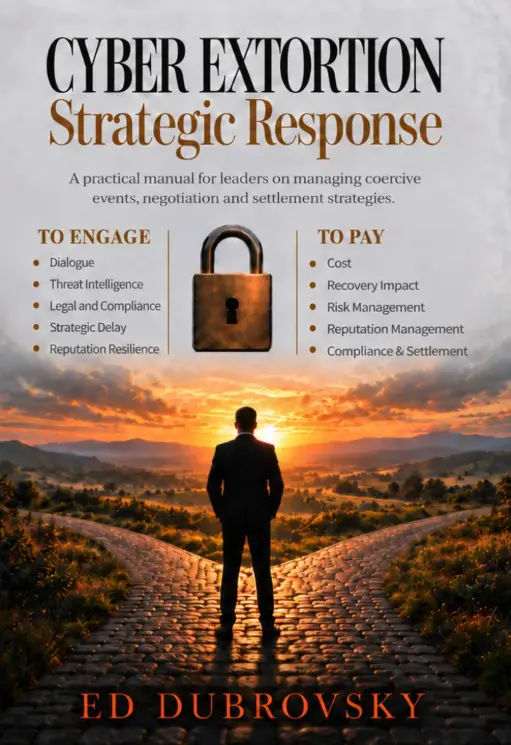
Dubrovsky’s professional background includes authorship of a specialized text titled Cyber Extortion Strategic Response, a 252-page volume marketed as a manual to help organizations navigate the critical decisions required to respond, recover, and protect critical assets following a cyberattack. Promotional material for the book highlights a core philosophical distinction regarding threat actors, noting that communicating with a criminal does not equate to negotiating a payment, and that entering into dialogue does not constitute a commitment to meet ransom demands. The text argues that active engagement can serve alternative tactical objectives, such as validating attacker claims, gathering intelligence, buying time, and preserving options while leadership formulates a comprehensive response strategy.
At the time of reporting, Mr. Dubrovsky could not be reached directly for comment. Inquiries sent to the other co-founders of CyberSteward yielded no immediate response, though updates are expected should corporate representatives issue a statement. Available court filings show that Dubrovsky has not yet retained private legal counsel, nor has the court formally appointed a public defender to represent him in the proceedings.
The ShinyHunters collective has established a formidable and destructive reputation in the global cybercrime landscape by utilizing sophisticated phishing campaigns and stolen credential sets to siphon confidential data repositories from corporate accounts at software-as-a-service providers. The group typically leverages the stolen data by threatening public leaks or commercial exposure unless substantial ransom demands are satisfied. According to federal estimates, the syndicate has successfully extorted more than $70 million from corporate and institutional victims over the course of the year.

Law enforcement agencies have intensified their pressure on the group in recent weeks. Sources indicate that federal investigators have spent considerable time examining digital storage media and electronic devices seized last month during an operation by Dutch law authorities. That operation resulted in the arrest of Pepijn van der Stap, a convicted cybercriminal linked directly to the ShinyHunters infrastructure. Investigators believe that additional criminal charges against principals at other specialized ransomware negotiation firms could be forthcoming as the inquiry widens.
The arrest of key figures has done little to quell the group’s brazen activities. Immediately following the apprehension of Van der Stap, another core operative within ShinyHunters operating under the alias "Rey" assumed leadership responsibilities over the collective. This individual quickly began taunting federal law enforcement online, highlighting the theft of sensitive internal files extracted from the FBI’s own online recruitment portal. The stolen cache reportedly contained granular details regarding individual personnel, unit assignments, professional specializations, and confidential medical and psychiatric records.
International reporting subsequently revealed that the operative known as Rey was actually a teenager named Saif Al-din Khader. Authorities detained the young hacker, who has reportedly begun cooperating with federal investigators. Law enforcement closed in on Khader as the cybercrime unit attempted an extortion campaign against a digital aviation and navigation unit that had been divested by aerospace giant Boeing.
Federal authorities continue to pore over digital evidence and financial trails as the investigation accelerates, with further developments expected as the case proceeds through the federal court system in Texas.
 Nila Kartika Wati
 Sagoh
 Ammar Sabilarrohman