
 By Jia Lissa

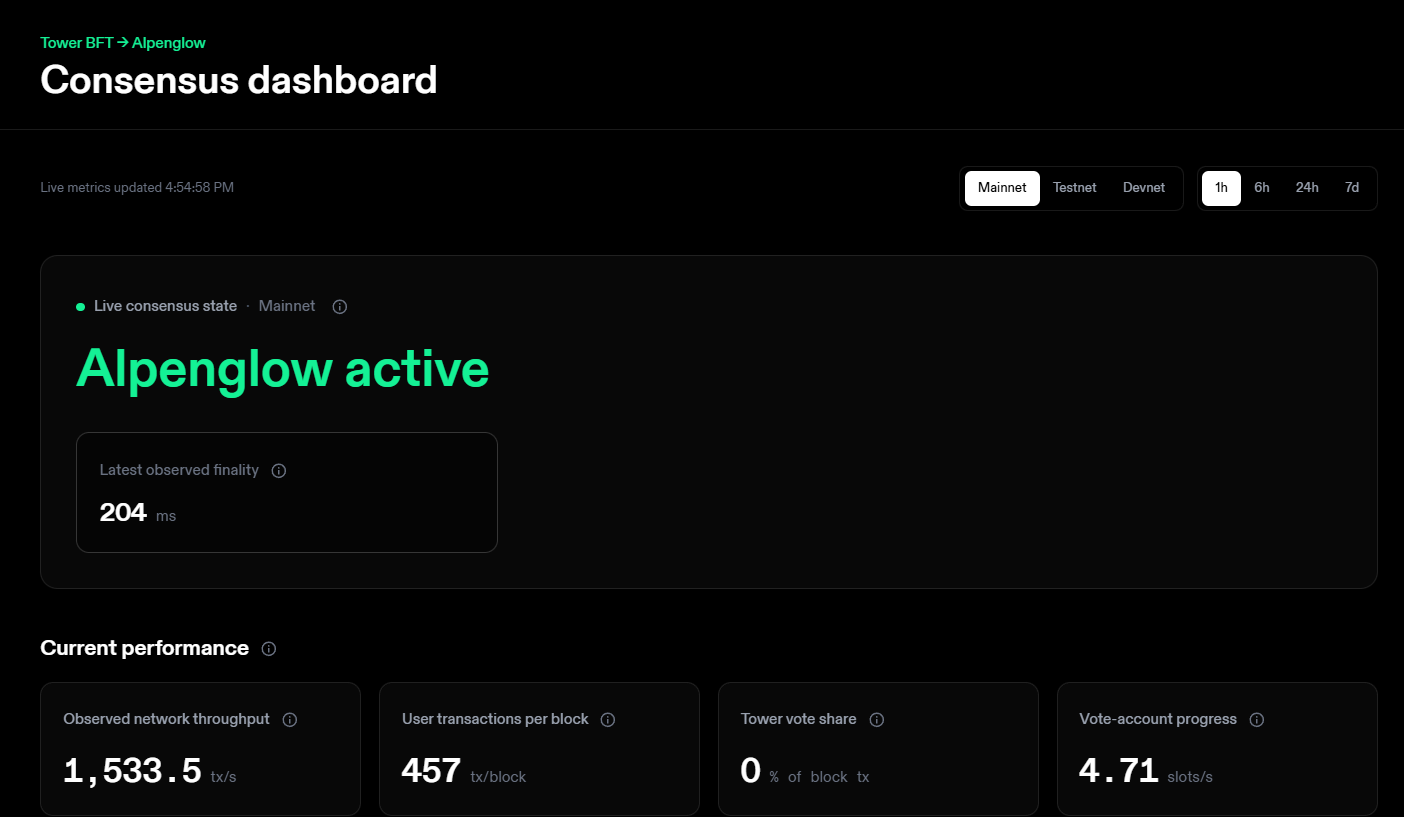
Solana’s first major consensus upgrade, Alpenglow, officially went live on the mainnet on Wednesday, marking what core developers and researchers are calling the most significant shift for the blockchain’s core architecture since its genesis block. According to data provided by the Solana Foundation’s Alpenglow dashboard, the milestone activation took place at approximately 1:54 pm UTC, signaling the beginning of a technical overhaul designed to dramatically accelerate network performance and align decentralized ledger technology closer to the speed of conventional Web2 infrastructure.
The primary objective of the Alpenglow upgrade is to slash transaction finality times by an astonishing 99%. Before the implementation, finalizing a transaction on Solana took roughly 12.8 seconds. Under the fully realized architecture of Alpenglow, that window is engineered to shrink to approximately 150 milliseconds. This near-immediate finality aims to transform the user experience across the decentralized finance (DeFi) ecosystem, enabling instantaneous payments, frictionless trade settlements, and highly responsive applications that can finally match the speed and expectations of traditional financial rails.
Inside the Architecture: Votor and Rotor
The rollout of Alpenglow is structured as a multi-phase transition, with the immediate activation introducing its critical first phase known as Votor. Votor fundamentally replaces Solana’s legacy voting and finalization mechanism—previously governed by the TowerBFT consensus model—with a sophisticated direct validator voting framework backed by a robust certificate-based system. This structural shift is the engine driving the targeted reduction in transaction finality down to the 150-millisecond threshold.
Following the stabilization of Votor, a subsequent phase of the Alpenglow upgrade will introduce Rotor, a brand-new block data-distribution protocol. Rotor is slated to replace the network’s current Turbine protocol, further optimizing how data is propagated across the global validator set and ensuring that the network can maintain its blistering performance metrics without compromising decentralization or network security.

At the exact time of the mainnet activation on Wednesday, telemetry reported by the Alpenglow dashboard indicated that the network was running with a transaction finality of roughly 6.6 seconds while maintaining a robust throughput of 4,721 transactions per second. Because Alpenglow is being phased in to guarantee network stability, these transitional figures reflect the initial deployment stages of Votor before the complete overhaul of all consensus layers and data-distribution pipelines is fully finalized.
Alpenglow Marks the Biggest Change for Solana’s Core Protocol
The journey toward Alpenglow has been years in the making, drawing extensive research and development from ecosystem contributors, including Solana Labs offshoot Anza. In a detailed blog post published by Anza researchers in May, developers Quentin Kniep, Kobi Sliwinski, and Roger Wattenhofer underscored the gravity of the shift, labeling Alpenglow the "biggest change to Solana’s core protocol" in the history of the network.
The Anza team highlighted that achieving a 150-millisecond latency profile allows Solana to directly compete with traditional Web2 infrastructure in terms of user responsiveness. By eliminating the lag traditionally associated with distributed ledger technologies, Alpenglow opens the door for blockchain architecture to become genuinely viable for entirely new categories of high-frequency applications, ranging from advanced gaming to high-speed institutional trading platforms.
This monumental consensus upgrade arrives on the heels of several critical performance-focused milestones achieved by the Solana ecosystem over the past year. In August, the Solana Foundation initiated a historic reduction in blockchain slot times for the first time since genesis. That initiative, designed to progressively halve slot times down to 200 milliseconds, completed its fourth and final stage in October, laying foundational improvements for latency reduction and paving the way for the smooth integration of Alpenglow.
Continuous Roadmap and Looking Ahead
Even as the crypto community digests the successful deployment of Alpenglow, core contributors and validators are already looking ahead to the next wave of network enhancements. Chief among these is Agave 4.5, an upcoming upgrade currently in development and slated for a December release. Agave 4.5 proposes increasing the number of accounts supported by a single versioned transaction from 64 to 96. According to documentation from the Solana Foundation, this adjustment is expected to foster better swap routes and superior execution prices for traders navigating decentralized exchanges on the network.
Meanwhile, market participants have closely monitored the macroeconomic and technical interplay surrounding the upgrade. In the 24 hours leading up to the mainnet activation of Alpenglow, the native Solana token (SOL) experienced an upward price movement of nearly 3%. This localized rally helped offset a portion of the broader 42% valuation decline the asset encountered over the preceding year, reflecting renewed investor optimism regarding the network’s technological roadmap and long-term scaling capabilities.
 Iffa Jayyana
 Laily UPN