
 By Nila Kartika Wati

Ripple USD (RLUSD), the stablecoin issued by prominent cryptocurrency firm Ripple, was initially brought to market under a strict "enterprise-focused" narrative. However, recent data and ecosystem developments reveal that the digital asset has steadily expanded its footprint, gaining unexpected and robust traction among everyday retail users across multiple blockchain platforms.
Officially introduced by Ripple in late 2024, RLUSD was heavily marketed by company executives as an institutional-grade financial instrument designed to bridge traditional finance and blockchain infrastructure. Ripple CEO Brad Garlinghouse repeatedly highlighted this specific institutional focus during the rollout, distinguishing RLUSD from legacy stablecoins that were primarily engineered for retail trading and decentralized finance applications.
Despite this deliberate positioning from leadership, the operational reality of the stablecoin has taken a broader trajectory. With increasing adoption across self-custodial wallets such as Xaman and widespread integrations with fiat-to-crypto platforms like Transak, RLUSD is increasingly transcending its original enterprise boundaries to serve a diverse user base.
Reflecting on this market shift, industry insiders note that while the asset’s foundational architecture was built for businesses, user demand has naturally spilled over into consumer markets. According to the chief operating officer of XRPL Labs and Xaman, although RLUSD launched with a distinctly enterprise-focused narrative—largely driven by the inherent strengths of the XRP Ledger, such as high transaction speed, cost-efficiency, and immediate settlement finality—real, tangible traction is now clearly visible on the retail side as well.
Controversy Over RLUSD’s Enterprise Focus
The path toward RLUSD’s current market standing began long before its official public debut in December 2024. Initial murmurs and reports regarding a proprietary Ripple-backed stablecoin surfaced months in advance, generating intense speculation within the broader digital asset community.

As early as October 2024, Ripple CEO Brad Garlinghouse publicly championed the asset on social media and industry panels, referring to it as the "gold standard for enterprise-grade stablecoins." His remarks reinforced the perception that the token was primarily tailored to corporate treasuries, cross-border corporate payments, and institutional liquidity management rather than general consumer use.
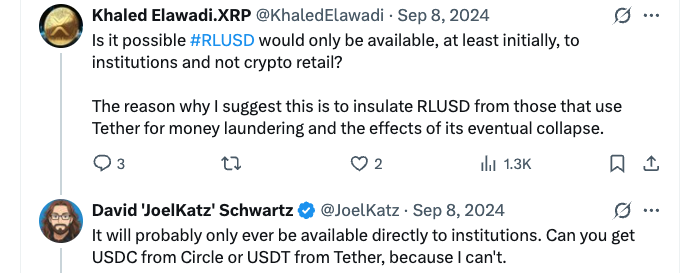
This sentiment was further echoed by Ripple Chief Technology Officer David Schwartz, who suggested in statements that RLUSD would "probably only ever be available directly to institutions." Schwartz’s comments triggered considerable debate across the cryptocurrency ecosystem, with many observers questioning whether the stablecoin would remain an exclusive, gated financial product or eventually open up to the open market.
When Ripple finally issued its official press release announcing the formal launch of RLUSD on December 16, 2024, the corporate messaging maintained a heavy emphasis on institutional utility. The announcement omitted any direct mention of consumer or retail use cases, instead spotlighting initial availability and liquidity support across major institutional-facing platforms and exchanges, including Uphold, Bitso, and MoonPay.
RLUSD as a Direct Competitor to Circle’s USDC
Despite the rigorous institutional framing applied by its creators, market dynamics have pushed RLUSD into a broader competitive arena. Industry analysts point out that regardless of initial marketing intent, stablecoins ultimately find their footing wherever utility dictates.
Speaking on the market positioning of the asset, Transak marketing head Harshit Gangwar noted that while RLUSD was fundamentally designed with enterprise-grade utility in mind, the underlying issuance and redemption infrastructure naturally supports both institutional and retail accessibility. This dual capability has allowed the asset to bridge the gap between corporate finance and everyday digital commerce.
Erbil Karaman, co-founder of Huma Finance, offered a similar perspective, observing that RLUSD currently operates much like any other general-purpose stablecoin in the global digital economy. According to Karaman, the token is now locked in direct competition with established industry heavyweights, such as Circle’s USDC, across virtually all market segments.
Karaman emphasized that this ongoing evolution underscores a fundamental truth about the cryptocurrency industry: the initial branding or the identity of the issuer matters far less than the actual utility the asset provides once it hits the open market, a reality that only becomes fully apparent after launch.
Most RLUSD is Issued on Ethereum, but Holders Prefer XRPL
An intriguing dichotomy has emerged regarding how RLUSD is minted versus where it is actually held and utilized. Data compiled by asset tracking platform RWA.xyz highlights a noticeable gap between the total volume of RLUSD issued on Ethereum compared to the user base preferring the native XRP Ledger (XRPL).
Current market data indicates that Ethereum-issued RLUSD accounts for approximately 88% of the stablecoin’s overall market capitalization, which sits at roughly $557 million. By contrast, less than 12% of the total circulating supply is minted directly on the XRPL network.
However, this supply distribution stands in stark contrast to user demographics and wallet activity. Representatives from XRPL Labs note that the vast majority of RLUSD holders—representing over 90% of the total 34,160 active users—reside on the XRP Ledger. This leaves only about 10% of the token’s active holders operating on the Ethereum network, a trend highlighted by prominent community figures using on-chain tracking data.
Industry observers attribute this phenomenon to the historical positioning of the XRPL infrastructure. Because the ledger has been marketed and utilized as an enterprise-grade chain since its inception—prized for its speed and finality—it continues to attract loyal community members and specialized users. At the same time, the broader liquidity requirements of decentralized finance have driven massive token issuance on Ethereum.
Even as retail participation continues to surge, key ecosystem stakeholders maintain that this organic consumer adoption does not dilute the core mission of the product. The expansion into retail use is viewed not as a pivot away from corporate finance, but as a validation of the underlying technology’s scalability and robust market appeal.
 Suro Senen
 Raul Delapena Setiawan
 Evan Lee Salim