
 By Evan Lee Salim

Cryptocurrencies could deliver a significantly better financial payoff from the ongoing artificial intelligence boom than traditional AI equities themselves, according to Jordi Visser, founder of Visser Labs and a veteran Wall Street strategist.
As explosive, easy-to-repeat gains in high-flying AI hardware and cloud stocks become increasingly difficult to replicate, market dynamics are shifting. At the same time, the proliferation of autonomous AI agents is creating an unprecedented natural demand for blockchain-based crypto payments, decentralized settlements, and tokenized assets.
Speaking in an interview on Cointelegraph’s Trade Secrets podcast, Visser emphasized the symbiotic relationship between these two rapidly evolving technology sectors. “Without AI, I don’t think crypto would be going through this bull market,” he noted, highlighting how computational advancements and digital asset infrastructure have become intertwined.
Driven by this overarching macroeconomic thesis, Visser has notably expanded his personal crypto portfolio. Moving beyond major layer-1 assets like Bitcoin, Ether, and Solana, he has diversified into a much broader basket of alternative digital tokens designed to capture the downstream utility of artificial intelligence.
Visser brings a distinguished three-decade career in traditional finance to his current outlook, having previously served as a managing director at Morgan Stanley and chief investment officer at Weiss Multi-Strategy Advisers. He currently heads AI Macro Nexus Research at 22V, positioning him uniquely at the intersection of traditional macroeconomic indicators, equities, and digital assets.
AI is Crypto’s Smartphone Moment
The core of the Wall Street veteran’s macro thesis rests on the premise that autonomous AI agents will soon allow everyday users to instruct software to seamlessly execute financial trades, manage portfolios, and handle complex cross-border transactions on their behalf. Instead of humans navigating decentralized finance protocols manually, intelligent software will operate directly on-chain.
“AI agents are effectively the same as the App Store or the smartphone for crypto,” Visser explained during the discussion.
In this forward-looking scenario, individual users will direct their specialized AI agents while the underlying software manages execution, liquidity routing, and security. The accelerating adoption and use of these agents are expected to drive exponential activity across tokenized assets, decentralized applications, and crypto-native payment rails. This dynamic extends the investment opportunity far beyond the narrow group of enterprise technology companies currently supplying heavy-duty computing power and semiconductor chips.
This perspective aligns with observations from other major financial institutions. Recently, global asset management giant BlackRock noted that the long-term potential for artificial intelligence to drive structural crypto demand remains heavily "underappreciated" by mainstream market participants.

However, Visser’s optimistic crypto outlook is not completely decoupled from the traditional equity markets. He explicitly identifies a severe, unforeseen AI market downturn that drags down broader global equity markets as a primary risk factor to his otherwise bullish digital asset thesis.
“I don’t think that would end the bull market, but I definitely think it would retest the lows that we just saw,” Visser cautioned, pointing out that systemic macroeconomic shocks in equities inevitably create short-term liquidity contractions across crypto assets.
The AI “Fireworks Show” Is Over
Reflecting a more pragmatic approach to equity investing, Visser revealed that he began actively reducing his investment exposure to memory chipmaker Micron as early as mid-May. He reached the conclusion that hedge funds, institutional allocators, and retail investors had become dangerously overcrowded in the consensus AI hardware trade.
“One of the reasons that Bitcoin and Ethereum were having such a hard time is because the focus was completely on AI,” Visser remarked, observing how capital was systematically sucked out of alternative asset classes to chase surging tech equities.
During this period, artificial intelligence offered investors seemingly greener pastures backed by rapidly expanding corporate revenues. Major tech enterprises routinely posted record financial metrics to justify their lofty valuations. For instance, in a quarterly report published on April 29, Microsoft stated that its dedicated AI business was generating revenue at an annualized rate of $37 billion, marking a more than 100% increase compared to the previous year. Meanwhile, memory giant Micron reported in March that its fiscal second-quarter revenue had nearly tripled to reach $23.86 billion.
Yet, equity investors in the artificial intelligence sector now face a substantially less forgiving macro environment. A proprietary 100-stock AI index tracked by Visser has gained roughly 40% over the course of the year, but it has simultaneously become notably more volatile than Bitcoin when measured on a rolling 126-day basis.
Furthermore, severe financing and cash-flow concerns have increasingly hit the companies building critical AI infrastructure. Building out massive data centers and training foundational models currently costs far more capital than these firms generate from their existing core business operations.
As a prominent example, cloud computing provider Oracle reported spending $55.7 billion on capital expenditures during its 2026 fiscal year, while generating only $32 billion in operating cash flow—forcing the company to raise an additional $43 billion in debt financing to bridge the gap.
“I didn’t say AI was over. AI fireworks show is over,” Visser clarified, emphasizing that while the initial speculative frenzy has cooled, the fundamental technological evolution continues.
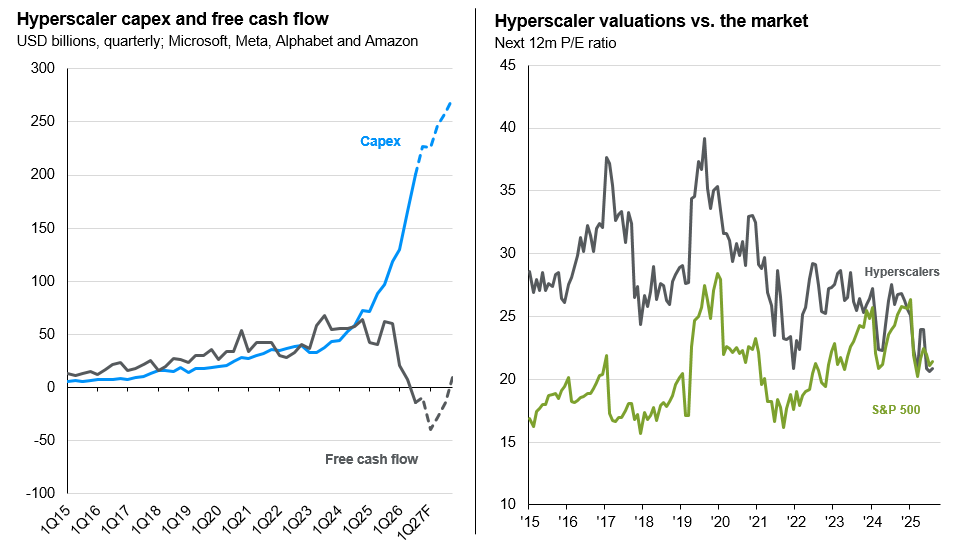
Despite the normalization of stock returns, Visser still foresees several years of sustained structural growth ahead in computing demand driven specifically by AI agents. However, he strongly advises equity investors to moderate their expectations for outsized corporate stock returns moving forward.
Visser Widens His Crypto Bets
Until recently, Visser’s digital asset allocation strategy remained conservative. Up until August, his crypto holdings consisted exclusively of foundational blue-chip assets: Bitcoin, Ether, and Solana. While Bitcoin continues to anchor his portfolio as his largest single position, he has begun methodically acquiring a much wider range of alternative tokens.
Among sentiment indicators, Dogecoin serves as a clear market signal that Visser closely monitors to gauge returning retail investor enthusiasm, which he views as an absolute prerequisite for sustaining a broad-based, healthy crypto market rally.
“They’re the energy of the space and they’re the ones that are going to fuel this as other people get involved,” he stated regarding retail participants.
To effectively track and participate in this broader market expansion, Visser maintains an equally weighted index composed of 42 distinct tokens alongside four publicly traded equities. According to his analysis, this diversified index has successfully outperformed Bitcoin since June, and he intends to maintain his holdings across all constituent assets.
Privacy has emerged as another core investment theme guiding his recent portfolio adjustments. As artificial intelligence tools become more ubiquitous across society, Visser believes that digital privacy and identity protection will take on critical importance, especially as malicious automated fraud and digital abuse scale alongside technological adoption.
Projects focused heavily on zero-knowledge cryptography and transaction confidentiality, such as Zcash and Monero, naturally align with this forward-looking investment thesis.
 Nana Wu
 Nana Muazin
 Nana