
 By Neng Nana
The sixth annual Solidity Developer Survey has officially released its findings, painting
a comprehensive picture of the global smart contract development landscape. Collecting responses from 1,095 developers across 87 countries, the 2025 survey provides critical insights into how the ecosystem is maturing, where developers continue to face friction, and how emerging technologies like artificial intelligence are reshaping everyday workflows.
The data reveals an ecosystem characterized by a broad geographic footprint, rapid tool adoption, and distinct operational hurdles that scale alongside a developer’s expertise. While newer frameworks and AI tools are being embraced at unprecedented rates, foundational challenges—such as stack-too-deep errors, bytecode size limitations, and the perennial difficulty of debugging—remain persistent fixtures of the Solidity development experience.
Who Responded
A closer look at the demographic and professional profile of the 1,095 respondents highlights the global nature of modern smart contract engineering. The survey shows that 70% of participants identify as smart contract developers, while 12% serve as auditors or security experts. Students account for the remaining 18% of the respondent pool, indicating a steady stream of new talent entering the blockchain space.

Experience levels lean heavily toward the early-to-mid career stages, with half of all respondents reporting two years or less of Solidity experience. Despite this relative greenness in tenure, engagement is remarkably high, as 49% of participants report writing Solidity code on a daily basis.
Geographically, the survey captured a diverse international audience, led by India with 205 respondents, followed by Nigeria with 148, and the United States with 83. The community also skews young, with 74% of all respondents falling between the ages of 18 and 34.
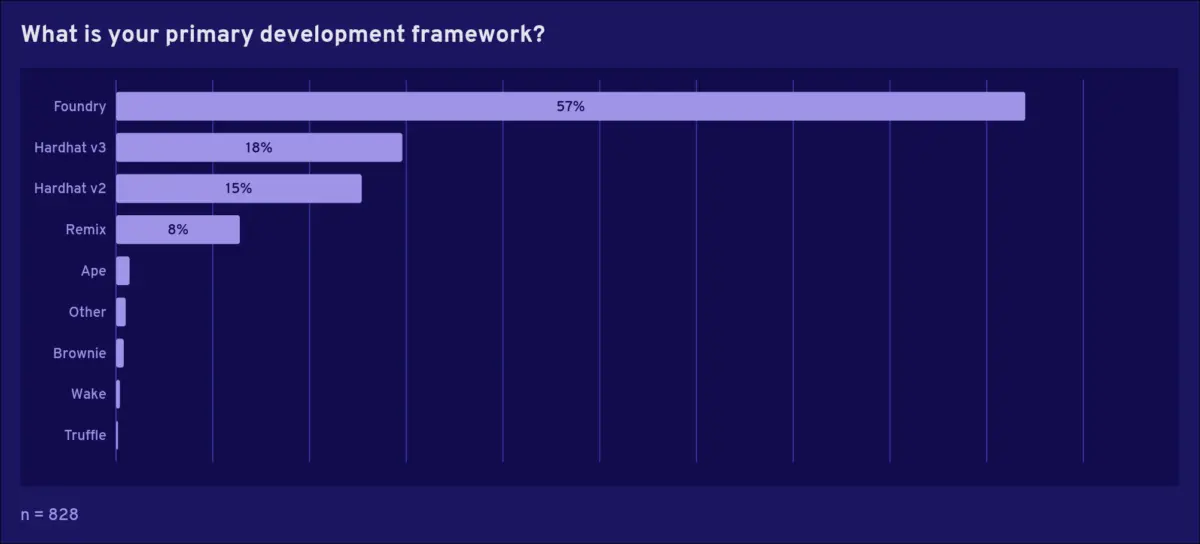
The underlying infrastructure stack powering these developers has also experienced notable shifts. Foundry has solidified its position as the dominant primary development framework, chosen by 57% of respondents—an increase from 51% in 2024. Meanwhile, Hardhat accounts for 33% of primary usage, split between version 3 at 18% and version 2 at 15%. Legacy frameworks like Truffle have nearly vanished from active use, dropping to a single remaining user from 2.4% in 2024. For secondary tooling, Remix remains the clear favorite, utilized by 41% of developers. When interacting with the Ethereum network, ethers.js stands as the most popular SDK at 70%, followed closely by viem at 39% and wagmi at 33%.
Pain Points
Despite advancements in tooling and language features, developers continue to grapple with recurring technical roadblocks. The most frequently cited issue is the notorious "stack-too-deep" error, reported by 47% of respondents. This is followed by bytecode size limits and debugging difficulties, both cited by 33% of developers. Interestingly, roughly 23% of participants reported encountering no recurring issues at all.

A deeper analysis of the data reveals that these pain points do not affect all developers equally; rather, they correlate strongly with experience levels. For instance, stack-too-deep errors are reported by only 25% of self-rated beginners, compared to a striking 65% of self-rated experts. A similar trajectory applies to bytecode size limits, which impact 17% of beginners versus 47% of experts. Debugging, however, remains a universal equalizer, consistently frustrating 29% to 35% of developers regardless of their self-reported expertise level.
When looking toward the future, developers have clear preferences for near-term language and tooling improvements. Better gas optimizations top the wish list at 44%, followed by EIP-712 typehash support at 29% and reference types in transient storage at 23%.
AI Adoption
One of the most dramatic shifts captured in the 2025 survey is the rapid integration of artificial intelligence into the smart contract development lifecycle. An overwhelming 88% of respondents report using AI tools at least on a monthly basis, with 58% incorporating them into their daily routines.
However, this high adoption rate is met with a notable paradox: developers are utilizing AI faster than they are learning to trust it. Nearly half of the respondents—45%—express varying degrees of distrust toward AI-generated outputs. When asked about their confidence levels, 49% stated they somewhat trust AI output, 30% somewhat distrust it, 15% highly distrust it, and only 6% reported high trust. Among daily AI users specifically, 36% openly express distrust in the tools they rely on.

Despite these trust reservations, developers have found specific, high-utility niches for AI assistance. The most common use cases include testing code at 61%, documenting code at 59%, and learning about unfamiliar codebases at 58%. Writing and reviewing code lag slightly behind at 49% each, suggesting that developers prefer to use AI as an analytical and supportive copilot rather than an autonomous author.
Core Solidity
The survey also introduced questions regarding Core Solidity, an ongoing conceptual evolution within the language. Familiarity with the initiative remains relatively low, with only 30% of respondents who answered the question stating they are familiar with Core Solidity.
Among those who are familiar, the most desired features include improved error handling as a try-catch replacement at 43%, and better delegatecall and library replacements at 41%. Opinions regarding more sweeping architectural changes are mixed. While 63% of respondents indicated that removing inheritance would present significant challenges for their projects, 44% estimated that rewriting their existing codebases to utilize type classes or traits would be somewhat difficult, with another 21% calling it very difficult. In free-text responses concerning Core Solidity, sentiment was evenly split: 21% of respondents expressed support, 23% urged caution, and 21% voiced concerns regarding potential language fragmentation.
Year-over-Year Changes and Key Takeaways
Comparing the 2025 findings to the previous year’s survey highlights a maturing developer base, though methodological changes—such as shifting from a single multi-select field for pain points in 2024 to separate checkboxes in 2025—account for some variance in year-over-year metrics. Nonetheless, several broad conclusions emerge from the data.

First, technical bottlenecks such as stack-too-deep errors and bytecode size limits are primarily the burden of experienced developers. Rather than being introductory hurdles, they represent structural ceilings encountered as codebases scale in complexity.
Second, the data suggests that current gas optimization dynamics can incentivize suboptimal coding practices. Free-text responses indicate that developers frequently resort to writing less readable code—such as inlining functions, reusing variables, or recalculating values instead of storing them—solely to meet gas efficiency targets.
Third, the profound gap between AI tool adoption and user trust remains a critical narrative. As an ecosystem responsible for securing billions of dollars in economic value, the reliance on tools that a significant portion of users distrust underscores the need for better verification and auditing mechanisms.
Finally, debugging continues to plague developers uniformly. Despite the overwhelming popularity of modern frameworks like Foundry, the fundamental act of debugging smart contracts has not grown appreciably easier over time, remaining a persistent pain point across all experience brackets.

What the Core Team Is Doing
In response to the feedback gathered from the 2025 survey, the Solidity core team has outlined several active initiatives to address developer friction points.
To tackle the pervasive stack-too-deep issue, the newly introduced v0.8.35-pre.1 pre-release features the SSA CFG code generator behind an --experimental flag, designed specifically to eliminate these errors ahead of a stable release.
To address low awareness surrounding Core Solidity, the team is expanding its educational outreach through upcoming blog posts on pattern matching, an interactive Core Solidity Playground slated for release before the end of summer, and increased conference presence and community collaboration to help define a standard library.
To alleviate debugging challenges, active development on ethdebug—a standardized debugging data format for EVM-compatible smart contracts—is moving forward. Meanwhile, discussions around an EIP to increase the contract size limit aim to address bytecode size constraints for advanced developers. Finally, documentation efforts are being realigned to prioritize practical examples concerning proxies, storage layout, gas optimization, and expanded multi-language translations.

The complete interactive report, featuring deep dives into all 60 survey questions alongside charts, data breakdowns, and respondent quotes, remains available on the official Solidity results page. Participants who entered the random draw for Devcon 8 tickets should monitor their email for notifications originating from official @argot.org addresses, and additional community feedback can continue to be shared directly on the Solidity Forum.
 Laily UPN
 Ammar Sabilarrohman
 Basiran