
 By Pevita Pearce

The perpetrators behind the catastrophic breach of Binance—estimated to be the largest cryptocurrency hack in history at approximately $6.3 billion—still retain control over billions of dollars in stolen digital assets, despite an unprecedented, coordinated counter-offensive by token issuers, security experts, and decentralized finance protocols to freeze the illicit proceeds.
The massive cyberattack erupted at 8:04 pm UTC on Thursday, sending immediate shockwaves through the global cryptocurrency ecosystem. Blockchain investigators swiftly traced the operation to the same North Korean-linked hacking collective widely believed to be responsible for the high-profile Bitget hack that occurred just the previous month. Moving with ruthless efficiency, the attackers immediately set a meticulously planned financial escape strategy into motion.
The core game plan for the hackers relied on a classic cyber-theft arbitrage mechanism: rapidly converting assets equipped with centralized "off switches"—such as fiat-backed stablecoins like Tether (USDT) and USD Coin (USDC)—into decentralized, censorship-resistant native cryptocurrencies like Bitcoin (BTC) and Ether (ETH) that lack any central issuer capable of halting transactions or blacklisting addresses.
Blockchain analytics and security engineers scrambled to monitor the carnage in real-time. CertiK security engineer Dickson Wu traced an initial movement of $500 million in USDT sent to a single attacker-controlled wallet address. Within less than an hour of the exploit commencing, by 20:59 UTC, approximately $325 million of that stolen stablecoin stash had already been systematically dumped onto the open market and traded with market makers in exchange for Ether.
Behind the scenes, a desperate race against time unfolded as the hackers collided directly with some of the most powerful gatekeepers in the digital asset industry. Stablecoin giants Tether and Circle leapt into action almost immediately, activating emergency compliance protocols to blacklist wallet addresses associated with the theft and stymie the rapid conversion of funds.
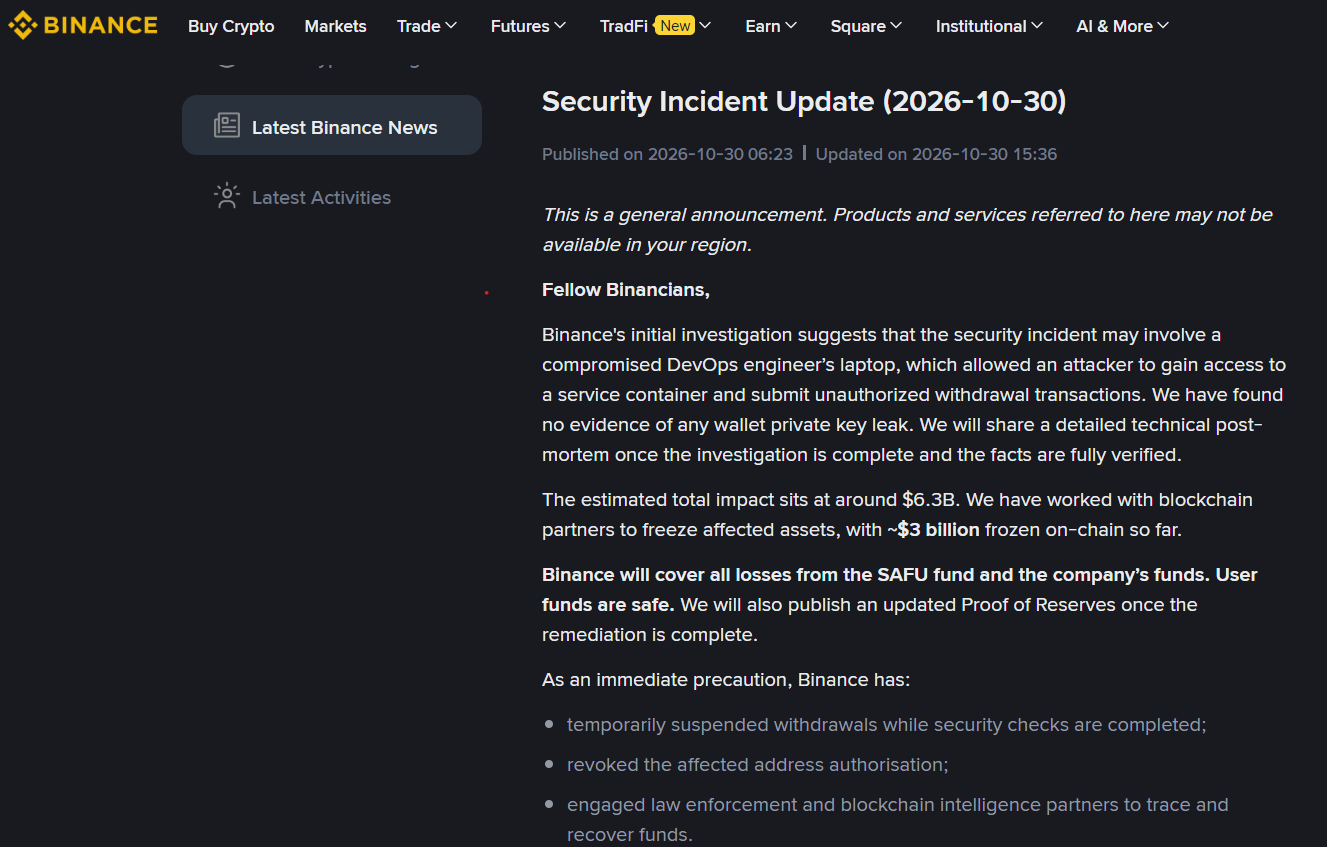
By Friday, crypto exchange giant Binance reported that roughly $3 billion worth of the stolen assets had successfully been frozen on-chain out of the estimated $6.3 billion total haul. Binance leadership emphasized that the company is actively collaborating closely with global law enforcement agencies, prominent token issuers, and leading blockchain analytics firms to trace and intercept any additional funds moving across various networks.
Even within a historically volatile industry accustomed to high-stakes exploits, the scale of this theft is staggering. Yet, with nearly half of the stolen funds frozen almost overnight, a critical question remains at the forefront of the digital asset community: how much of the stolen cryptocurrency can the perpetrators actually liquidate and spend?

Crypto with an Off Switch
Unlike decentralized native assets like Bitcoin or Ether, which operate on permissionless public ledgers with no central governing authority and no administrative button to pause network activity, centralized stablecoins possess built-in safety mechanisms. Issuers of tokens like Tether’s USDT and Circle’s USDC maintain direct administrative control that allows them to freeze tokens held at specific, designated wallet addresses when malicious activity is identified.
This structural design grants major stablecoin issuers the power to act with remarkable speed during major systemic emergencies. Tether alone managed to freeze approximately $1.567 billion in USDT during the incident, executing its first major freeze just 37 minutes after the stolen funds originally hit the primary Ethereum wallet controlled by the attackers.
Circle followed suit rapidly, freezing around $823 million in USDC just three minutes after Tether’s initial intervention. Other major industry players, including Ripple and World Liberty Financial, also moved quickly to implement defensive blacklisting measures on their respective assets.
Crucially, the capability to immobilize suspicious funds proved not to be restricted solely to centralized stablecoin issuers. Despite operating on decentralized foundations without a central administrator, several decentralized protocols demonstrated unexpected agility. The Arbitrum network’s Security Council intervened swiftly, shifting roughly $30.5 million in native ARB and ETH tokens into an intermediary frozen wallet. Within this secure holding mechanism, the assets cannot be touched unless authorized by further action from the council or an explicit governance vote by the Arbitrum DAO.
Industry analysts emphasize a vital legal and technical distinction, however: frozen funds do not automatically translate to recovered funds. While immobilizing assets effectively prevents suspected attackers from spending or transferring them across the open market, it does not instantly return those capital reserves to Binance or the affected users, leaving a complex legal and technical road ahead for asset restitution.
The Aave Complication
The involvement of decentralized lending protocols introduced an additional layer of intricate technical complexity to the unfolding crisis. Between 20:58 and 20:61 UTC, a wallet address linked directly to the hackers deposited $60 million in USDT into Aave V3 deployed on the Ethereum blockchain. Shortly afterward, approximately 40 minutes before the first wave of stablecoin freezes hit, the attackers borrowed $44.6 million worth of wrapped Ether (WETH) against that deposited collateral.
LlamaRisk, an independent risk service provider for the Aave ecosystem, provided clarity in an overnight update, noting that the attacker’s borrowing position subsequently held around $59.9 million in USDT collateral against a total debt of $43.8 million. Aave representatives confirmed that the overarching lending position remained safely overcollateralized throughout the ordeal, ensuring that protocol liquidity providers and suppliers were never put at direct financial risk.
Because the stolen USDT had already been officially deposited into Aave’s decentralized liquidity pools prior to the blacklisting, simply flagging the attacker’s original wallet address could not automatically retrieve the collateral held securely within the smart contracts. Marc Zeller, founder of the Aave Chan Initiative, explained the delicate mechanics of the situation to the public, pointing out that from the perspective of the protocol’s immutable code, the deposits were technically legitimate transactions backed by dollar-pegged value, regardless of their illicit origin.
To protect its user base and prevent further exploitation during the chaos, Aave proactively implemented a temporary freeze across lending and borrowing markets on its V3 and V4 deployments. During this precautionary pause, existing platform users retained the ability to withdraw their funds, repay active loans, and liquidate positions safely.
Once security audits confirmed the integrity of the platform, Aave lifted the precautionary freeze across its V3 and V4 markets. Protocol representatives reiterated that their smart contracts remained completely unaffected by the broader Binance breach and that all remaining borrower positions stayed safely overcollateralized. Zeller later characterized the dramatic events with characteristic industry stoicism, remarking that it was "just another day in crypto."
So What Can the Attackers Actually Keep?
Data compiled by blockchain intelligence firm Elliptic revealed that by 7:00 am UTC on Friday, an estimated $2.84 billion had been successfully frozen across the ecosystem, leaving the hackers in control of roughly $3.33 billion in unimmobilized assets that issuers were unable to intercept in time.
While these rapid defensive freezes successfully slashed the attackers’ available profit pool by nearly half, industry experts warn that the remaining funds cannot be easily recovered either. Because Bitcoin, Ether, and other native layer-1 assets lack a centralized administrative issuer, there is no entity capable of easily blacklisting individual addresses or rolling back blockchain states. Once stolen capital is fully laundered into these decentralized cryptocurrencies, transactions can be tracked and monitored, but freezing or confiscating the underlying tokens becomes exponentially more difficult.
In the wake of the historic breach, Binance leadership has moved aggressively to reassure its global customer base. The exchange pledged to cover all potential financial losses entirely out of its own corporate reserves and the Secure Asset Fund for Users (SAFU), affirming that user funds remain fully backed and secure.
Providing a status update on the ongoing remediation efforts, Binance Chief Executive Richard Teng confirmed that the exchange’s security teams and investigators are already actively working to recover stolen assets on behalf of its users as the fallout from the largest hack in crypto history continues to reverberate across the global financial technology sector.
 Nana Wu
 Nana Muazin
 Nana