
 By Azzam Bilal Chamdy

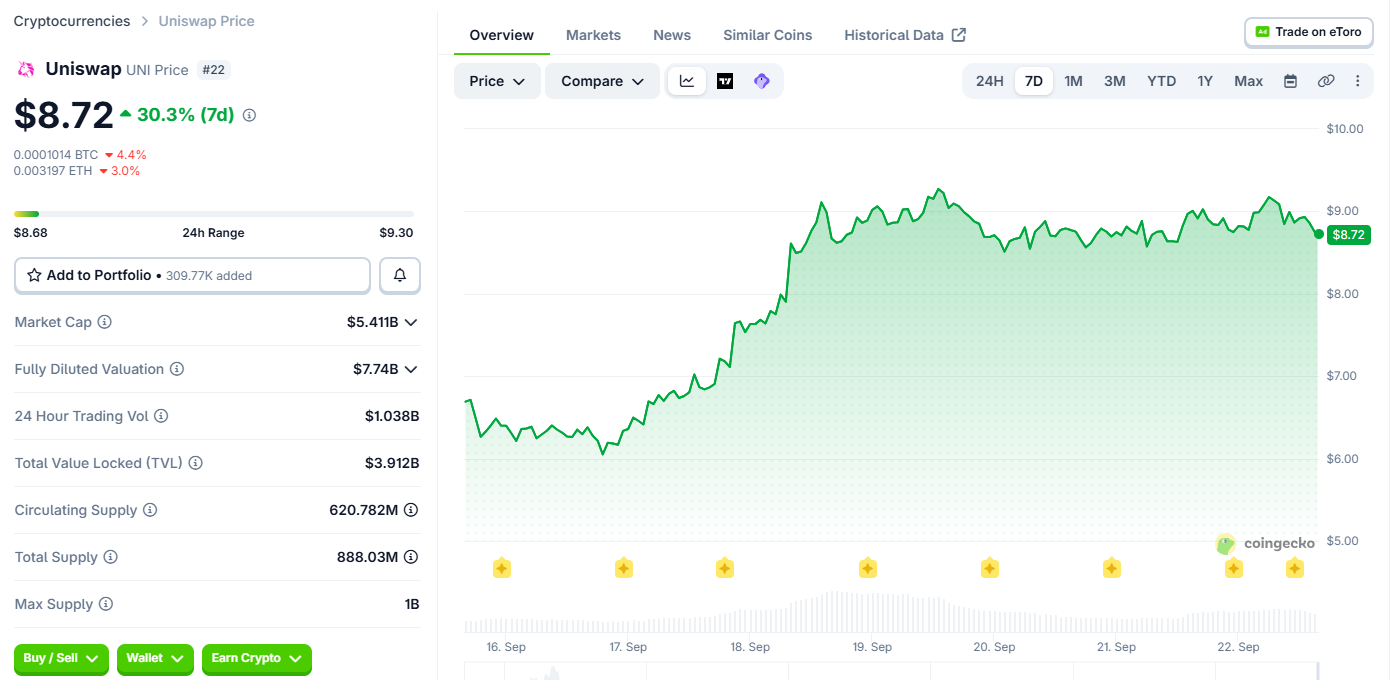
“Tokenization is coming to America,” declared Robinhood Chief Executive Vlad Tenev following a landmark regulatory announcement from the United States Securities and Exchange Commission last week. The crypto and decentralized finance markets appeared to receive the development with immediate optimism. In the wake of the SEC’s announcement regarding its new Innovation Exemption, major digital assets experienced notable upward momentum. Bitcoin (BTC) and Ether (ETH) surged by over 10%, while Uniswap’s UNI token—representing a protocol increasingly viewed as prime real estate for prospective tokenized stock trading—rallied by more than 30% over the subsequent days.
While the SEC has indeed greenlit a pathway for tokenized stocks in the United States, a closer examination of the regulatory text reveals that the vast majority of existing stock tokens currently circulating in the market fall outside the boundaries of the new framework. The commission’s five-year Innovation Exemption creates a specific legal mechanism for eligible trading venues to facilitate the onchain exchange of National Market System (NMS) stocks without formally registering as traditional securities exchanges. Furthermore, it permits third parties to engage in the tokenization of equities, but this activity is strictly confined to a narrow and demanding set of conditions.
Under the new regulatory parameters, tokens must grant holders the exact same “rights and privileges” as the underlying traditional shares, while the trading venues themselves are required to implement permissioned user access and liquidity pools. This distinction highlights that not all tokenized financial products are created equal. A digital token can visually mirror a share and track its price performance on a chart without actually conferring the fundamental shareholder rights associated with the underlying equity. Under the SEC’s updated classification rubric, any instrument that achieves this without direct equivalence is categorized as a synthetic stock, rendering it strictly non-compliant with the temporary exemption.
This stringent requirement means that certain major players within the digital asset industry may already find themselves with a structural head start, while others will be forced to undergo significant operational pivots to achieve compliance. Reflecting on the commission’s proactive stance, Peter Curley, head of global regulatory affairs at Ondo Finance, noted that while not every existing operation will fit the new mold, the primary takeaway is that the SEC chose to act decisively rather than waiting for legislative action from Congress.
The SEC’s Tokenization Lane Is Narrow
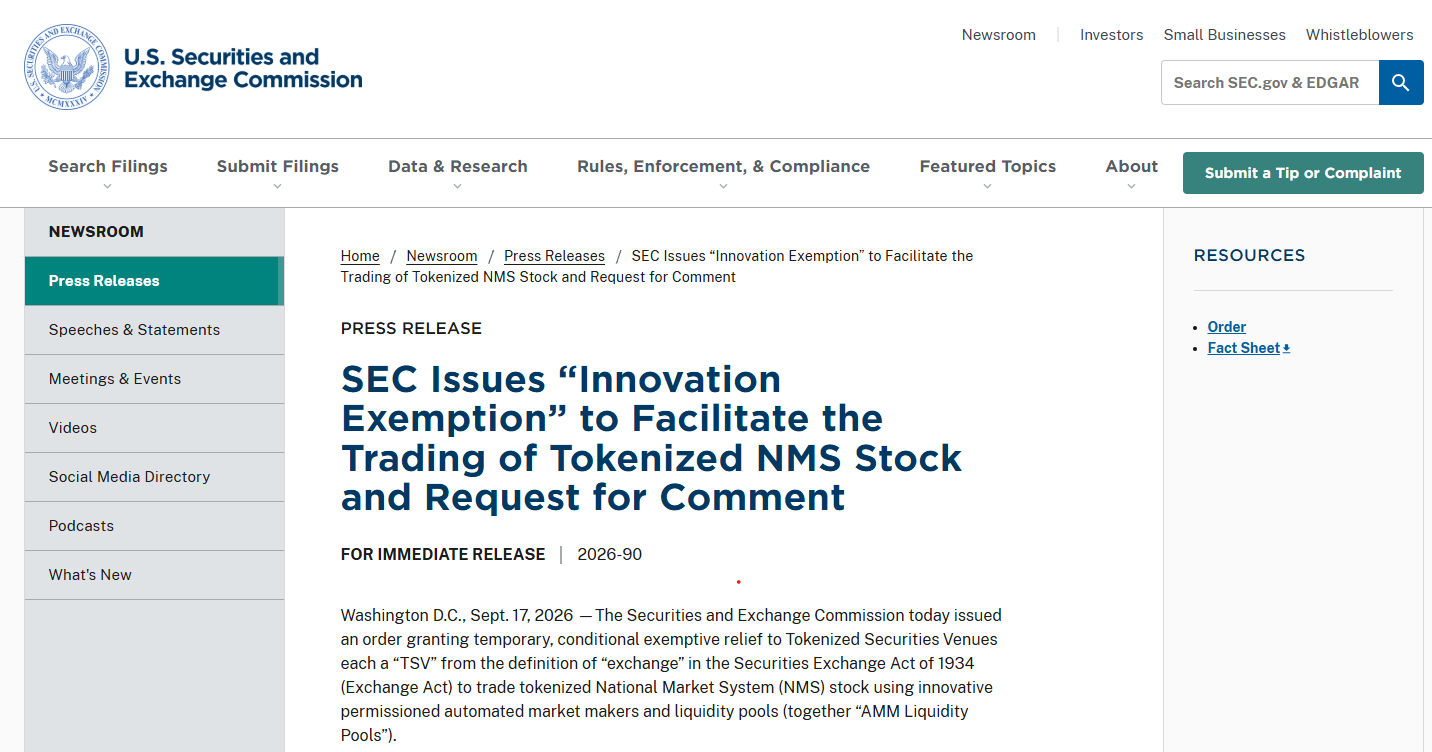
The official SEC order, issued on September 17, grants specific trading venues temporary relief from traditional exchange registration requirements when executing trades involving tokenized NMS stocks through permissioned Automated Market Maker (AMM) liquidity pools. In practical terms, the regulatory agency has carved out a dedicated lane for onchain equity trading, yet it remains a remarkably specific corridor where the exact structural mechanics of the token carry just as much weight as the compliance framework of the trading venue itself.

To qualify for the exemption, a tokenized stock must ensure that holders receive identical dividend distributions and voting rights to those enjoyed by investors holding the conventional security in traditional brokerage accounts. Although third-party entities are permitted to tokenize a stock without a direct affiliation with the original corporate issuer, the issuer retains the legal opportunity to veto or block the token before trading activity can officially commence.
This specific regulatory hurdle effectively rules out synthetic exposure models, spelling immediate complications for products such as Robinhood’s Stock Tokens and Kraken’s xStocks in their current architectural iterations. During statements following the release, SEC Commissioner Hester Peirce emphasized that the exemption is intentionally tailored to accommodate one specific structural model rather than serving as a blanket authorization for every conceivable method of trading tokenized securities. Nevertheless, she noted that the commission remains open to evaluating alternative models that operate outside the confines of the established tokenized security venue structure.
The Products Closest to the SEC’s Model
Certain industry products are already closely aligned with the SEC’s envisioned framework. Coinbase’s suite of stock tokens, for instance, sits comfortably within the broader parameters of the regulatory dialogue. On September 14, Coinbase Chief Executive Brian Armstrong stated via social media that his company had established an industry benchmark with its tokenized equities, emphasizing that they are neither synthetic instruments nor debt obligations, but rather fully backed, genuine securities that are redeemable for underlying shares, with integrated dividend mechanisms and voting rights slated for imminent introduction.
Despite this alignment, Coinbase’s current tokenized stock offerings are primarily targeted at non-US clientele, and the platform’s core exchange infrastructure relies on a traditional central limit order book rather than the permissioned AMM liquidity pools specified in the SEC exemption. However, given that Coinbase operates the Base blockchain network, the firm maintains structural flexibility to adapt its offerings moving forward.
Similarly, Ondo Finance launched its suite of tokenized US securities in June, utilizing a model where underlying equities are held in traditional institutional custody while the corresponding tokens represent the investor’s enforceable entitlement onchain. Ondo further bolstered its capabilities by acquiring Oasis Pro, an acquisition that incorporated an SEC-registered broker-dealer, an Alternative Trading System (ATS), and a transfer agent, thereby bridging traditional financial infrastructure with onchain capabilities.
Curley observed that the SEC’s new exemption closely mirrors the operational model that Ondo has already validated and tested: a custodial, entitlement-based framework where authentic shareholder rights and corporate actions pass through directly to the end holder. At the same time, he maintained a cautious outlook, emphasizing that the firm is not operating under the assumption that existing setups will automatically clear regulatory hurdles without ongoing dialogue. Both Coinbase and Ondo possess critical components of the infrastructure the SEC appears to favor, and while neither can assume full compliance without additional refinement, both companies face a shorter path to alignment than competitors built entirely on synthetic models.
Uniswap’s Permissioned Pools Could Open the Door
Because the SEC’s exemption is explicitly structured around permissioned AMM liquidity pools, the development has generated significant optimism around decentralized protocols like Uniswap. The protocol introduced Permissioned Pools for its v4 iteration in July, a feature designed to enable regulated financial assets to trade seamlessly through AMMs while embedding compliance controls directly onchain.
While the introduction of this technology does not automatically transform Uniswap itself into an approved tokenized security venue, its v4 infrastructure provides the underlying architecture that market operators could utilize to build compliant platforms. Because these permissioned pools allow asset issuers to exert granular control over who is permitted to trade or supply liquidity, the technical design aligns closely with the regulatory requirements outlined by the SEC.
Achieving permissioned access within these decentralized environments necessitates robust Know Your Customer (KYC) verification procedures, stringent record-keeping protocols, public reporting notices, and total transaction transparency. If this decentralized technical infrastructure can be successfully bridged with the corporate governance and shareholder rights requirements mandated for US securities trading, Uniswap possesses a foundational framework that could be adapted to meet the SEC’s specialized model.
Robinhood Has the Users, but Not the Right Product
Robinhood already facilitates the trading of approximately 200 distinct stock tokens through the Robinhood Chain, an ecosystem that Vlad Tenev has previously described as being backed on a one-to-one basis and fully composable within the decentralized finance sector. However, industry analysts, including Jaewon Kim, head of research at Four Pillars, have highlighted that the SEC’s recent order explicitly excludes synthetic exposure, creating an immediate regulatory barrier for products such as Robinhood’s Stock Tokens and Kraken’s xStocks.
Robinhood’s Stock Tokens are structured as tokenized debt securities issued by Robinhood Assets (Jersey) Limited. Consequently, these instruments provide economic exposure to the performance of the underlying equities without conferring legal or beneficial ownership rights to the holders. Furthermore, these products are not registered under US federal securities laws and remain unavailable to US persons.
Despite the fact that Robinhood’s existing product architecture does not currently fit the narrow compliance parameters established by the SEC, the company’s massive retail user base and established blockchain infrastructure could afford it a distinct strategic advantage if leadership decides to adapt its underlying model to satisfy the new regulatory demands. Kraken’s xStocks face a similar structural reality; although they are fully backed by underlying equities, they do not grant holders the identical rights associated with conventional shares, and simple asset backing alone is insufficient to secure qualification under the temporary exemption.
Bryan Choe, head of research and operations at digital asset intelligence platform RWA.xyz, noted that while the majority of existing tokenized equity products are currently sponsored by third parties, that dynamic is likely to shift over the coming year. Anticipating a transition toward issuer-sponsored models, Choe pointed out that the new exemption effectively aligns the interests of token issuers with those of traditional stock issuers, potentially restoring balance across different issuance methodologies.
Five Years to Prove Tokenized Stocks Are Actually Better
The SEC has explicitly characterized the new framework as a temporary exemption. SEC Chairman Paul Atkins noted that the five-year evaluation period is intended to provide the broader market with adequate breathing room to develop and innovate while the commission evaluates potential future rule-making initiatives.
Beyond the race to establish the first fully compliant trading venue, the ultimate test for the industry will be whether tokenized equities can achieve widespread organic adoption. As Curley emphasized, market participants must ultimately be offered a financial instrument that proves to be faster, more cost-effective, or functionally superior to a conventional brokerage position. Industry observers have already raised important questions regarding whether fragmented liquidity for tokenized stocks will be capable of delivering competitive pricing structures and a seamless user experience.
While the exemption opens the technical possibility for continuous 24/7 trading, fractional asset ownership, accelerated settlement times, onchain composability, and uncompromised shareholder rights, these technological advantages will ultimately matter only if investors find tangible value in the transition.
 Lina Irawan
 Nila Kartika Wati