
 By Nana Wu

The corporate world is on the brink of a massive shift toward mainstream digital currency adoption, with business use of stablecoins projected to skyrocket over the next twelve months. According to a comprehensive new report released by payments infrastructure firm Cybrid, a significant portion of enterprises are already altering how they handle cross-border payments, cutting out legacy financial rails in favor of faster, cheaper blockchain-based alternatives.
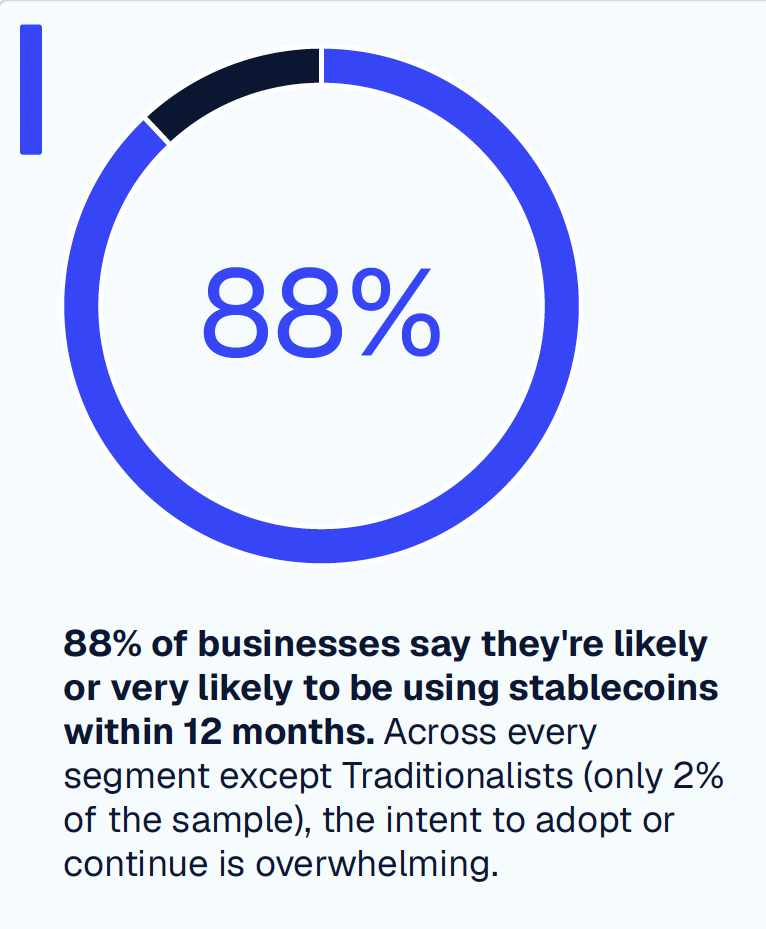
The comprehensive industry study reveals that 42% of businesses surveyed are already actively utilizing stablecoins for cross-border transactions. Looking ahead, an overwhelming 88% of respondents indicated that they are either likely or very likely to integrate stablecoins into their operations within the coming year. In stark contrast to this surging enthusiasm, only 2% of surveyed executives identified as committed users of traditional, legacy payment rails, highlighting a dramatic pivot away from conventional banking infrastructure for international settlements.
The primary catalyst behind this rapid corporate migration appears to be the undeniable financial efficiency offered by digital assets. Companies already utilizing stablecoins in their day-to-day operations reported average cross-border payment cost savings of an impressive 35%. Furthermore, the financial upside scales dramatically with enterprise size. Corporations processing more than $100 million in monthly payment volume reported even steeper savings, averaging up to 47%. These substantial reductions in friction and fees are forcing corporate treasuries to rethink long-standing operational models.
Underpinning this commercial activity is a rapidly expanding global marketplace. Current market data from CoinGecko places the total global stablecoin market capitalization at $307.64 billion. The sector continues to be dominated by Tether’s USDT, which commands a market cap of $184.7 billion, followed closely by Circle’s USDC at $73.51 billion. Additionally, the digital asset ecosystem has received a significant structural boost from recent legislative developments. Stablecoins compliant with the GENIUS Act have officially surpassed a market cap of $76 billion, establishing the very first federal regulatory framework specifically designed for payment stablecoins within the United States.
The Cybrid report’s findings are derived from a targeted survey of 468 executives and business leaders conducted between April 28 and May 4. The survey captured insights from key decision-makers across the technology, financial services, and e-commerce sectors located in the United States, Canada, and the United Kingdom. Respondents included C-suite executives, finance and treasury managers, as well as payments and operations leaders who manage the financial lifelines of their respective organizations.

Varied Users Look for Regulatory Clarity to Gain Confidence
As businesses diversify how they apply blockchain-based currencies, payroll and contractor disbursements have emerged as the single most common use case among survey respondents. Following closely behind are supplier payments, customer transactions, investment and yield generation, vendor payouts, and broader treasury and liquidity management operations. Companies are finding that stablecoins provide a versatile medium of exchange that can solve liquidity bottlenecks across multiple departments simultaneously.
Despite the high adoption rates and clear financial incentives, corporate leaders remain vocal about what is needed to accelerate this transition further. Regulatory clarity emerged as the absolute top factor that respondents said would increase their overall confidence in expanding stablecoin deployment. In fact, 71% of surveyed executives identified clear government regulations as more important than partnering with trusted infrastructure providers or achieving seamless integration with existing enterprise resource planning systems.
This emphasis on regulatory frameworks underscores the cautious optimism shared by institutional players. While the operational benefits are clear, corporate boards and compliance officers require legal certainty before deploying capital at scale across decentralized networks. The recent rollout of legislative measures in the United States has gone a long way toward building that foundation, but enterprises continue to monitor legislative and regulatory developments globally to ensure long-term compliance.
Independent industry data from other major payment providers corroborates the trajectory outlined in the Cybrid findings. In June, payments infrastructure provider Paybis reported that business customers accounted for a staggering 98% of all stablecoin payout volume processed through its platform during the first four months of the year. This represents an astronomical leap from just 36% in 2023, illustrating how rapidly the commercial sector has outpaced retail adoption in specific payment corridors.
Furthermore, Paybis highlighted research from management consulting firm McKinsey, which estimated that business-to-business transactions accounted for roughly 60% of the $390 billion in global stablecoin payment volume recorded throughout the previous year. These compounding data points confirm that the current wave of stablecoin adoption is not merely a speculative retail phenomenon, but a structural evolution driven by institutional and corporate utility.
Companies Expand Infrastructure for Stablecoin Payments
To meet this surging enterprise demand, financial institutions and technology providers are rapidly expanding the underlying infrastructure required to support secure, compliant stablecoin transactions. The marketplace has witnessed a flurry of institutional product launches designed to integrate blockchain rails directly into traditional banking and trading environments.
In May, Falcon Finance debuted its dollar-backed stablecoin, fUSD, utilizing Anchorage Digital Bank’s federally regulated issuance platform. This targeted product launch was specifically engineered to cater to institutional trading desks, collateral management, and complex treasury workflows that require high standards of security and regulatory oversight.
Building on this momentum, major traditional banking institutions are also entering the fray. BNY expanded its digital asset custody platform to provide full support for Circle’s USDC. This integration allows institutional clients to securely store, transfer, mint, and redeem the stablecoin directly through the bank, bridging the gap between traditional custody solutions and decentralized financial networks.
As more financial heavyweights build out institutional-grade infrastructure and regulatory landscapes continue to mature, the barriers to entry for corporate stablecoin adoption are steadily dissolving. With billions of dollars in transaction volume already migrating to blockchain rails and businesses realizing unprecedented cost efficiencies, the next twelve months are shaping up to be a transformative period for mainstream digital currency integration.
 Suro Senen
 Raul Delapena Setiawan
 Evan Lee Salim