
 By Laily UPN

Ripple USD, the stablecoin issued by prominent cryptocurrency firm Ripple, was initially introduced to the global digital asset ecosystem as a specialized, enterprise-focused financial instrument. However, a shifting landscape of adoption and integration has seen the digital asset gain significant traction among everyday retail users, bridging the gap between institutional finance and decentralized community usage.
Officially introduced in late 2024, the Ripple USD (RLUSD) stablecoin was heavily marketed by executive leadership, including Ripple CEO Brad Garlinghouse, who emphasized its institutional focus to set the asset apart from competitors primarily tailored for retail consumers. Despite this strict institutional framing, the rapid integration of RLUSD into self-custodial wallets like Xaman and broader platform partnerships such as Transak indicates that the stablecoin’s utility is expanding far beyond corporate boardrooms and traditional banking corridors.
The emergence of retail interest highlights a fascinating evolution in how enterprise-grade digital assets find their footing in the broader economy. While the infrastructure was designed with corporate requirements in mind, market demand is proving that utility often dictates adoption regardless of initial marketing narratives.
Reflecting on this organic shift, the chief operating officer of XRPL Labs and Xaman noted that while RLUSD may have launched with an enterprise-focused narrative—likely due to the inherent strengths of the XRP Ledger such as high speed, cost-efficiency, and absolute finality—there is undeniable and growing traction on the retail side of the equation.
Controversy Over RLUSD’s Enterprise Focus
The trajectory of RLUSD was a subject of intense speculation and debate long before its official launch. Initial reports concerning the stablecoin began circulating well ahead of its formal debut in December 2024. In October of that year, Ripple CEO Brad Garlinghouse publicly characterized the upcoming asset as the "gold standard for enterprise-grade stablecoins," signaling a clear intention to target corporate liquidity management and cross-border institutional settlements.

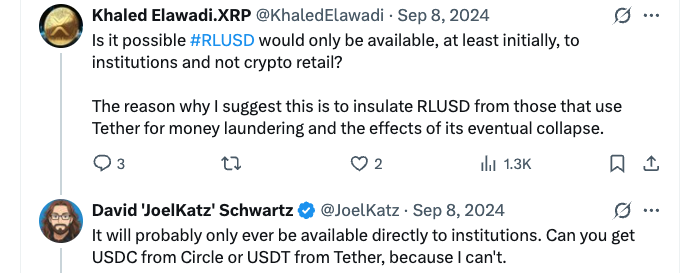
Adding fuel to the exclusivity debate, Ripple Chief Technology Officer David Schwartz suggested in public commentary that RLUSD would "probably only ever be available directly to institutions." These remarks sparked considerable discussion across the cryptocurrency community regarding whether the stablecoin would be deliberately walled off from retail participants and everyday crypto traders.
When Ripple formally announced the rollout of RLUSD on Dec. 16, 2024, the official company statements omitted explicit mention of retail use cases. Instead, the launch materials concentrated heavily on its initial availability through major institutional-facing platforms and liquidity providers such as Uphold, Bitso, and MoonPay. This strategic messaging reinforced the perception that Ripple was carving out a niche designed specifically to serve corporate clients navigating regulatory compliance and institutional-grade security.
RLUSD as a Direct Competitor to Circle’s USDC
Despite the corporate-centric rollout, the infrastructure underpinning the stablecoin has naturally invited broader participation. Speaking on the design philosophy behind the asset, Transak marketing head Harshit Gangwar observed that while RLUSD was indeed engineered with enterprise-grade utility in mind, its fundamental issuance and redemption architecture inherently supports accessibility for both institutional entities and retail users alike.
This dual-market accessibility has transformed the asset’s competitive positioning. Huma Finance co-founder Erbil Karaman noted that RLUSD currently operates much like any general-purpose stablecoin in the digital asset market. By functioning in this manner, it has positioned itself as a direct challenger to established market heavyweights, most notably Circle’s USDC, across virtually all market segments.
Karaman emphasized that this market evolution underscores a fundamental truth about the cryptocurrency industry: the ultimate utility of a financial product rarely depends on who issues it or how it is initially marketed. Instead, value is determined strictly by what the asset becomes useful for in practice, a reality that typically only becomes clear well after the product has launched.
Most RLUSD Is Issued on Ethereum, but Holders Prefer XRPL
An intriguing dynamic in the distribution and usage of RLUSD involves a distinct divergence between where the stablecoin is minted and where its holders choose to store and utilize it. Data compiled by RWA.xyz reveals that Ethereum-issued RLUSD accounts for a commanding 88% of the stablecoin’s current market capitalization of approximately $557 million. In contrast, less than 12% of the total circulating supply is minted directly on the XRP Ledger.
However, this capital concentration on Ethereum contrasts sharply with user demographics and holding preferences. According to data highlighted by prominent community member Vet and discussed by XRPL Labs’ Kiuru, more than 90% of the total 34,160 individual RLUSD holders reside on the XRPL network, leaving only about 10% of holders interacting with the asset via Ethereum.
Kiuru attributes this persistent alignment with the XRP Ledger to its long-standing brand identity and technological architecture. He noted that the XRP Ledger has been positioned as an enterprise-grade blockchain since its inception, valued particularly for its transaction speed and efficiency.
While the substantial market cap concentrated on Ethereum reflects broader multi-chain liquidity strategies, the overwhelming preference for XRPL among individual holders demonstrates a strong organic community base. Kiuru expressed the view that the heavy retail participation is a major win for the ecosystem, while emphasizing that this grassroots activity does not detract from or alter the foundational positioning of the XRPL and RLUSD as premier enterprise solutions.
Ripple has not yet provided further comment regarding the rising wave of retail adoption surrounding its flagship stablecoin.
 Suro Senen
 Raul Delapena Setiawan
 Evan Lee Salim