
 By Lina Irawan

Last weekend, the Federal Bureau of Investigation stunned the digital asset industry by claiming that North Korea was behind the monumental $6.3 billion Binance hack—an incident that analysts and cybersecurity experts are now calling the largest digital heist on record.
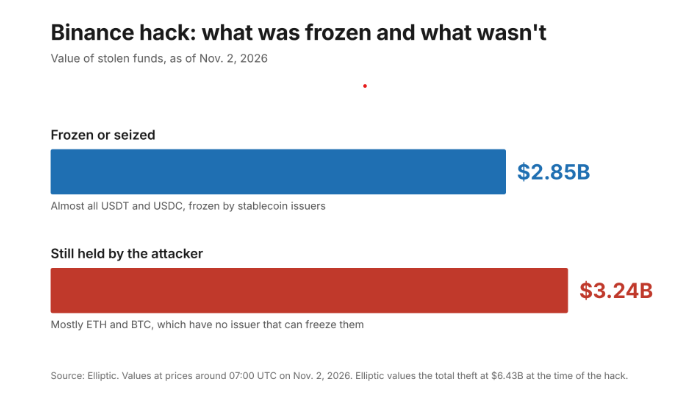
While public discourse and media coverage have largely focused on the staggering scale of the breach and its sophisticated mechanics—which Binance later traced back to fake job interviews that compromised an AI tool—far less attention has been paid to what went right in the immediate aftermath. Despite the unprecedented loss, the perpetrators have not actually been able to hold on to a significant proportion of their ill-gotten gains. In a testament to rapid cross-industry coordination, $2.85 billion of the stolen funds has already been successfully frozen.
The primary driver behind this massive asset recovery comes down to the precise composition of the stolen capital. Of that $2.85 billion in halted funds, an overwhelming 94% was held in stablecoins.
This catastrophic security breach delivered a harsh wake-up call to the industry, but it simultaneously underscored a profound reality: centralized control mechanisms, which are frequently criticized by decentralized finance purists, might actually represent one of the most potent tools currently available in the global fight against cybercrime. Unlike traditional cryptocurrencies or privacy-focused assets, stablecoins feature built-in technical functionalities that allow their private corporate issuers to freeze tokens at will. This mechanism grants victims a genuine, real-time chance to intercept stolen money before it permanently reaches the wrong hands.
However, this undeniable defensive capability raises a deeply uncomfortable question for the future of digital finance. If private, unelected commercial entities possess the unilateral power to freeze billions of dollars in assets on a moment’s notice, who ultimately decides when they should be allowed to exercise that authority, and what oversight governs their actions? As the crypto landscape matures, the United Kingdom now finds itself in a unique position to establish a sensible precedent and answer these pressing regulatory questions.
The High-Stakes Race to Evade Stablecoin Freezes
To fully grasp the critical importance of these real-time freezes, one only needs to examine the frantic actions taken by the hackers within the very first hour of the heist.
Clearly anticipating the defensive capabilities of major stablecoin issuers, the perpetrators understood that they possessed an extremely limited window to move their dollar-pegged assets before automated or manual blocks could be implemented. Less than an hour after the hack commenced, they had already rushed to liquidate approximately $325 million worth of stolen USDT—Tether’s widely used stablecoin—in exchange for Ether. The strategic rationale behind this rapid maneuver was simple: swap a vulnerable, centralized asset that could be instantly frozen for a decentralized asset that could not.
Fortunately, major stablecoin issuers proved remarkably agile. Tether executed its first major freeze just 37 minutes after the stolen funds successfully reached the hackers’ primary wallet. Rival issuer Circle followed suit merely three minutes later, blocking the movement of millions in USDC.

Without the swift and decisive interventions of Tether and Circle, a vastly larger share of the stolen billions would have slipped beyond the reach of law enforcement and the exchange, ultimately disappearing into untraceable mixing services and decentralized liquidity pools.
The Absence of an Agreed Regulatory Standard
While the emergency freezes largely succeeded in mitigating the damage, their success relied entirely on a handful of private companies making unilateral decisions in real time without a standardized framework.
The underlying problem facing the cryptocurrency ecosystem is that there is still no universally agreed-upon standard outlining precisely when a freeze is legally justified, how quickly issuers are required to respond, or what evidentiary threshold must be met. The industry is already beginning to experience the turbulent legal consequences of operating in this regulatory vacuum.
For instance, Circle is currently facing a proposed class action lawsuit brought forward by Drift Protocol investors. The plaintiffs allege that Circle failed to freeze approximately $230 million in stolen USDC following an April hack, arguing that the company possessed the technical capacity to stop the funds from moving but failed to act with sufficient speed.
At the same time, Tether is embroiled in a high-stakes legal battle in New York, where two businessmen have filed a lawsuit claiming the company froze millions of dollars of their assets months before any formal seizure warrant or legal order existed. Tether has vigorously defended its actions, dismissing the allegations as entirely baseless.
Drawing from professional experience in payments and banking, observers note that traditional financial institutions freeze money and accounts on a regular basis. From that perspective, one might naturally argue that if traditional commercial banks can exercise this power frequently, stablecoin issuers should be afforded the same prerogative.
The critical distinction, however, lies in due process. Traditional banks do not wake up and decide to freeze customer assets out of nowhere; their actions are invariably tied to established legal triggers, regulatory mandates, and structured pathways for appeal and challenge. Stablecoin issuers now wield identical freezing powers over global digital economies, yet they are forced to act at unprecedented speeds and across complex international borders, often operating without clear legal parameters. It is becoming increasingly evident that these private entities require a structured framework to guide their enforcement actions.
How Britain Can Step In and Fix the Gap
There is, of course, a significant caveat when considering how to regulate stablecoin issuers. Tether and Circle, as the two dominant players in the market, are not headquartered in the United Kingdom, meaning British regulators cannot simply issue direct mandates compelling their global operations.
What the United Kingdom can effectively control, however, is precisely which stablecoins are legally permitted to be bought, sold, and traded by UK-based customers on regulated platforms—and authorities have already taken decisive steps in this direction.
In June, the Financial Conduct Authority published its comprehensive cryptoassets regime. Under these new rules, UK-regulated trading platforms must carry out rigorous due diligence and publish detailed disclosure documents before listing any digital asset, a requirement that explicitly encompasses foreign-issued stablecoins. This regulatory regime is scheduled to come into full legal force on October 25, 2027. Concurrently, the Bank of England is finalizing its overarching Code of Practice for systemic stablecoin issuers, focusing specifically on tokens that achieve widespread adoption for payments and could pose systemic risks to UK financial stability.
Neither of these existing frameworks currently establishes the clear, explicit obligations regarding the freezing of stolen funds that many industry participants believe are necessary. However, because both regulatory architectures are still actively taking shape, the UK is presented with a golden opportunity to address this critical gap proactively, rather than attempting to retrofit retroactive requirements years down the line.
Proposing Two Conditions for UK Stablecoin Listings
To resolve this regulatory dilemma constructively, a balanced policy solution could be implemented before any stablecoin is permitted to be listed and traded on a UK-regulated platform.
First, the token issuer should be contractually and legally required to demonstrate that it is readily contactable and operationally prepared to act on reports from any verified entity. While Tether and Circle responded rapidly last week, the primary victim was Binance, the world’s largest cryptocurrency exchange. Smaller domestic platforms must be guaranteed the exact same level of responsiveness. Many boutique crypto businesses lack Binance’s immense market profile or a direct institutional line to major issuers, leaving them vulnerable and neglected under the current ad-hoc system.
Second, there must be a transparent, predictable timetable governing the lifecycle of an asset freeze. If an issuer decides to freeze funds in response to a suspected theft, it should be legally mandated to notify the National Crime Agency or relevant law enforcement bodies within the same business day. Furthermore, the freeze should automatically expire after a specified duration unless law enforcement or the victimized party secures an official court order to keep the wallet frozen.
These proposals are neither extreme nor controversial. They would provide law enforcement agencies with a reliable window of opportunity to intervene when digital assets are stolen while simultaneously protecting ordinary market participants from having their capital frozen indefinitely without proper legal grounds.
The catastrophic Binance hack has demonstrated beyond a doubt that centralized stablecoin controls can grant victims of sophisticated crypto crime a fighting chance to recover stolen funds before they vanish forever. Ensuring that this defensive lifeline remains available and fairly administered should not be a privilege reserved exclusively for the world’s largest exchanges.
 Azzam Bilal Chamdy
 Neng Nana
 Evan Lee Salim