
 By Raul Delapena Setiawan
While an official "
altseason" may not yet be universally recognized by the market, digital asset traders are actively rotating capital, and the performance figures are becoming increasingly difficult to overlook.
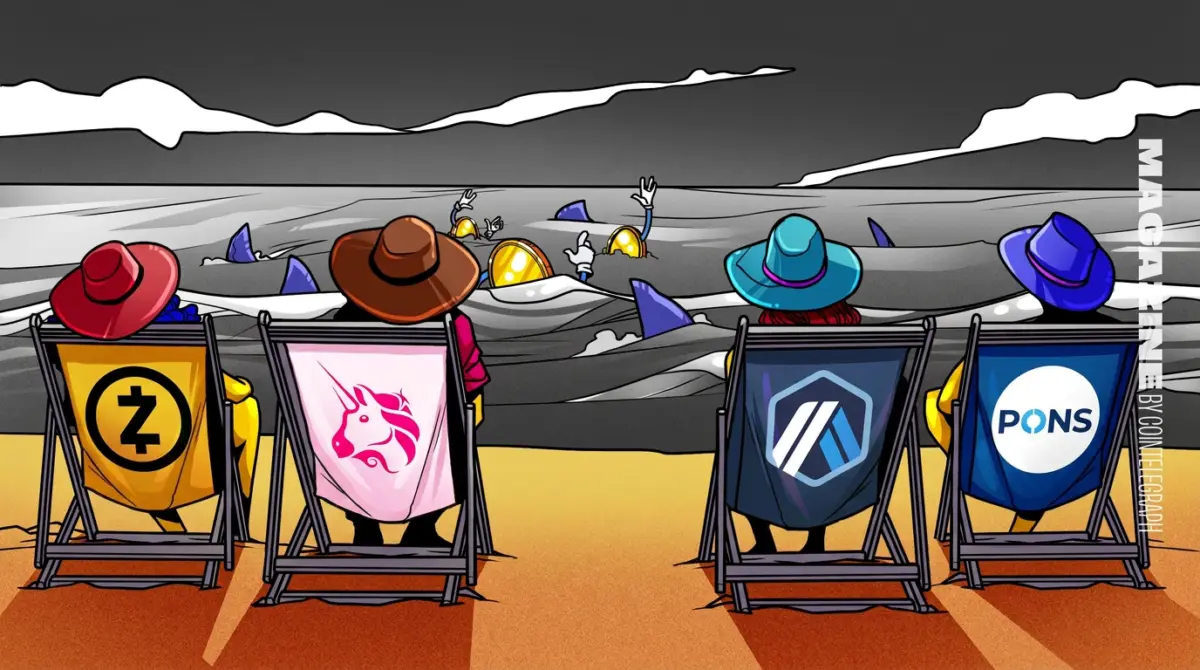
Over the past 30 days, pockets of the crypto market have experienced massive upward momentum. PONS, a prominent memecoin launchpad, skyrocketed more than 350% in price. Meanwhile, within the decentralized finance (DeFi) sector, Uniswap’s native token UNI gained upwards of 110%, Arbitrum’s ARB surged more than 150%, and the artificial intelligence-focused NEAR protocol shot up by roughly 180%.
The impressive market movement has not been restricted to a single niche. Privacy-focused digital asset Zcash reached a record high above $1,600, while Bitcoin Layer-2 token LIT and memecoin launchpad token PUMP also secured positions among the period’s top-performing assets, according to data from CoinMarketCap.
Spanning very different sectors of the digital asset ecosystem, these diverse gains do not point to one singular, obvious trade. Instead, the price action suggests that a significant portion of market participants are shifting their focus toward tokens backed by a tangible business case rather than relying solely on speculative hype.
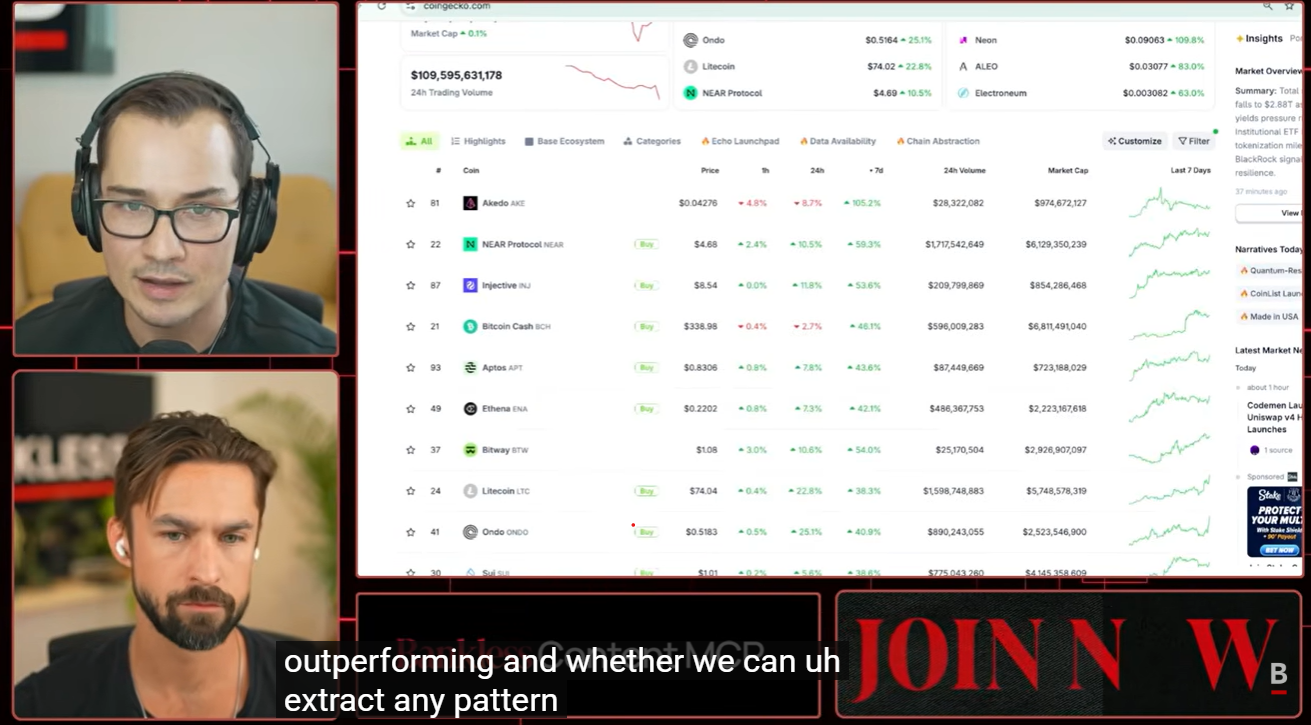
Highlighting the massive surges seen in tokens such as ARB, UNI, Jupiter’s JUP, and Ondo’s ONDO, Bankless podcast host David Hoffman pointed out a unifying characteristic during a recent broadcast. What these successful tokens have in common, according to Hoffman, is that "they make money, they all print revenue," a trend suggesting that the current market rally could be driven by underlying utility rather than pure speculation.
Supporting this thesis, data from the top 20 biggest gainers over a recent weekly period reveals that only two were memecoins, with just Pudgy Penguins making the list over a subsequent seven-day timeframe.
However, market observers caution that fundamentals are not the sole driver of current price action. Sergej Kunz, co-founder of 1inch, notes that over the past 30 days, memecoins have continued to demonstrate some of the strongest growth in terms of buyer acquisition. At the same time, Kunz points out that decentralized finance protocols, privacy-focused tokens, artificial intelligence projects, and tokenized real-world assets are also successfully capturing market attention.
"The pattern so far is breadth before depth," Kunz explains, noting that an increasing number of active wallets are purchasing a broader range of tokens, though generally in smaller individual amounts.
"The caution in the data fits the broader pattern of selective participation," he says, adding that users are currently participating "selectively rather than going all-in."
So What Will Make This Altseason Different?
As market momentum builds, a central question remains: Is the digital asset market finally becoming more discerning and allocating capital into assets with actual utility, as Hoffman suggests, or will the cycle ultimately end up driven by memecoins featuring dogs in hats and lighthearted internet humor?
It remains too early to definitively answer that question, particularly as CoinMarketCap’s official Altcoin Season Index has yet to officially break into altseason territory. The index is currently sitting at 64 out of 100. While this represents a notable increase from 48 the previous week, it still sits a measurable distance below the 75 threshold that historically marks the official onset of a new altseason.
Furthermore, a concentrated number of large-cap coins continue to account for the vast majority of the broader market. Data from institutional trading firm Talos indicates that the top 10 altcoins currently account for roughly 80% of the total altcoin market capitalization, an increase from approximately 70% at the end of 2024.
Samar Sen, head of international markets at Talos, notes that the data is "pointing to a market where capital is clustering around a smaller number of assets rather than rotating broadly into the long tail."
Sen adds that Talos September flow data reveals a "notably strong buying tilt," with consistent buying dominance across almost every trading day. This dynamic contrasts sharply with late 2024, a period when buyers and sellers were far more evenly matched, and the post-election market rally produced broader outperformance across a wider array of tokens, including DOGE, ADA, and HBAR.
What People Are Actually Buying
According to Sen, the strongest market performance is currently clustering around specific narratives. These include revenue-generating protocols, onchain perpetual trading platforms, and select DeFi projects such as HYPE, LIT, UNI, and MORPHO.
Privacy-related assets like ZEC, NEAR, and XMR are also delivering strong performances, alongside AI-adjacent tokens including VVV and TAO. Additionally, Talos is observing a flurry of activity surrounding memecoin launchpads, such as PUMP and PONS, while the Robinhood ecosystem and the USELESS memecoin have also recorded solid gains.
Echoing the sentiments of Kunz, Sen emphasizes that the market is becoming "much more selective."
"Investors are concentrating around specific narratives and ecosystems rather than treating altcoins as a single broad trade," Sen observes.
Tokenized gold and tokenized stocks are similarly attracting a higher volume of buyers, while artificial intelligence tokens continue to climb, albeit from a relatively small baseline.
Overall, rather than a wholesale structural shift from pure speculation to fundamental utility, the current environment presents a complex jumble of competing narratives. This overlap was vividly illustrated following the explosion of unconventional trading pairs on Robinhood, offering a glimpse into how traditional and speculative categories are beginning to merge. Tokenized stocks are suddenly being traded directly against memecoins through newly established market pairings like BONER/HIMS and SPACEHOOD/SPCX.
The appetite for these unique configurations is substantial, with one such unorthodox pairing generating more than $425 million in 24-hour trading volume during early September.
The Case for a More Fundamental Altseason
Michael Egorov, founder of Curve Finance and Yield Basis, reports observing a notable shift in market attention toward actual use cases and sustained institutional demand compared to previous crypto cycles.
"All in all, I’d say there’s now more interest in protocols that actually do something useful, can connect crypto with real financial activity, and prove it in action," Egorov states.
Stablecoins serve as a prime example of this trend, particularly regarding their expanding utilization in onchain foreign exchange operations and broader fintech applications. Egorov believes that the "biggest driver" moving forward will be the deepening integration of crypto-native infrastructure with the traditional real-world economy.
Should this organic demand continue its upward trajectory, it could supply the current altseason with a sustainable new source of capital inflows, as underlying blockchain infrastructure becomes increasingly useful outside of pure digital asset trading itself—though realizing that potential remains a significant undertaking.
Who is Actually Driving the Rally?
Underpinning these shifting market dynamics are notable changes in participant behavior. Talos data reveals that professional dealer participation in altcoin trading has declined from approximately 65% at the end of 2024 to about 32% in September, even as market flows maintained a strong, sustained buying trend.
"That is a significant difference from the last altcoin rally," Sen explains, "and suggests liquidity providers and market makers have so far played a smaller role in the current move."
At the same time, technological and platform developments have made market access considerably easier for everyday participants. Exposure that once required traders to interact directly with decentralized trading venues like Raydium or Orca is now readily accessible through mainstream centralized and hybrid platforms. That evolution "lowers barriers to entry and broadens retail participation," according to Sen.
Concurrently, professional traders now have access to an expanded suite of sophisticated tools for monitoring capital movement—ranging from advanced wallet tracking to copy-trading mechanisms capable of providing real-time signals regarding where funds are flowing across different wallets, protocols, and underlying blockchains.
This unique combination of broader, simplified retail access alongside advanced analytical tools for professional participants has created a distinctly different operational landscape, defining how capital is deployed as the broader crypto market navigates its ongoing evolution.
 Neng Nana
 rifanmuazin
 Evan Lee Salim