
 By Evan Lee Salim
The results of the sixth annual Solidity Developer Survey are officially in, offering a comprehensive snapshot of the trends, tools, and challenges defining the smart contract development landscape. Drawing 1,095 responses from developers spread across 87 countries, the latest survey highlights a maturing industry marked by shifting tooling preferences, distinct experience-based technical bottlenecks, and a rapid, albeit cautious, embrace of artificial intelligence. While newer frameworks continue to gain ground and long-standing development hurdles remain front and center, the findings also shed light on how the community is adapting to the complexities of writing secure, high-performance code on the Ethereum Virtual Machine.
Who Responded: A Global and Diverse Developer Base
The demographic data from the 2025 survey highlights a globally distributed and relatively young workforce powering the smart contract ecosystem. Seventy percent of respondents identified primarily as smart contract developers, while 12 percent work as auditors or security experts, and 18 percent are students entering the space. Experience levels remain heavily skewed toward newer practitioners, with half of all respondents reporting two years or less of Solidity experience. Despite this relative greenness in terms of years on the job, daily engagement is high, with 49 percent of developers using Solidity on a daily basis.
Geographically, the survey captured significant participation from emerging tech hubs alongside established markets. India led all countries with 205 responses, followed closely by Nigeria with 148, and the United States with 83. The age distribution further underscores the youthful energy of the sector, with 74 percent of all participants falling between the ages of 18 and 34.

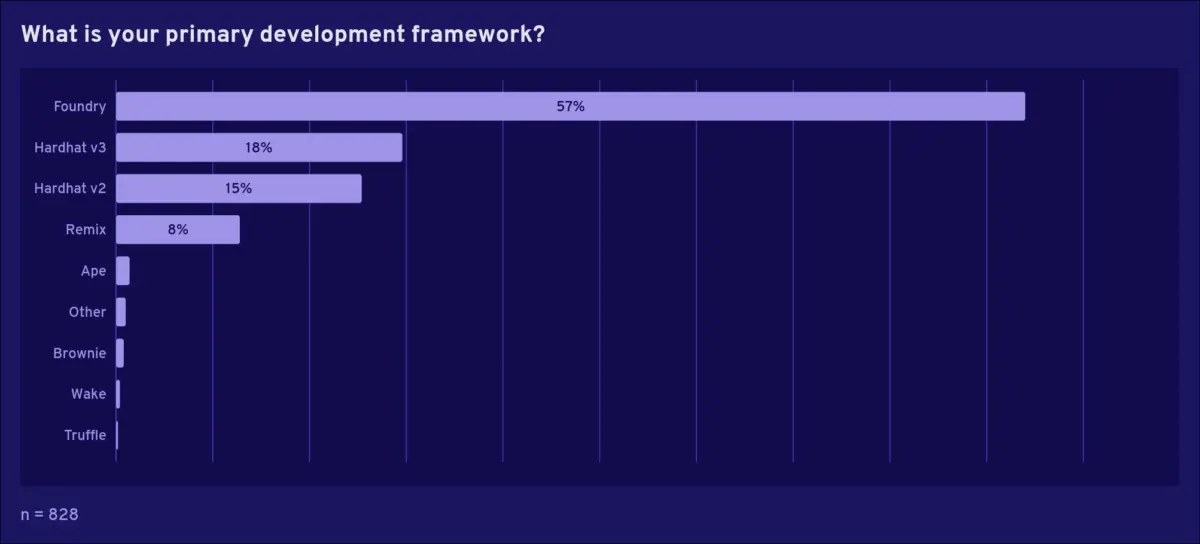
Tooling preferences within this diverse cohort have also undergone notable shifts. Foundry has solidified its position as the dominant primary development framework, capturing 57 percent of the market share—up from 51 percent in 2024. Hardhat maintains a combined 33 percent share, split between version 3 at 18 percent and version 2 at 15 percent, while older mainstays like Truffle have nearly vanished from active workflows, registering a single remaining user down from 2.4 percent in the previous year. For secondary frameworks, Remix remains the favorite, utilized by 41 percent of developers. When interacting with Ethereum via SDKs, developers heavily favor ethers.js at 70 percent, followed by viem at 39 percent and wagmi at 33 percent.
Pain Points and the Toll of Experience
While tools have evolved, developers continue to grapple with persistent architectural and debugging hurdles. "Stack-too-deep" errors emerged as the most reported recurring issue, cited by 47 percent of respondents, while bytecode size limits and debugging both tied at 33 percent. Interestingly, nearly a quarter of participants—23 percent—reported encountering no recurring issues at all.
A deeper analysis of these pain points reveals a fascinating correlation with developer experience. Rather than being beginner stumbling blocks, major compilation limits tend to disproportionately plague veterans whose codebases have grown in complexity. For instance, stack-too-deep errors are reported by only 25 percent of self-rated beginners, but that figure climbs sharply to 65 percent among self-rated experts. A similar dynamic applies to bytecode size limits, which affect 17 percent of beginners compared to 47 percent of experts. Debugging, however, proves to be a universal equalizer, remaining a consistent pain point across all experience levels at roughly 29 to 35 percent.

Looking toward future enhancements, developers expressed a clear desire for language and compiler improvements. Better gas optimizations stood out as the most requested near-term feature at 44 percent, followed by EIP-712 typehash support at 29 percent and reference types in transient storage at 23 percent. Free-text comments frequently elaborated on these frustrations, noting that current gas optimization incentives often push developers toward writing suboptimal code, such as inlining functions instead of abstracting them or recalculating values rather than storing them cleanly.
The AI Paradox: Rapid Adoption Meets Lingering Distrust
One of the most striking narratives in the 2025 survey data is the rapid integration of artificial intelligence into daily development workflows, juxtaposed against a lingering undercurrent of skepticism regarding the reliability of AI-generated outputs.
The survey found that 88 percent of respondents use AI tools at least on a monthly basis, with a remarkable 58 percent relying on them daily. However, this enthusiasm has not translated into blind faith. Forty-five percent of developers expressed general distrust in AI outputs. Among daily users specifically, 36 percent still maintain some level of distrust, illustrating that developers are adopting these technologies faster than they are learning to fully trust them.

When examining how these tools are deployed, developers primarily turn to AI for assistance with testing at 61 percent, documenting code at 59 percent, and learning about unfamiliar codebases at 58 percent. Direct code generation and code review trailed slightly behind, each accounting for 49 percent of use cases. When asked to quantify their sentiment, 49 percent of respondents stated they "somewhat trust" AI outputs, 30 percent "somewhat distrust" them, 15 percent "highly distrust" them, and a mere 6 percent expressed high trust. Given that Solidity code often secures millions or even billions of dollars in decentralized finance value, the gap between AI reliance and security confidence remains a critical focal point for the ecosystem.
Core Solidity and the Path Forward
The survey also gauged community awareness and sentiment surrounding Core Solidity, a major conceptual evolution for the language. Familiarity remains relatively low, with only 30 percent of respondents who answered the question stating they were familiar with the initiative. Among those who are acquainted with Core Solidity, the most desired features include improved error handling to replace try-catch blocks at 43 percent, and better delegatecall or library replacement mechanisms at 41 percent.
Reactions to potential structural shifts within the language were mixed. Sixty-three percent of respondents indicated that removing inheritance would create significant challenges for their existing projects. Furthermore, transitioning current codebases to utilize type classes or traits was estimated to be somewhat difficult by 44 percent of developers and very difficult by 21 percent. Free-text responses reflected a cautious community dialogue: 21 percent were supportive of the direction, 23 percent were cautious, and 21 percent voiced concerns regarding potential language fragmentation.

In response to these findings, core contributors have already begun outlining targeted interventions. To address the persistent stack-too-deep bottleneck, the v0.8.35-pre.1 pre-release introduces the SSA CFG code generator behind an experimental flag, aimed at eliminating the error entirely ahead of a stable release. To combat low awareness of Core Solidity, upcoming initiatives include a dedicated blog series on pattern matching, an interactive playground slated for a summer release, and closer collaboration with ecosystem partners to define a standard library.
Other ongoing infrastructure efforts include development on ethdebug—a standardized debugging data format for EVM-compatible networks—alongside active discussions regarding an Ethereum Improvement Proposal (EIP) to raise smart contract bytecode size limits. Documentation efforts are also being adjusted based on respondent feedback to include more practical guidance on proxies, storage layouts, and gas optimization strategies, alongside expanded multilingual translations.
The complete interactive report, detailing all 60 survey questions alongside comprehensive charts and respondent feedback, is now accessible online. The team behind the survey encourages community members looking to share further thoughts to join the ongoing discussions on the Solidity Forum.
 Laily UPN
 Ammar Sabilarrohman
 Basiran