
 By Nila Kartika Wati

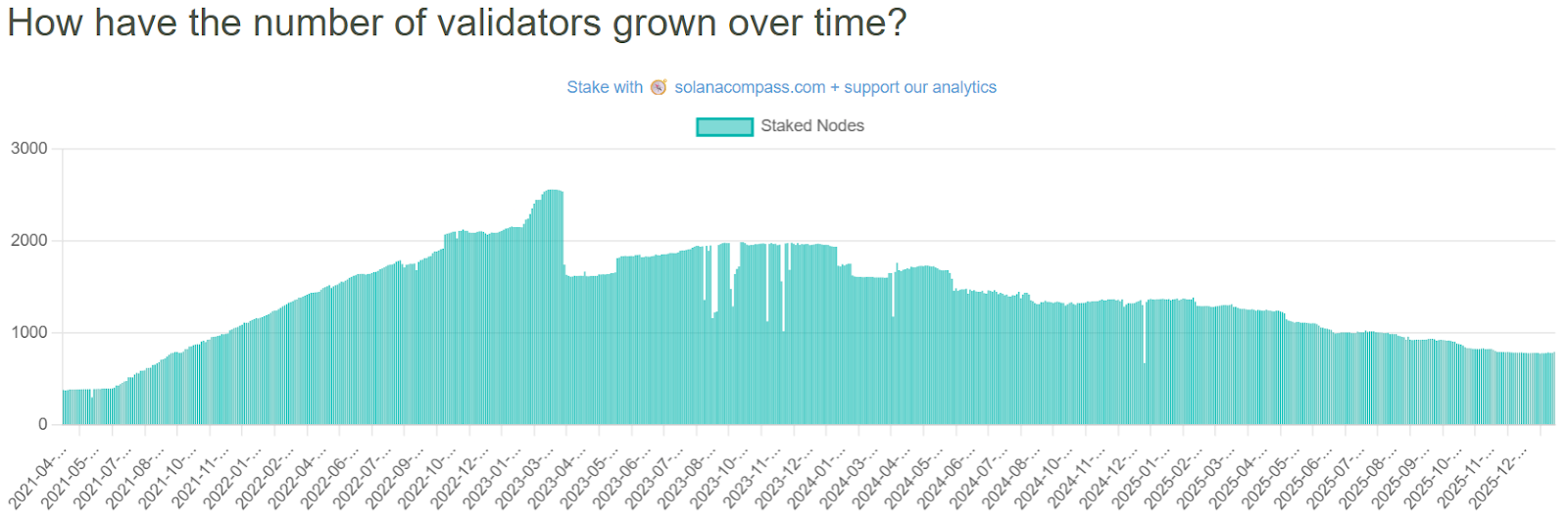
Solana’s validator ecosystem is facing severe structural pressures, with its active node count falling dramatically over the past three years. This sharp contraction has reignited intense industry debates regarding the long-term decentralization of the high-performance blockchain network, as escalating operating expenses and aggressive fee competition continue to price out independent, smaller-scale operators.
According to data compiled by Solanacompass, the total number of Solana validators plunged by 68% down to 795 as of Wednesday. This represents a steep decline from an all-time peak of 2,560 active validator nodes recorded in March 2023.
Within the architecture of proof-of-stake blockchain networks, validators serve as the foundational backbone. They are directly responsible for adding new blocks to the ledger and rigorously verifying transactions contained within proposed blocks. Because of these critical functions, a robust, geographically dispersed, and diverse network of validators is widely considered essential for maintaining the censorship resistance, security, and true decentralization of any distributed ledger.
While a portion of the historical decline in node numbers can be attributed to routine network hygiene—such as the systematic purging of inactive, abandoned, or "zombie" nodes—industry insiders emphasize that this explanation tells only part of the story. Increasingly, independent operators are finding themselves squeezed out of the ecosystem entirely due to soaring operational costs and intense fee pressures from larger, heavily capitalized market participants.
An independent Solana validator operator who publishes updates under the pseudonym Moo addressed these growing economic realities in a post on X, noting that numerous small-scale validators are actively weighing whether to power down their infrastructure permanently because the math simply no longer works.

"Many small validators are actively considering shutting down (including us). Not due to lack of belief in Solana, but because the economics no longer work," Moo wrote on the social media platform.
Moo elaborated that aggressive market practices, specifically large validator entities charging zero percent commission fees, have successfully undercut smaller competitors, effectively destroying their profit margins. Under these market conditions, continuing to run a dedicated node has become economically unviable for independent operators who lack massive capital reserves.
"We started validating to support decentralization. But without economic viability, decentralization becomes charity," Moo added.
This widening economic divide signals a troubling trend for the broader blockchain community: retail and independent validators can no longer sustainably contribute to the security and maintenance of the network. Consequently, Solana’s infrastructure is steadily shifting toward an oligopoly dominated by large-scale, professional node operators. This consolidation inevitably raises renewed concerns regarding the network’s overall degree of decentralization and its long-term vulnerability to systemic points of failure.
Solana’s Nakamoto Coefficient Sees 35% Decline
The alarming contraction in the raw count of validator nodes is further mirrored by a parallel decline in mathematical metrics designed to gauge network distribution. Solana’s Nakamoto Coefficient has experienced a significant downturn over the same multi-year timeline, dropping by 35% to rest at 20 as of Wednesday, down from a reading of 31 in March 2023, according to Solanacompass metrics.
In blockchain analytics, the Nakamoto Coefficient serves as a widely accepted benchmark for measuring the decentralization of a network. It calculates the minimum number of independent entities—such as individual validators or mining pools—required to collude or be compromised in order to disrupt, halt, or censor the blockchain. A shrinking Nakamoto Coefficient clearly indicates that the total amount of staked Solana supply is becoming increasingly concentrated among fewer hands, leaving the underlying network structurally less decentralized than it was during its previous peaks.
Driving this consolidation is the escalating cost profile associated with running a competitive, profitable validator node. Over the past three years, these overhead expenses have risen significantly, compounded by the broader valuation trends of the native Solana (SOL) token.
Aside from the baseline capital expenditures required for enterprise-grade hardware and reliable cloud server hosting, prospective validators face substantial financial barriers just to participate in protocol consensus. Data from the technical documentation of Solana validator Agave highlights that validators must commit an initial investment of at least $49,000 worth of SOL tokens to fund their operations for the first year. Furthermore, they are required to expend a minimum of 401 SOL annually purely on voting fees to remain operationally viable.
Because Solana’s high-throughput architecture relies heavily on continuous consensus participation, validators must submit a vote transaction for every single block they agree upon. These recurring vote submissions can accumulate rapidly, costing individual operators up to 1.1 SOL per day simply to cast their mandatory consensus votes. For smaller operators working with tight margins, these daily protocol-level expenses can quickly outpace any incoming delegation rewards, particularly when competing against institutional-grade operations subsidizing their services or running zero-fee models.
Cointelegraph reached out to the Solana Foundation for formal commentary regarding the declining validator count and the broader economic challenges facing independent node operators, but had not received a response prior to the time of publication.
 Nana Wu