
 By Azzam Bilal Chamdy

Cryptocurrencies could ultimately deliver a much higher financial payoff from the ongoing artificial intelligence boom than traditional AI equities themselves, according to Jordi Visser, founder of Visser Labs and a veteran Wall Street strategist.
As explosive, easy-to-repeat gains in premier artificial intelligence stocks become increasingly difficult to replicate in the current market climate, the financial landscape is shifting. Visser, whose extensive three-decade career includes serving as a managing director at Morgan Stanley and chief investment officer at Weiss Multi-Strategy Advisers, notes that emerging autonomous AI agents are rapidly generating a brand-new demand for crypto-native payments and tokenized assets. Currently heading 22V’s AI Macro Nexus Research, Visser points out that this structural shift is fundamentally altering the investment thesis for digital assets.
“Without AI, I don’t think crypto would be going through this bull market,” Visser tells Cointelegraph’s Trade Secrets, highlighting the deep macroeconomic ties binding the two technological revolutions together.
Driven by this overarching thesis, Visser has systematically expanded his own personal investment portfolio beyond traditional blue-chip holdings like Bitcoin, Ether, and Solana. He has branched out into a much broader, diversified basket of tokens to capture the downstream value creation of artificial intelligence.
AI is Crypto’s Smartphone Moment
The core of the Wall Street veteran’s broader macro bet centers on the advent of autonomous AI agents. These advanced software programs will soon allow everyday users and institutional participants alike to instruct software to execute complex trades, manage portfolios, and complete various financial transactions seamlessly on their behalf.
In Visser’s view, this technological leap represents a watershed epoch for the digital asset economy. “AI agents are effectively the same as the App Store or the smartphone for crypto,” he explains.
Under this transformative scenario, individual users will simply direct their autonomous agents while the underlying software program handles the heavy lifting of real-world execution. The exponential proliferation and daily utility of these agents will inevitably drive an unprecedented volume of activity across tokenized assets and decentralized crypto payments. This dynamic effectively extends the primary investment opportunity far beyond the concentrated circle of legacy hardware companies and cloud providers currently supplying immense computing power to the AI sector.

This perspective aligns closely with observations from other institutional market giants. BlackRock, the world’s largest asset manager, has similarly noted that the ultimate potential for artificial intelligence to fuel long-term organic crypto demand remains heavily underappreciated by mainstream equity markets.
However, Visser’s bullish outlook on digital assets is not entirely insulated from traditional market risks. He explicitly identifies a severe, unforeseen AI market downturn that aggressively drags down broader equity indices as a primary external threat to his thesis. While he believes such a correction would not spell the definitive end of the broader crypto bull market, it would likely trigger a sharp market reaction. “I don’t think that would end the bull market, but I definitely think it would retest the lows that we just saw,” he cautions.
The AI “Fireworks Show” Is Over
The transition in Visser’s investment strategy did not happen in a vacuum. He reveals that he began actively reducing his concentrated equity exposure to memory chipmaker Micron as early as mid-May. This strategic pivot came after he concluded that institutional hedge funds and retail investors had become dangerously overcrowded in the traditional AI trade, leaving the market vulnerable to sudden sentiment shifts.
“One of the reasons that Bitcoin and Ethereum were having such a hard time is because the focus was completely on AI,” Visser observes, noting how capital was relentlessly sucked out of alternative asset classes to chase high-flying tech equities.
During this period, artificial intelligence offered equity investors seemingly greener pastures backed by visibly rising corporate revenues. Major technology firms posted staggering financial metrics to justify sky-high valuations. Microsoft announced in a quarterly report on April 29 that its dedicated artificial intelligence business was generating revenue at an annualized rate of $37 billion, representing more than double the figure recorded a year prior. Concurrently, Micron reported in March that its fiscal second-quarter revenue had nearly tripled to reach $23.86 billion.
Despite these robust corporate fundamentals, equity investors now face a significantly less forgiving market environment. A comprehensive 100-stock AI portfolio tracked by Visser has gained roughly 40% for the year, but it has simultaneously grown markedly more volatile than Bitcoin when measured on a rolling 126-day basis.
Furthermore, mounting financing concerns have begun to weigh heavily on the companies building out fundamental AI infrastructure. The staggering capital expenditures required to construct massive data centers and train advanced models currently exceed the actual operating cash flows generated by many of these businesses from their existing operations.
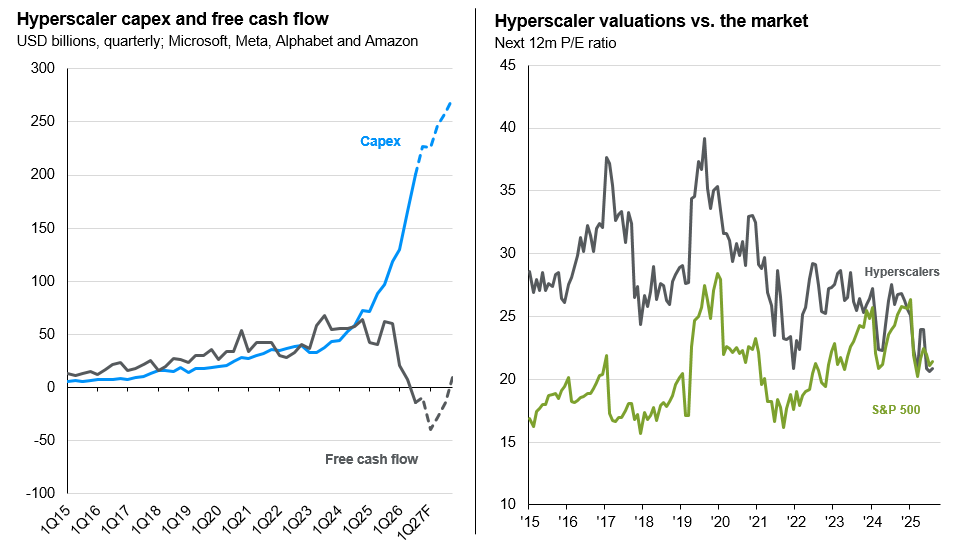
As a prominent example, Oracle reported spending a staggering $55.7 billion on capital expenditures in fiscal 2026 against just $32 billion in operating cash flow, forcing the enterprise technology giant to raise $43 billion in fresh debt financing to bridge the financial gap.
“I didn’t say AI was over. AI fireworks show is over,” Visser clarifies. While he still projects several years of sustained structural growth in computing demand driven directly by the proliferation of AI agents, he strongly advises investors to moderate their future expectations regarding outsized equity returns.
Visser Widens His Crypto Bets
Until August of this year, Visser’s cryptocurrency exposure was strictly confined to the undisputed heavyweights of the ecosystem: Bitcoin, Ether, and Solana. Although Bitcoin continues to command the largest allocation in his portfolio, he has systematically initiated positions in a much wider array of alternative tokens to capture emerging market trends.
Among the specific market signals he closely monitors is Dogecoin, which he views as a reliable sentiment gauge for returning retail investor enthusiasm—a psychological component he considers vital for sustaining any expansive, market-wide rally.
“They’re the energy of the space and they’re the ones that are going to fuel this as other people get involved,” Visser notes, acknowledging the unique cultural and liquidity dynamics that meme assets inject into the broader crypto economy.
To effectively track and participate in this broader market recovery, Visser maintains a custom, equally weighted index comprising 42 distinct tokens alongside four publicly traded stocks. According to his performance metrics, this diversified basket has successfully outperformed Bitcoin since June, and he intends to maintain his holdings across all constituent assets.
Privacy stands out as a core thematic pillar where Visser has already committed significant capital. As artificial intelligence advances rapidly, he believes that individual data privacy and robust cryptographic identity protection will become paramount concerns, especially as synthetic fraud, deepfakes, and other malicious forms of digital abuse multiply across the internet. Projects focused on cryptographic privacy, such as Zcash and Monero, neatly align with this long-term investment thesis.
 Lina Irawan
 rifanmuazin
 Suro Senen