
 By Suro Senen

Blockchain scaling and cryptography firm StarkWare has announced a major technical milestone, successfully creating a zero-knowledge (ZK) verification proof of the Bitcoin blockchain capable of running seamlessly on everyday mobile devices. The development introduces a lightweight client architecture that compresses the entire chronological history of Bitcoin block headers—spanning from the genesis block up to the modern era—into a remarkably compact 1-megabyte cryptographic proof.
Zero-knowledge technology allows one party to prove to another that a statement is true without revealing any information beyond the validity of the statement itself. By applying this advanced cryptographic framework to the Bitcoin network, StarkWare has engineered a system where users can verify transactions in under 100 milliseconds without needing to download or store the full, detailed Bitcoin ledger, which currently exceeds 680 gigabytes in size.
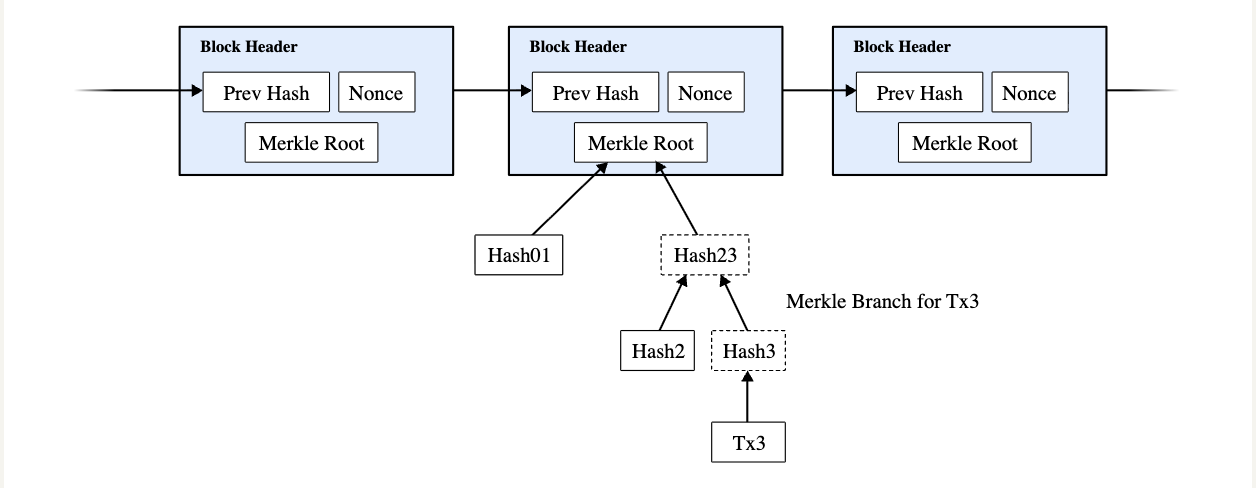
According to Abdelhamid Bakhta, head of ecosystem at StarkWare, the newly unveiled BTC ledger proof encapsulates the foundational block headers that form the structural backbone of the network. Each block header contains essential consensus data, including the version number of the Bitcoin software used to mine the respective block, a cryptographic reference linking back to the previous block in the chain, an exact timestamp, the overall block size, and the critical nonce—the variable random number miners must discover and submit to successfully add a new block to the public ledger.

This lightweight client infrastructure directly builds upon Simplified Payment Verification (SPV), an innovative concept originally detailed in Satoshi Nakamoto’s foundational Bitcoin white paper. SPV was designed to provide smaller, resource-constrained nodes with a secure method to verify payments without requiring them to download the entirety of the blockchain ledger. StarkWare’s modern ZK implementation modernizes this vision, allowing mobile users and resource-light devices to independently verify transaction security with cryptographic certainty.
The breakthrough carries significant implications for the broader cryptocurrency ecosystem. Historically, verifying Bitcoin payments with high security required users to set up and maintain a full Bitcoin node. However, full nodes can cost anywhere from $300 to $1,000 in hardware expenses and often demand a technical proficiency that can be overly complex for the average everyday user. By shrinking verification requirements down to a mobile-compatible format, StarkWare’s protocol opens up trustless verification to a substantially wider audience.
Node Storage Requirements and Ledger Size Become Points of Contention in the BTC Community
The introduction of StarkWare’s mobile verification tool arrives at a time of intense internal debate within the Bitcoin community regarding node storage requirements, ledger expansion, and the long-term decentralization of the network. Compared to many alternative blockchain networks—which can demand thousands of dollars in specialized server hardware and massive storage arrays to operate a validating node—Bitcoin has traditionally maintained relatively accessible node requirements.
Because of the relative simplicity of the core Bitcoin protocol, network nodes have historically been able to run smoothly on standard retail personal computers. This accessible hardware threshold has been widely regarded as a cornerstone for preserving the decentralization of the protocol, ensuring that consensus is enforced collectively by independent node runners scattered across the globe rather than centralized data centers.
Industry analysts and core protocol developers have long warned that if running a node becomes prohibitively expensive due to mounting hardware requirements, the network risks sliding toward centralization. In such a scenario, validation power would naturally concentrate among large service providers and institutional entities with the capital resources to manage heavy infrastructure, directly undermining Bitcoin’s core value proposition as a peer-to-peer, censorship-resistant digital currency.
In recent years, these concerns have intensified amid growing debates over non-monetary data storage on the blockchain. The emergence of inscriptions, ordinals, and various forms of arbitrary data embedding has sparked sharp controversies. Critics argue that these trends accelerate centralization risks by artificially inflating the size of the ledger, forcing independent node operators to allocate significant storage and memory resources toward non-monetary files rather than pure financial transactions.
The debate deepened significantly when Bitcoin Core, the development group responsible for maintaining the reference software utilized by approximately 80% of BTC node runners, announced that the upcoming Bitcoin Core 30 update—slated for release in October—will remove the long-standing OP_Return limit. The OP_Return parameter has historically capped the amount of non-monetary data that can be embedded directly into Bitcoin transactions at 80 bytes, a size intentionally designed to be far too small to accommodate large images, documents, or multimedia content.
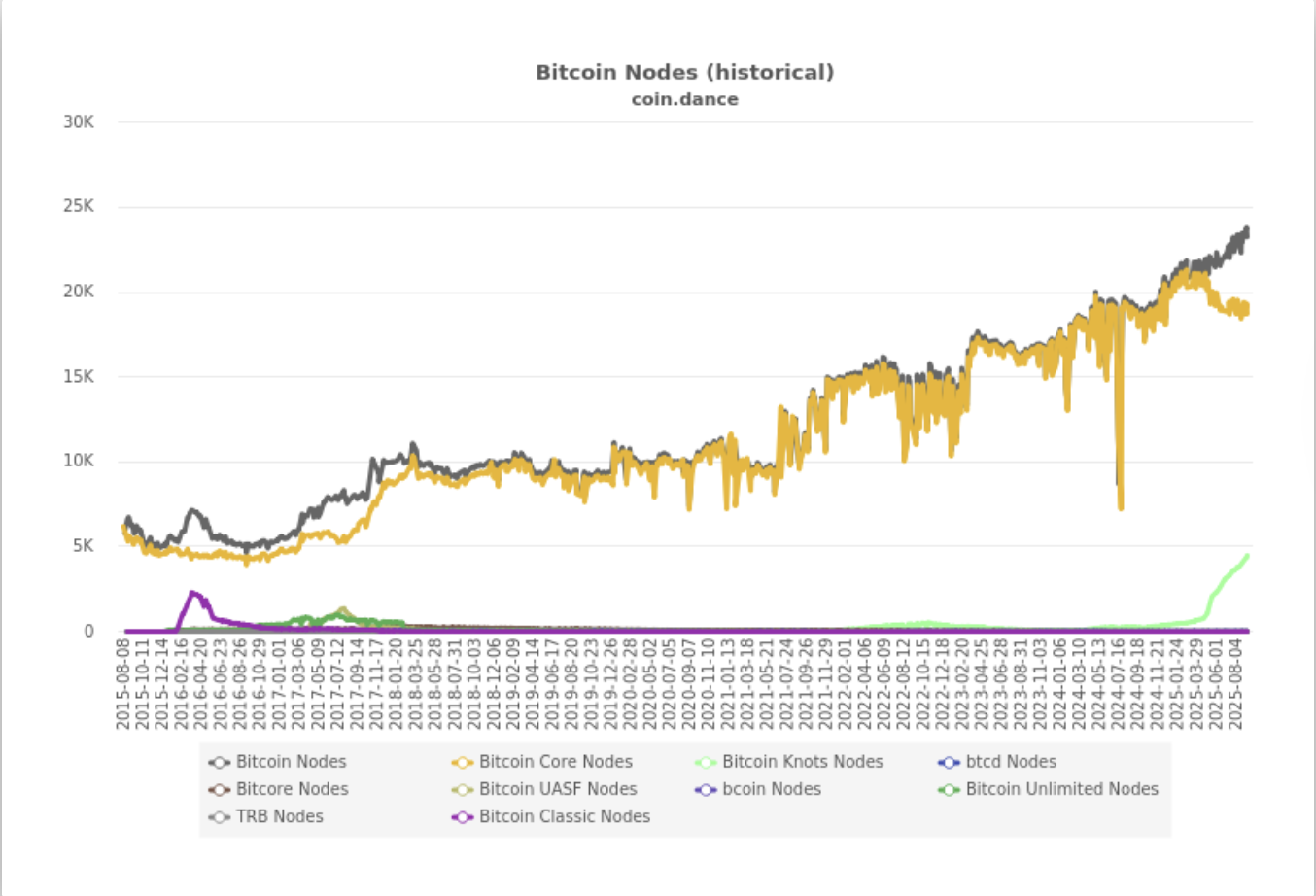
The prospect of lifting this limit has triggered a historic shift in network dynamics, prompting a sharp surge in users migrating away from traditional software and adopting Bitcoin Knots nodes instead. Bitcoin Knots is an alternative node software implementation that offers highly customizable parameters, giving individual node operators the administrative flexibility to limit or outright reject the amount of OP_Return data they choose to store in their local memory pools and relay across the peer-to-peer network.
Market data illustrates the speed of this ideological and technical migration. By 2025, Bitcoin Knots nodes have grown to account for nearly 20% of the entire network’s software distribution share. This represents a dramatic, almost vertical increase from late 2024, when Knots nodes represented a marginal slice of roughly 1% of the total market share, highlighting a deeply divided community actively grappling with the future boundaries of Bitcoin data storage and network decentralization.
 Dwi Wanna
 Asro
 Nana Wu