
 By Nana

For a long time, the prevailing narrative surrounding onchain foreign exchange (FX) assumed that adoption would follow a top-down trajectory. Under this conventional view, traditional commercial banks would eventually tokenize various fiat currencies, large global financial institutions would migrate their institutional-scale foreign exchange operations onto public or private blockchain rails, and massive institutional liquidity would naturally follow.
The theoretical end result of this top-down approach would be a blockchain-based foreign exchange ecosystem that eventually grows large enough to rival and ultimately resemble its traditional, legacy counterpart. However, according to Michael Egorov, the founder of decentralized finance protocols Curve Finance and Yield Basis, that is not necessarily how the real-world evolution of onchain FX is going to unfold.
Instead, growing market indicators and real-world usage trends suggest that blockchain-based foreign exchange is developing in the exact opposite direction—rising organically from the bottom up.
In the emerging decentralized economy, stablecoins pegged to regional or national fiat currencies, such as the Brazilian Digital token (BRZ) or Monerium’s euro-backed stablecoin (EURe), can be swiftly minted, redeemed onchain, and seamlessly transferred between self-custodial digital wallets and traditional bank accounts. These localized digital assets generate healthy, consistent trading activity as decentralized finance users actively swap them within decentralized exchange (DEX) liquidity pools.
Markets of this nature end up developing in real time around a deeply practical, everyday user need: the necessity of moving value directly and efficiently between digital currencies and local fiat systems without enduring the friction of legacy financial intermediaries.
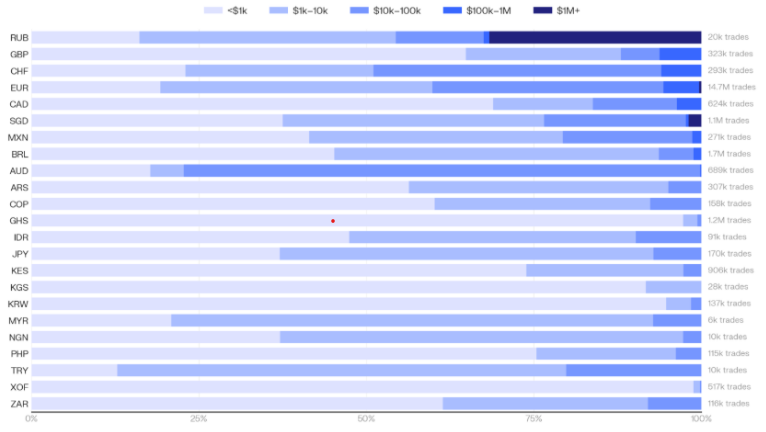
While this decentralized paradigm is still in a relatively early stage of maturation, the underlying use cases and economic demand are robust and verifiable. Recent data compiled by digital asset market maker Keyrock indicates that the vast majority of onchain stablecoin trades tied directly to emerging market currencies typically fall within the modest range of $1,000 to $10,000 per transaction.
While these sums are objectively modest when compared against the massive multi-million-dollar scale of traditional institutional foreign exchange trading, that characteristic is precisely the point. The data demonstrates how the market is actively building itself in the general direction of onchain foreign exchange to satisfy practical, real-world payment and transfer needs, rather than merely catering to high-volume institutional traders and macro-speculators.
‘Small’ Is Not the Same as ‘Usable’
Everyday people and modern businesses constantly need to move their capital across international borders and between different national currencies. Clearly, these market participants are not content to sit back and patiently wait for major traditional finance (TradFi) institutions to slowly modernize and migrate their cumbersome foreign exchange operations onto modern blockchain rails.
There remains a widely held assumption within traditional financial circles that an onchain foreign exchange market requires massive, deep pools of pre-existing liquidity before it can ever become genuinely useful to the broader public. In daily practice, however, that theoretical assumption does not entirely hold true.
If there is genuine, organic economic demand from an individual or enterprise that needs to exchange United States dollars into euros, Swiss francs, or another regional currency, even a comparatively smaller liquidity pool can successfully process those transactions and serve a profoundly real economic purpose.

Onchain foreign exchange does not need to achieve massive, global scale before it can deliver utility; rather, it can grow organically precisely because real people are actively using it to solve everyday financial problems.
As a matter of historical fact, this bottom-up trajectory mirrors the exact path taken by dollar-pegged stablecoins themselves. They began their existence as a relatively niche, crypto-native use case utilized primarily by early adopters within digital asset trading venues, and yet today they have firmly established themselves as a vital component of a much broader, highly resilient global financial infrastructure.
Recent market research shared by blockchain analytics firm Chainalysis highlights this rapid expansion, showing that cross-border stablecoin economic activity surged past $220 billion by the middle of 2026. That impressive milestone represents an extraordinary expansion of nearly 80% over the course of a single year, proving beyond a doubt that real-world demand and transactional activity are on a permanent upward trajectory. There is no fundamental reason why onchain foreign exchange cannot follow a remarkably similar path of organic adoption.
The End User Does Not Care How Big the Market Is
Examining this evolution reveals its most practical dimension. Onchain foreign exchange will obviously not be in a position to compete directly with the entirety of the multi-trillion-dollar global foreign exchange market anytime soon; reaching that ultimate level of market dominance is still years away. A far more compelling and immediate question, however, is what specific financial problems onchain FX can solve right now for someone who already maintains capital within the digital asset ecosystem.
In the current financial landscape, an individual can seamlessly exchange a United States dollar stablecoin into a euro-backed stablecoin—or another alternative digital currency—directly onchain and deploy those funds for commercial payments with remarkably little operational friction. Operating in this manner is frequently significantly faster and considerably more cost-effective than relying on a classic international bank wire transfer.
The exact same foundational logic applies directly to the broader category of onchain foreign exchange. Modern fintech applications, cross-border payment providers, and crypto-native debit card companies do not need to recreate the entire complex apparatus of the traditional institutional FX market. Instead, what they fundamentally require is the ability to move their customers’ funds efficiently and affordably between different national currencies.
When an ordinary consumer attempts to make a purchase or complete a transfer in a foreign currency through traditional channels, the currency conversion process invariably adds substantial hidden costs to the operation. These legacy transactions typically route through major payment networks like Visa or Mastercard, which routinely assess processing and conversion fees hovering around 1% of the total transaction value.
Decentralized onchain exchanges present a markedly superior alternative in these scenarios. If a user’s funds are already residing natively on high-speed blockchain rails, swapping USD-pegged stablecoins into EUR-pegged stablecoins can be executed directly, completely bypassing any requirement to engage extra intermediaries. This direct exchange model is inherently faster and drastically less expensive.
Traditional commercial banks will most likely retain their critical importance as compliant entry and exit points where digital money must interact with the legacy physical banking world. Issuing and redeeming local fiat currencies, managing traditional bank accounts, and handling stringent regulatory compliance requirements represent areas where legacy financial institutions will naturally continue to take the lead.
However, once the capital is successfully resident onchain, many of the traditional, resource-heavy intermediary steps can be safely eliminated to achieve vastly superior operational efficiency.
From the perspective of an end user who simply wishes to execute a cross-border financial transfer with minimal complications and low fees, this represents a highly positive structural improvement. The physical size of the broader macroeconomic foreign exchange market matters very little to an individual whose primary concern is speed and cost-effectiveness.
Real Demand Is Only Half the Equation
Real-world demand is undoubtedly a crucial component of financial innovation, but it does not magically solve the complex economic problem of liquidity provision. The core challenge facing decentralized FX is not simply the technical feat of creating a euro-to-dollar or franc-to-dollar trading pool; the true challenge lies in making those liquidity pools economically sustainable over the long term.
This is precisely where automated market makers (AMMs) can make a profound difference. Traditional, professional market-making firms may not initially find it financially attractive to provide dedicated liquidity for a smaller, nascent foreign exchange market. There may simply not be enough transactional volume in early-stage currency pairs to justify the ongoing operational costs and capital commitment required from institutional desks.
Automated liquidity protocols fundamentally change that economic equation because software is capable of providing liquidity on a continuous, 24/7 basis without requiring a human market-making firm to manually monitor and manage every individual trade.
Consider two prominent dollar-backed stablecoins, such as USD Coin (USDC) and Tether (USDT). From the perspective of a traditional, legacy foreign exchange desk, executing a conversion from one dollar stablecoin into another might appear to be a remarkably mundane and unrewarding business activity. Both digital assets are designed to maintain a stable value pegged closely to $1, meaning there is very little volatile price movement to trade around for speculative profit.
Despite the lack of volatility, if there remains a persistent, real-world economic need for people and businesses to seamlessly switch between stablecoins of this nature, an automated market maker can easily establish a specialized liquidity pool where users can execute that swap directly.
Every single transaction completed within the pool generates a modest fee for the decentralized liquidity providers supplying the capital. When a sufficient aggregate number of users require the exact same currency conversion, a viable market can successfully exist and thrive, even if that specific trading pair does not look particularly exciting or profitable to a traditional, human-managed market-making firm.
This specialized style of organic adoption cannot accurately be described as explosive, but there is also nothing inherently wrong with slow, natural, and compounding growth. Sometimes, emerging financial markets require nothing more than a dedicated core group of users who share a persistent problem that the existing legacy infrastructure simply does not solve particularly well. If those users are capable of making the underlying market economically viable through consistent use, organic liquidity will follow and expand outward from there.
 Ammar Sabilarrohman
 rifanmuazin
 Asep Darmawan