
 By Iffa Jayyana

The cryptocurrency industry’s heavy financial backing of the United States Republican Party has alienated key Democratic lawmakers whose support is urgently required to pass comprehensive federal digital asset legislation, according to former New York Governor Andrew Cuomo.
Speaking during a high-profile panel discussion alongside OKX CEO Star Xu at the Token2049 conference on Tuesday, Cuomo offered a candid assessment of the digital asset sector’s current political strategy. He argued that the industry has mistakenly leaned too heavily into a partisan approach in its pursuit of regulatory clarity, specifically pointing to the stalled CLARITY Act as a primary casualty of this dynamic.
"When you invest heavily in the Republican Party, by definition, you’re going to alienate Democrats," Cuomo told the audience, emphasizing that the path to enacting enduring regulatory frameworks in Washington requires a genuinely bipartisan consensus rather than a lopsided political alliance.
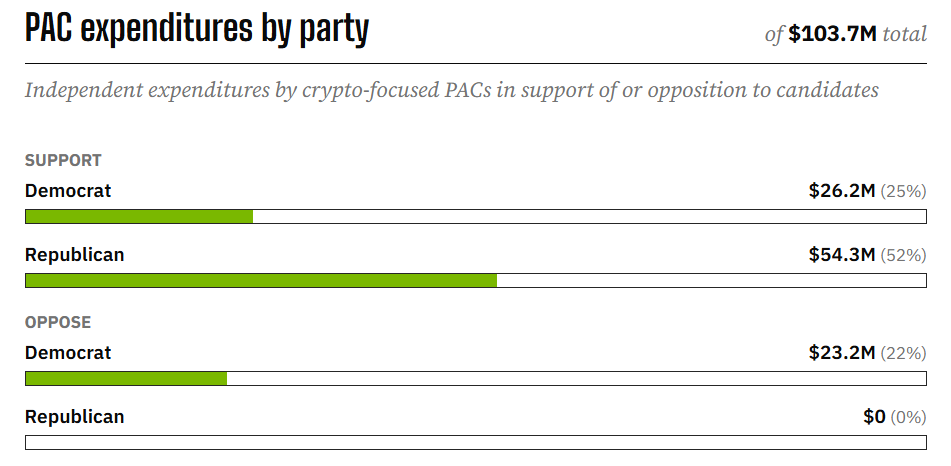
Data from independent political trackers underscores the former governor’s observations regarding campaign spending. According to figures compiled by Tech Influence Watch, crypto-focused political action committees have poured substantial resources into the 2026 election cycle. As of Thursday, these PACs have directed $54.3 million toward supporting Republican candidates, compared to just $26.2 million spent in direct support of Democrats. Furthermore, the tracking data reveals an additional $23.2 million deployed specifically to oppose Democratic candidates, illustrating a clear partisan tilt in the industry’s electoral engagement strategy.
This financial imbalance comes at a critical political crossroads for Capitol Hill. Kalshi prediction market metrics checked on Thursday indicated a roughly 61% probability that Democrats could win control of both chambers of Congress in upcoming legislative outcomes. Cuomo noted that a Democratic-controlled Congress could alter the political landscape drastically. Such a shift might lead lawmakers to actively seek the rollback of recent administrative crypto initiatives or, alternatively, compel a more collaborative approach with the White House to negotiate and pass the full text of the CLARITY Act.

"You need Democrats to pass the bill. You need Republicans. You have to be more balanced," Cuomo stressed during the panel, pointing to the mathematical reality of passing legislation in a closely divided federal government where Senate filibusters and House majorities demand broad cross-aisle agreement.
Democrats Aren’t Anti-Crypto, Says Cuomo
Addressing common misconceptions held within financial technology circles, Cuomo strongly disputed the prevailing narrative that the Democratic Party is inherently hostile or opposed to cryptocurrency and blockchain innovation.
"There’s a sense that Democrats are anti-crypto," he noted, pushing back against industry generalizations that paint the entire party with a broad brush based on the actions of select progressive or regulatory-focused lawmakers.
Instead, the former governor drew a conceptual parallel between the core tenets of decentralized finance and the historical mission of the Democratic Party. He suggested that the foundational promise of blockchain technology—providing permissionless, decentralized access to economic tools—aligns naturally with progressive goals of financial inclusion.
"As a matter of fact, I could argue that the crypto technology is exactly suited to the Democratic Party," Cuomo added. "It’s empowering people who otherwise wouldn’t have access to financial products, and the Democratic Party has been working to do that all its life."
Despite partisan tensions, digital asset legislation has historically attracted pockets of support from both sides of the aisle, even though Republican lawmakers have demonstrated a higher degree of unity behind major legislative packages. In July 2025, a significant milestone was reached when 78 House Democrats joined forces with 216 Republicans to successfully pass the CLARITY Act through the lower chamber, overcoming 134 Democratic votes in opposition. In the upper chamber, a parallel momentum was observed in June 2025 when 18 Democratic senators voted in favor of passing the GENIUS Act.
However, legislative momentum hit a major roadblock later in the year. During a crucial procedural vote in September, all Senate Democrats and four Republicans voted against advancing the CLARITY Act. Legislative analysts noted that much of the Democratic opposition at that time was not necessarily rooted in a fundamental rejection of digital assets, but rather stemmed from heightened concerns regarding potential conflicts of interest tied to commercial crypto enterprises associated with the Trump administration.
Demonstrating that the door to compromise remains open, seven Democratic senators subsequently issued a joint statement reaffirming their steadfast commitment to finding a path forward for the CLARITY Act. Led by prominent lawmakers, the statement emphasized that establishing clear rules of the road for the digital economy remains a legislative priority independent of partisan friction.
External political actors are also attempting to calibrate a more balanced approach ahead of upcoming electoral contests. Fairshake, one of the most prominent crypto-focused political action committees in the United States, announced on Monday that it plans to support 32 distinct House candidates in the November midterm elections. Reflecting an effort to diversify political relationships, the PAC’s endorsement list includes 19 Republican candidates and 13 Democrats, signaling a strategic shift toward bipartisan outreach as the digital asset sector navigates its complex relationship with Washington policymakers.
 Sagoh
 Basiran
 Nana Wu