
 By Nila Kartika Wati
Crypto traders can now put artificial intelligence agents to work around the clock, automating complex strategies, hunting for market inefficiencies, and executing transactions while humans sleep. However, Animoca Brands chairman Yat Siu warns that users face a hidden trap: they risk building their entire trading and personal routine around a service they do not ultimately control.
Speaking on the sidelines of the Token2049 conference in Singapore, Siu highlighted the dual-edged nature of the rapid integration of autonomous AI into digital asset markets. While these digital assistants promise unprecedented efficiency and continuous market coverage, the growing reliance on centralized third-party models introduces significant concerns regarding platform lock-in, data privacy, and systemic financial risk.
The Promise and Perils of Round-the-Clock Automation
The appeal of AI agents in cryptocurrency trading is undeniable. Unlike traditional trading bots that require strict, rigid parameters and predefined technical indicators, modern AI agents can dynamically scan the web, interpret unstructured data, and alert users to emerging developments they might otherwise miss amid the relentless flow of news.
To illustrate the distinction between passive tools and active agents, Siu used conference planning as an example. A standard chatbot might supply a static list of events when explicitly asked, whereas an autonomous agent acts with greater agency. It remains on the lookout for new announcements, cross-references them with the user’s known interests, and proactively suggests attendance when a genuinely worthy event pops up. In a crypto context, this translates to agents continuously monitoring liquidity shifts, regulatory announcements, and token launches.
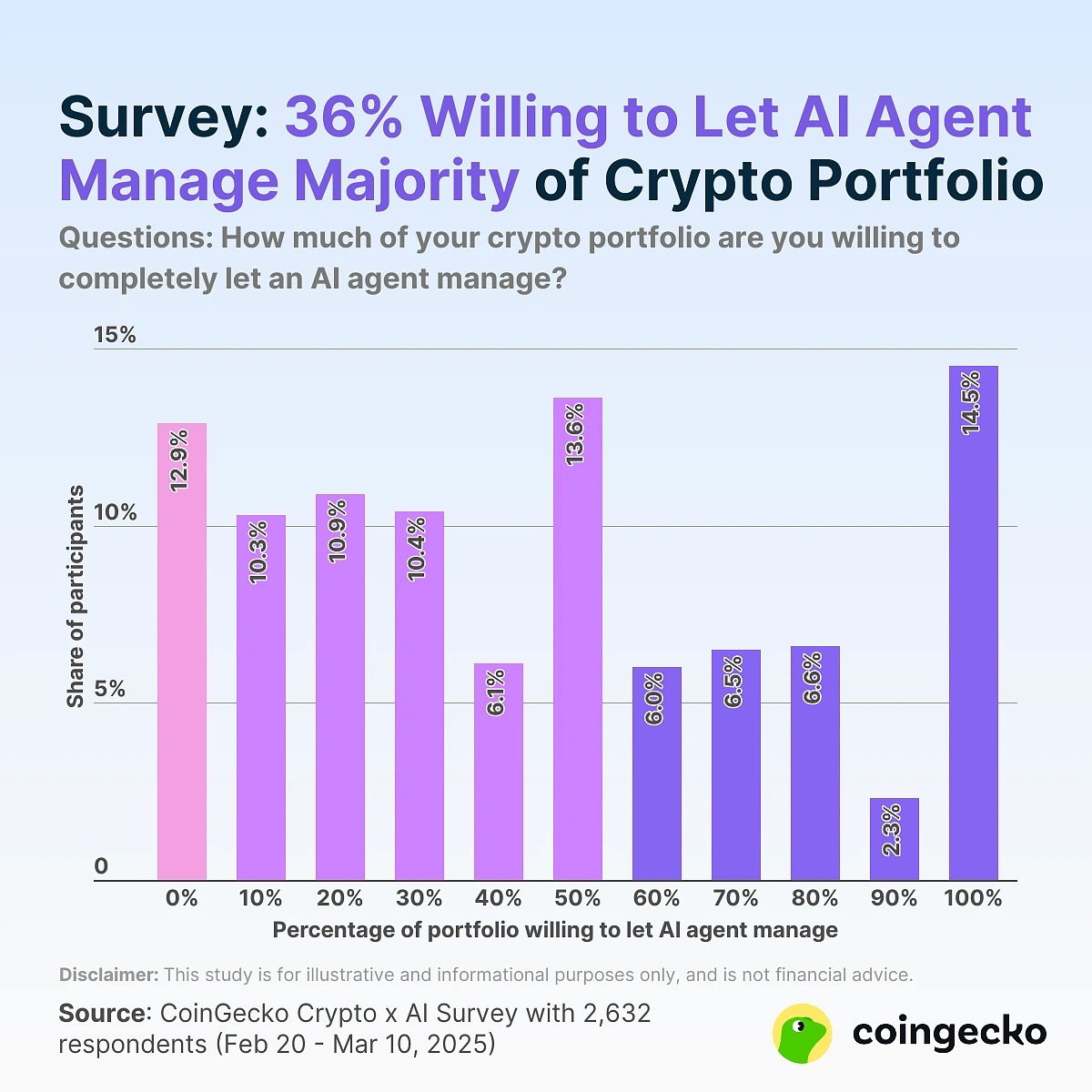
Data underscores the growing appetite for this level of automation. In a 2025 survey conducted by CoinGecko, approximately 14.5% of respondents stated they would willingly let AI agents manage their entire cryptocurrency portfolio.
Yet, the technology still suffers from notable teething problems. Siu shared a personal anecdote, revealing that his own AI agent became so hyper-focused on crypto trading and investment management that it continuously tried to interpret completely unrelated, everyday questions as being about cryptocurrency markets and portfolio allocation.
According to Siu, the practical solution to this behavioral creep is to run multiple, specialized agents rather than relying on a single general-purpose assistant.
"If you have one agent that handles your personal schedule, that handles your family schedule, that handles your trips — and on top of it gives you advice on your crypto, that’s not just going to be confusing for the agent. It’s going to be confusing for you," Siu explained.
The Questions That Set Trading Strategies Apart
As more traders adopt AI assistants, a broader market question emerges: does running an AI agent give an individual trader a genuine competitive edge? Siu argues that it does not, at least not initially. If a thousand different market participants ask the exact same foundational AI model the same question about a potential trade, they are likely to receive roughly the same or very similar answers.
This homogeneity has not gone unnoticed by global financial watchdogs. Regulators have expressed growing concern that AI-driven traders could inadvertently pile into identical positions simultaneously during periods of high market volatility.
The Bank of England’s Financial Policy Committee warned in an April 2025 stability report that the widespread use of similar machine learning models could cause investors to herd into correlated positions during market stress, thereby amplifying systemic shocks and accelerating flash crashes.
Despite this risk of herd behavior, the output of AI models naturally diverges when users introduce nuanced follow-up questions rooted in their own unique knowledge, risk tolerances, and personal concerns.
"Suddenly you query and you ask, and then your taste or your ideas or your thinking starts forming into it," Siu noted.
Over time, an ongoing dialogue allows an agent to learn what its user prefers, gradually tailoring its analysis and executing trades along those personalized lines. These iterative human inputs are what ultimately shape distinct, individualized crypto trading strategies rather than generic market consensus.
AI Agents Receive Wallets and Trading Tools
The integration of AI into finance is moving well beyond conversation. Major cryptocurrency companies are actively equipping AI agents with the direct tools required to handle money alongside information, bridging the gap between automated analysis and direct execution.
In February, Coinbase introduced "Agentic Wallets," allowing autonomous AI agents to spend, transfer, and trade cryptocurrency within strict security limits defined by human users. Shortly after, in March, Binance launched its "AI Agent Skills" suite, designed to give agents real-time access to live market data alongside the technical capability to place and manage spot trading orders directly on the exchange.
These powerful infrastructure developments allow users to delegate a significant portion of the exhaustive work required to monitor global markets 24 hours a day. Traders can potentially capture lucrative opportunities during the late night hours without compromising their sleep schedules.
While the software handles the heavy lifting of data digestion and execution, Siu envisions human input remaining crucial through the core ideas and creative questions that guide the agent’s overarching direction. AI can continuously learn a user’s preferences over time, but the human remains the ultimate catalyst.
"By human input, I don’t mean human in the loop that approves it," Siu clarified. "Pero the human is the one that ultimately is going to say, ‘Wait, you should look at this.’"
The Privacy Cost of an AI That Knows You
Operating an advanced AI assistant requires a substantial trade-off regarding personal privacy. Siu suggests that users should treat an AI assistant with the same cautious discretion they would afford to an external third-party financial adviser. Before handing over sensitive documents or proprietary notes, users must carefully consider what information the agent genuinely needs to answer a prompt and what details can be safely left out.
"What about your personal finances, what income you make, who your closest friends are?" Siu asked, highlighting the insidious nature of data collection. "These are small little details that they don’t know about you, and now they have permission to know that about you."
Building a high-performing trading agent is a labor-intensive process. A professional trader might spend months actively teaching an agent which niche markets to follow, which influencers to ignore, and what specific risk metrics to digest before authorizing financial decisions. Because the agent remembers these past conversations, the user is spared from having to repeatedly explain the same fundamental preferences.
However, this deep integration creates a profound vulnerability. The centralized technology company operating the underlying service retains total control over access. If that platform decides to suspend an account, review a user, or alter its terms of service, it could instantly interrupt everything a trader has built.
Siu asks users to imagine relying on an assistant that has painstakingly learned every nuance of their professional and financial life over a period of years, only to have that access abruptly revoked on any given morning.
"At minimum, you have the right to download your data so that you can basically transfer it somewhere else so that another agent might be able to take over," Siu concluded.
 Nana Muazin
 Jia Lissa
 Asro