
 By Evan Lee Salim

Bitcoin’s rebounding hashrate is serving as an “indirect bullish signal” from traditional financial institutions that continue to provide robust backing to publicly traded Bitcoin mining corporations, according to Ki Young Ju, the founder and CEO of blockchain analytics platform CryptoQuant.
The assertion highlights an intriguing dynamic within the digital asset ecosystem: while broader macroeconomic headwinds and inflation fears weigh heavily on public equities and mining stocks, the underlying infrastructure of the world’s largest cryptocurrency continues to strengthen in terms of raw computational power and network security.
“Higher hashrate means stronger security and better fundamentals as a store of value,” Ki wrote in a post on the social media platform X, emphasizing that he interprets the metric’s steady recovery as a clear vote of confidence from traditional finance (TradFi) institutions that heavily capitalize public mining operations.
To understand the significance of this metric, it helps to examine what hashrate actually measures. Hashrate is the primary indicator of the computational power driving a proof-of-work blockchain network. It quantifies how many hash calculations—essentially cryptographic guesses—are performed per second by mining rigs across the globe. A higher hashrate correlates directly with a more secure network, as it demands substantially more economic and computational resources for any malicious entity to attempt a 51% attack or disrupt transaction finality.
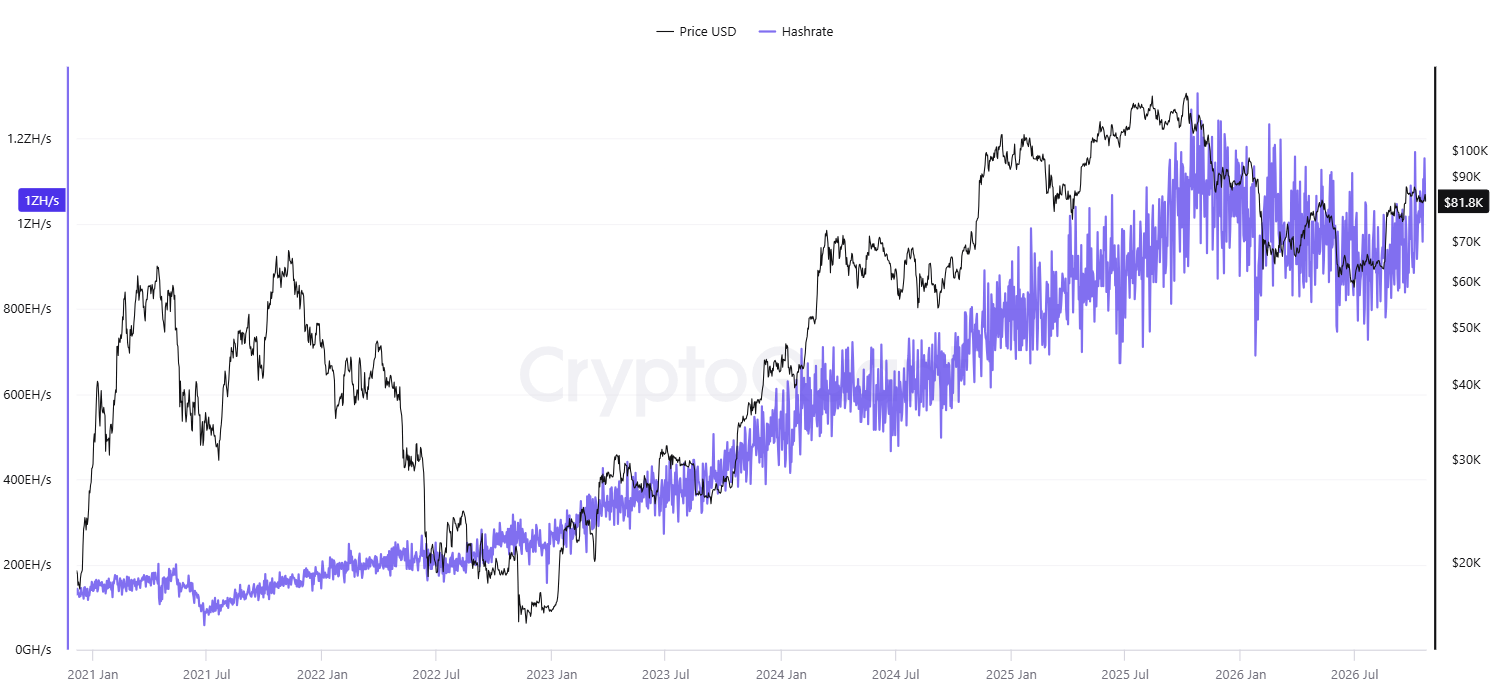
According to comprehensive network data provided by CryptoQuant, Bitcoin’s global hashrate has experienced a remarkable resurgence, recovering by approximately 45% from the lows recorded during the summer months. The metric climbed from a local trough of roughly 726 exahashes per second (EH/s) in July to approximately 1,050 EH/s.

Ki views this sharp upward trajectory not only as an institutional endorsement of Bitcoin’s long-term value proposition and network security, but also as a testament to the operational resilience and aggressive capital allocation strategies deployed by major mining entities.
Despite this robust recovery, the global hashrate remains below its all-time high of 1,305 EH/s, a milestone achieved in October when Bitcoin’s spot price was surging well above the $111,000 mark. By comparison, as the trading day opened on Wall Street, Bitcoin was exchanging hands at roughly $81,843, reflecting the broader price corrections experienced across digital asset markets over recent months.
NIP Group Expands Bitcoin Mining Capacity
Publicly traded Bitcoin miners continue to push forward with aggressive expansion plans, injecting fresh capital and hardware into the ecosystem and directly driving the upward momentum of the global hashrate. Among these players is Nasdaq-listed NIP Group, which recently announced a significant operational scaling initiative.
According to a corporate announcement, NIP Group has entered into a third tranche on-rack asset purchase agreement aimed at acquiring approximately 4.47 EH/s of fully operational, already-deployed Bitcoin mining hardware. Once the transaction formally closes, these newly acquired machines are expected to immediately bolster the company’s daily Bitcoin production output. Upon the completion of all three tranches, NIP Group’s total operating hashrate is projected to scale up to an impressive 13.85 EH/s.
This expansion places NIP Group within a competitive landscape dominated by massive industrial operators. Market intelligence data from Ziven indicates that NIP Group currently ranks as the 16th-largest public Bitcoin miner by operating hashrate, boasting a baseline of 3.11 EH/s prior to the finalization of its latest acquisition. At the upper echelon of the sector, industry giant Bitdeer commands the top position with an operating hashrate of 79.9 EH/s.
However, the aggressive expansion of mining infrastructure unfolds against a backdrop of severe equity market pressure. On the same day NIP Group announced its asset purchase agreement, its stock price experienced a sharp downturn, falling 6.8% to close at $6.10. This single-session drop extended a troubling trend for the equity, marking an 86% decline over the trailing twelve-month period, according to data from Yahoo Finance.
NIP Group was far from alone in feeling the pain. A broad-based selloff rippled across Wall Street, delivering the most severe equity contraction for US markets since July. The downturn was catalyzed by higher-than-expected macroeconomic inflation figures, which sent shockwaves through equities and placed intense downward pressure on both Bitcoin miners and artificial intelligence infrastructure firms—sectors that share intensive energy and capital expenditure profiles.
Major industry peers faced similar double-digit losses during the session. Publicly traded mining firms such as TeraWulf, Core Scientific, Cipher Mining, and IREN each watched their share prices plummet by roughly 12% as institutional investors reevaluated risk exposure in the face of persistent inflationary pressures and shifting monetary policy expectations.
 Neng Nana
 Jia Lissa