
 By Iffa Jayyana
The United Kingdom has launched a major economic strike against Cryptomus, a chameleonic cryptocurrency platform that security experts identify as a principal conduit for ransomware payments, narcotics trafficking, darknet markets, fraud, and illicit cybercrime services designed to help Russia circumvent international financial restrictions.
Announced on October 8, the British sanctions target Cryptomus—which has previously operated under the corporate aliases Certa Payments and Xeltox Enterprises—for processing high-volume transactions that directly benefit the Russian government and its sanctioned financial institutions. Under the terms of the new measures, any assets held by Cryptomus in British banks are frozen, and UK-based companies are strictly barred from conducting any form of business with the platform, whether virtual or traditional. Alongside Cryptomus, the UK government’s designations also hit several other associated virtual payment platforms, including VexPay, TokenSpot, and the Tsunami Payments service.
The crackdown underscores a mounting international effort to dismantle the financial scaffolding supporting the wartime Russian economy. According to data and insights from blockchain intelligence firms, Cryptomus has spent years acting as a core clearinghouse for illicit funds, facilitating the operations of numerous Russian crypto exchanges and underground sites peddling cybercrime tools.
Blockchain data-crunching firm Chainalysis emphasized in an October 8 advisory that the newly enacted UK sanctions strike directly at the broader infrastructure sustaining Russia’s war machine. Cryptomus and its spin-off services have emerged as massive payment hubs for unlawful activity, outstripping traditional crypto mixers in total volume across tracked illicit categories, with the number of illicit counterparties interacting with the network surging past 900 in a single month in late 2025.
Prior assessments by blockchain analysis firm TRM Labs revealed that since its inception in 2022, Cryptomus had processed upwards of $7 billion in cumulative transactions. This staggering volume included substantial flows tied to vendors of child sexual abuse material, international terrorist financing networks, and human trafficking operations. TRM Labs also noted that while Cryptomus experienced a temporary dip in transaction volume after instituting stricter "Know Your Customer" (KYC) policies, the platform routinely adapted to regulatory pressure by spawning alternative, non-compliant payment channels.

For blockchain investigators who have spent years mapping out the complex architecture of underground payment processors, the UK’s decision to apply full economic sanctions represents a critical turning point. Richard Sanders, a seasoned blockchain investigator who spent months tracing Cryptomus’s payment trails and transacting directly with its customer base, pointed out that previous regulatory penalties—such as the massive CAD $176 million fine levied by Canada in late 2025 for severe anti-money laundering violations—ultimately proved uncollectible and unenforceable in practice.
"A fine doesn’t stop a cryptocurrency payment processor from processing payments," Sanders wrote in a public assessment of the enforcement action. "Sanctions kill the operation. The distinction matters."
The operational lineage of Cryptomus has long been characterized by evasion and shell corporations. During previous investigative work, researchers discovered that Cryptomus shared a nominal Vancouver address with dozens of other foreign currency dealers and money transfer businesses, none of which maintained any physical presence at the location. When Canadian authorities hit the platform with their record-shattering penalty, Cryptomus appealed the fine while simultaneously launching a parallel, no-KYC payment service dubbed "Heleket," allowing it to continue processing vast volumes of high-risk transactions largely uninterrupted.
Sanders also highlighted the unique geopolitical significance of the UK’s action, noting it as the first known instance of a "Five Eyes" intelligence-sharing nation—comprising Australia, Canada, New Zealand, the United Kingdom, and the United States—formally sanctioning a cryptocurrency operation originally incorporated within another jurisdiction belonging to the same alliance.
The ability of entities like Cryptomus and Heleket to establish themselves and project international financial authority has long posed a puzzle to regulators. The answer, uncovered through deep corporate and infrastructural mapping, leads back to a web of phantom financial institutions overseen by a questionable regulatory body situated in a region with disputed sovereignty in northwest Africa: the Western Sahara.

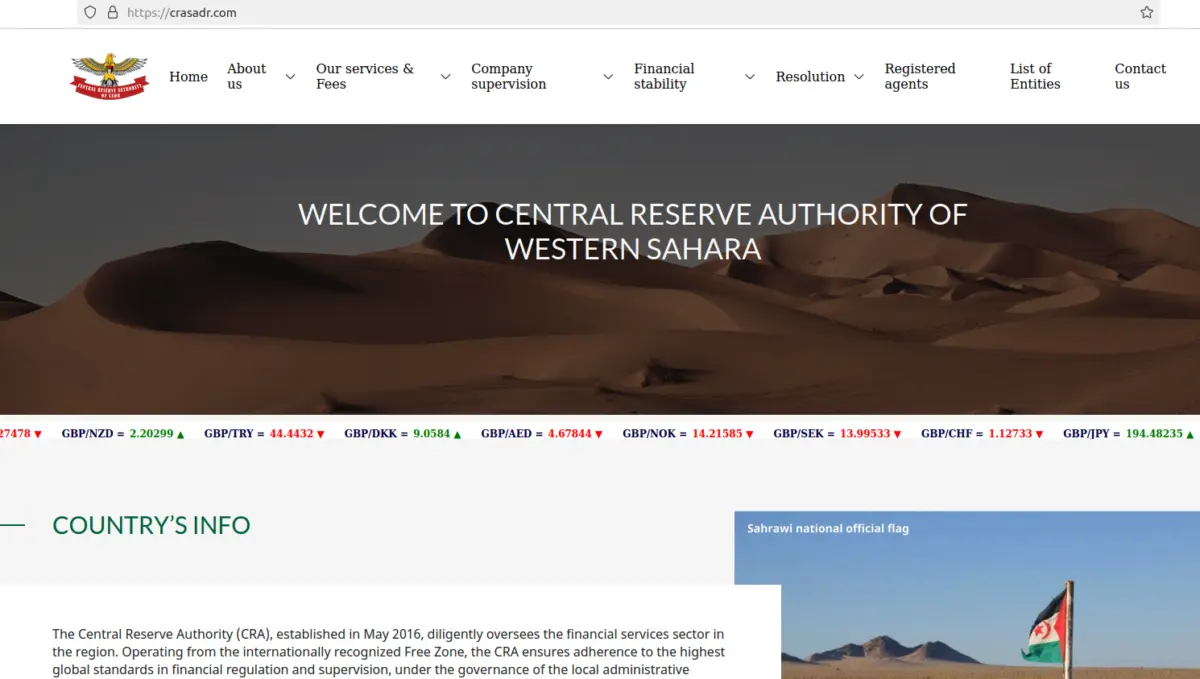
Investigations into the ownership structure of Cryptomus revealed that the sole shareholder of its parent company, Certa Payments, was a 25-year-old Ukrainian woman who simultaneously headed several other corporate entities. Among these was the WS Management and Advisory Corporation, an organization that markets itself as an exclusive regulatory body overseeing licensing for cryptocurrency firms, foreign exchange brokerages, and online gambling businesses incorporated within the Western Sahara territory.
The regulatory website operated by this entity, crasadr.com, explicitly claims to assist corporate applicants with bank account formation, online gaming licenses, and the establishment of foreign exchange brokerages. Furthermore, technical infrastructure analysis revealed that one of Certa Payments’ former web domains shared a server with a dozen other web properties, including rasd-state.ws, which serves as the online portal for the Central Reserve Authority of the Western Sahara.
Despite mounting public documentation, regulatory penalties, and now debilitating British sanctions, representatives associated with the platform’s ecosystem have frequently attempted to distance themselves from their operational history. Even as UK sanctions took effect and telegram support bots for Cryptomus abruptly stopped processing transactions on October 8, support agents for the parallel Heleket platform insisted in chat interactions—in defiance of all technical and corporate evidence—that their service maintained no affiliation with Cryptomus whatsoever.
 Asro
 Ammar Sabilarrohman
 Laily UPN