
 By Layla Zulfa

Business use of stablecoins is poised to experience a massive acceleration over the next 12 months as the adoption of digital currencies moves firmly into the corporate mainstream. According to a comprehensive new report released by payments infrastructure firm Cybrid, enterprises are increasingly turning away from legacy financial networks in favor of blockchain-based alternatives to handle their day-to-day transactions, driven primarily by significant cost reductions and unprecedented efficiency gains in international trade.
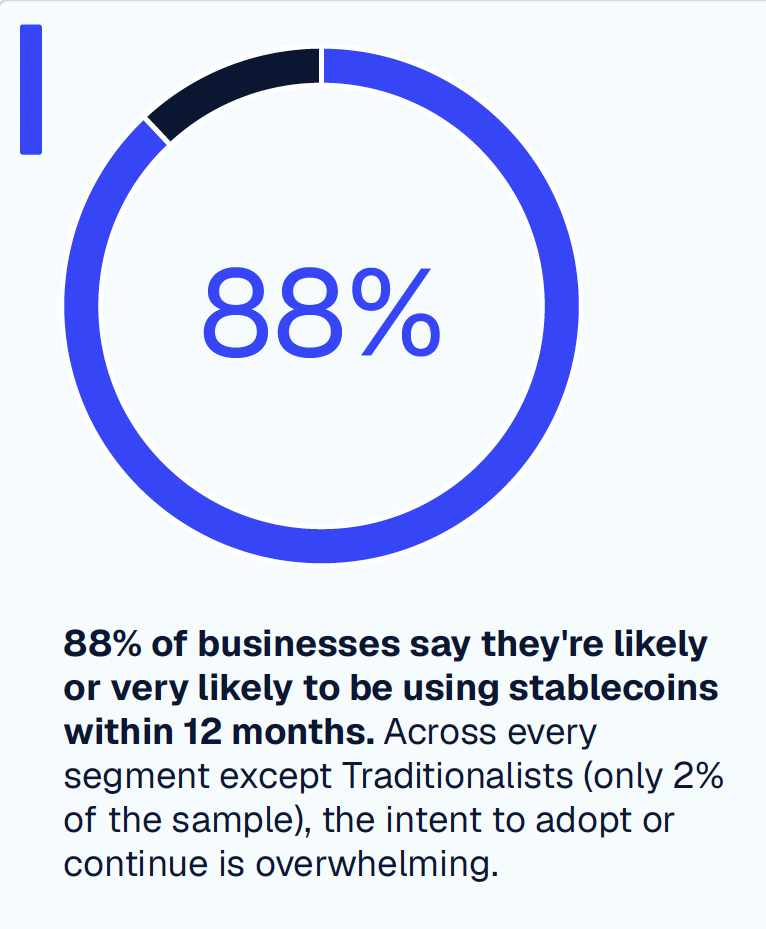
The Cybrid study reveals that 42% of businesses surveyed are already utilizing stablecoins for cross-border payments. Looking ahead, the sentiment toward future integration is overwhelmingly positive, with 88% of respondents stating that they are likely or very likely to implement stablecoins within the coming year. Perhaps most telling of the shifting tides within corporate finance is the finding that only 2% of surveyed executives identified themselves as committed users of traditional payment rails, signaling a profound erosion of confidence in legacy banking infrastructure for international settlements.
For the companies that have already made the leap, the financial incentives are clear. Businesses utilizing stablecoins reported average cross-border payment cost savings of 35%. Even more striking, enterprises processing more than $100 million in monthly payment volume reported average savings of up to 47%. These dramatic reductions in transaction fees and processing times are proving to be a powerful catalyst for executive boards looking to optimize their balance sheets and streamline global operations.
This corporate migration coincides with a period of substantial growth for the broader stablecoin market. The global stablecoin market capitalization currently sits at $307.64 billion, anchored heavily by market leaders Tether’s USDT, which commands a $184.7 billion market cap, and Circle’s USDC, sitting at $73.51 billion, according to data from CoinGecko. Furthermore, the market has received a distinct regulatory tailwind from recent legislative milestones. Stablecoins compliant with the GENIUS Act have reached a market cap exceeding $76 billion, effectively establishing the first federal regulatory framework for payment stablecoins in the United States and providing enterprises with a clearer legal foundation upon which to build their digital asset strategies.

The data compiled by Cybrid is drawn from a detailed survey of 468 executives and business leaders conducted between April 28 and May 4. The respondents represented a diverse cross-section of the technology, financial services, and e-commerce sectors across the United States, Canada, and the United Kingdom. Participants included C-suite executives, finance and treasury managers, and leaders overseeing corporate payments and operational strategies, ensuring that the findings reflect the practical priorities of those directly managing enterprise capital flows.
Varied Users Look for Regulatory Clarity to Gain Confidence
As businesses integrate stablecoins into their financial workflows, the range of applications continues to expand beyond simple international transfers. According to the survey, payroll and contractor payments emerged as the most common stablecoin use case among respondents. This was followed closely by supplier payments, customer payments, investment and yield generation, vendor payments, and broader treasury and liquidity management operations. Companies are finding that the programmability and round-the-clock availability of stablecoins offer distinct operational advantages over traditional banking hours and batch-processing systems.
Despite the rapid adoption and clear financial benefits, corporate leaders emphasize that certain hurdles remain before digital assets achieve absolute ubiquity in the boardroom. Regulatory clarity emerged as the single most critical factor that respondents said would increase their confidence in expanding their stablecoin usage. In fact, 71% of survey participants identified regulatory certainty as more important than partnering with trusted infrastructure providers or achieving seamless integration with existing enterprise resource planning systems. As governments around the world continue to debate and implement digital asset rules, corporate treasurers are watching closely for frameworks that mitigate compliance risks.
The demand for regulatory reassurance spans across all participating geographies and industries. Whether managing contractor payouts across North America or handling cross-border vendor settlements in the UK, finance leaders require assurance that their digital asset operations comply with evolving legal standards. The introduction of frameworks like the GENIUS Act represents a vital step in this direction, yet executives continue to advocate for cohesive, international regulatory alignment to fully unlock the potential of blockchain-based corporate finance.
Companies Expand Infrastructure for Stablecoin Payments
Broader industry metrics reinforce the narrative of rapid institutional and corporate adoption presented in the Cybrid findings. Separate data released in June by payments infrastructure provider Paybis highlights the dramatic shift in volume composition over recent years. According to Paybis, business customers accounted for nearly 98% of the stablecoin payout volume processed through its platform during the first four months of 2026. This represents a monumental leap from 2023, when business payouts accounted for just 36% of the platform’s total volume.
This surge aligns with broader macroeconomic estimates. Paybis cited research from McKinsey estimating that business-to-business transactions accounted for roughly 60% of the $390 billion in global stablecoin payment volume recorded throughout 2025. As these transaction volumes scale, financial institutions and technology providers are racing to build out the underlying infrastructure necessary to support enterprise demand.
The private sector has responded aggressively to this market demand through a series of high-profile product launches and institutional integrations. In May, Falcon Finance debuted its dollar-backed stablecoin, fUSD, utilizing Anchorage Digital Bank’s federally regulated issuance platform. The product was specifically engineered to target institutional trading, collateral management, and advanced corporate treasury workflows.
Traditional banking giants are also moving quickly to capture institutional stablecoin flows. BNY announced an expansion of its digital asset custody platform to incorporate support for Circle’s USDC. This integration allows institutional clients to securely store, transfer, mint, and redeem the stablecoin directly through the bank’s established custody infrastructure, bridging the gap between traditional institutional banking and the decentralized digital asset economy. As these institutional-grade rails continue to mature, the groundwork is laid for stablecoins to transition from an alternative financial tool into a foundational pillar of modern global commerce.
 Suro Senen
 Raul Delapena Setiawan
 Evan Lee Salim