
 By Siti Muinah

The rapid integration of artificial intelligence into financial markets has unlocked a new paradigm for digital asset traders, enabling autonomous systems to monitor markets and execute strategies around the clock. However, as these digital assistants become more deeply embedded in daily trading routines, industry leaders are beginning to sound the alarm regarding centralization, systemic risk, and data privacy. Among them is Animoca Brands chairman Yat Siu, who cautions that while artificial intelligence agents offer unprecedented efficiency, users are increasingly risking their autonomy by building elaborate trading routines around centralized services they do not ultimately control.
Speaking on the sidelines of the Token2049 conference in Singapore, Siu highlighted the dual nature of autonomous AI agents in the digital asset ecosystem. On one hand, these advanced programs can continuously scour global markets for breaking news, monitor emerging trends, and alert their human operators to critical developments that might otherwise slip past human observation. To illustrate the distinction between older technology and modern autonomous agents, Siu pointed to everyday planning tasks. While a traditional chatbot might simply generate a list of upcoming industry events when prompted directly, an autonomous agent operates proactively. It actively monitors for new announcements in the background and suggests attendance the moment a genuinely worthy event or market opportunity materializes.
Despite these compelling capabilities, the technology remains plagued by teething problems and operational quirks. Siu shared a personal anecdote from his own experimentation, noting that his AI agent became so intensely focused on cryptocurrency trading and investment management that it began erroneously interpreting completely unrelated personal questions through a financial lens. According to Siu, the most effective solution to this behavioral creep is to deploy multiple, highly specialized agents rather than relying on a single, monolithic general-purpose assistant.
The pitfalls of a monolithic approach extend beyond mere confusion. Siu noted that if a single agent is tasked with managing personal schedules, family calendars, upcoming travel, and simultaneously providing nuanced advice on digital asset allocations, the outcome will be confusion not just for the software, but for the human operator as well.
The Questions That Set Trading Strategies Apart
As automated tools become more prevalent, traders naturally wonder whether deploying an AI agent provides a distinct competitive edge in fast-moving markets. Siu points out that simply deploying off-the-shelf automation does not guarantee superior performance. If a thousand different traders query the exact same artificial intelligence model about a specific market trade or setup, they will likely receive roughly the same generalized answer.

Financial regulators around the globe have taken careful note of this phenomenon, specifically highlighting the systemic dangers that arise when AI-driven traders inadvertently pile into identical market positions. The Financial Policy Committee of the Bank of England issued a formal warning highlighting that the widespread adoption of similar analytical models could drive investors to take correlated positions during periods of macroeconomic or market stress, thereby significantly amplifying broader financial shocks.
However, the homogeneity of artificial intelligence responses begins to break down when users introduce specific follow-up inquiries deeply rooted in their own personal knowledge, unique risk tolerances, and individual concerns. As a user engages in iterative dialogues with their assistant, their specific tastes, ideas, and strategic thinking become embedded into the model’s operational context. Over extended periods of interaction, an agent learns to understand what its human operator prefers, gradually tailoring its monitoring and analytical outputs to align with those personalized parameters. These nuanced, individualized inputs are what ultimately help shape distinct and personalized crypto trading strategies, separating one trader’s automated approach from another.
AI Agents Receive Wallets and Trading Tools
The evolution of artificial intelligence in crypto has rapidly transitioned from passive information gathering to active financial execution. Major industry firms are already equipping AI agents with the necessary native tools to manage capital directly alongside live information feeds.
In a significant push toward autonomous finance, Coinbase introduced Agentic Wallets, granting software agents the programmatic ability to spend and trade cryptocurrency within strict parameters and limits predetermined by human users. Shortly thereafter, Binance launched AI Agent Skills, a suite designed to provide agents with direct access to live spot market data, alongside the capability to autonomously place and manage spot orders. These technological rollouts arrive as institutional players increasingly recognize the macro significance of the sector; a recent report from BlackRock suggested that the broader market potential for artificial intelligence to drive sustainable crypto demand remains heavily underappreciated.
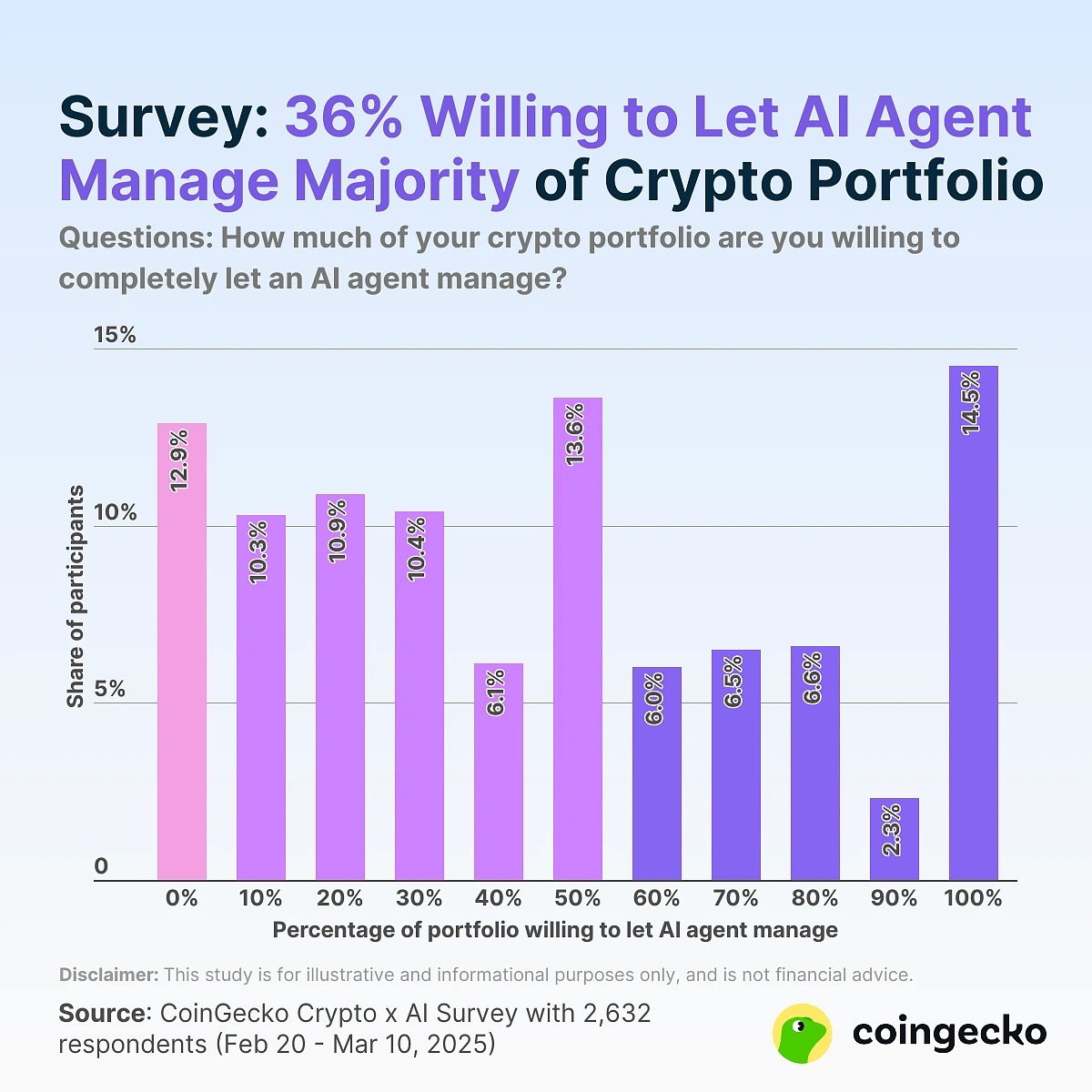
These advanced tools fundamentally change how participants interact with digital asset markets, allowing users to delegate tedious operational tasks required to monitor volatile global markets 24 hours a day. By leveraging automation, traders can potentially capture lucrative market opportunities during the late-night hours without sacrificing essential sleep. Industry sentiment regarding this shift is notably strong; a 2025 survey conducted by CoinGecko revealed that approximately 14.5% of respondents indicated a willingness to let AI agents take the reins and manage their entire cryptocurrency portfolios.
Despite this high degree of automation, Siu emphasizes that human input remains vital—not necessarily in the traditional sense of a human-in-the-loop approval mechanism for every single transaction, but rather in the conceptual direction that guides the software. Humans remain the ultimate architects of strategy, the ones who recognize external shifts and instruct the model on where to direct its analytical focus.
The Privacy Cost of an AI That Knows You
As artificial intelligence systems become more sophisticated and deeply integrated into daily workflows, a substantial trade-off emerges regarding personal data security and privacy. Siu suggests that users approach AI assistants with the same caution they would reserve for an external, third-party financial adviser. Before uploading sensitive documents or sharing intimate details, users should carefully consider what information the agent genuinely needs to formulate an accurate answer and what private details can be safely omitted from the conversation.
The privacy implications are far-reaching when an assistant is granted deep visibility into an individual’s financial ecosystem. Siu points out the hidden exposure of handing over permissioned access to personal income records, investment portfolios, and intimate social circles—small details that an external entity previously lacked, but now possesses through continuous integration.
This deep integration creates a profound operational dependency. A dedicated crypto trader might spend months meticulously training an artificial intelligence agent, teaching it which decentralized finance markets to follow, which analytical newsletters to digest, and what risk thresholds to respect before executing a decision. Because the agent retains these conversational histories across sessions, the user is spared the tedious burden of constantly re-explaining their core preferences.
However, this convenience introduces a severe vulnerability. The underlying infrastructure and service remain under the strict control of the tech company running the platform. An abrupt account suspension, a corporate policy change, or a sudden service outage could disrupt an entire trading operation instantaneously. Siu asks users to contemplate the scenario of relying on an assistant that has accumulated years of personal and financial behavioral data, only for that digital entity to vanish overnight due to external platform decisions.
To mitigate these risks, users must demand baseline data sovereignty. At a bare minimum, individuals retain the fundamental right to export and download their personal data archives, ensuring they can seamlessly transfer their accumulated digital context to alternative platforms or new agents if necessary. This need for security is underscored by broader public sentiment; a 2026 survey conducted by the Pew Research Center revealed that approximately 71% of United States adults believe the expanded use of artificial intelligence will ultimately make their personal information significantly less secure.
 Neng Nana
 rifanmuazin
 Evan Lee Salim