
 By Nana Wu

Cryptocurrency exchange Binance has officially reopened withdrawals across 15 blockchain networks following a devastating breach late last week in which North Korean hackers stole $6.3 billion from its hot wallets. Despite the historic scale of the security incident, the exchange reported a surprisingly modest net outflow as trading operations began to normalize.
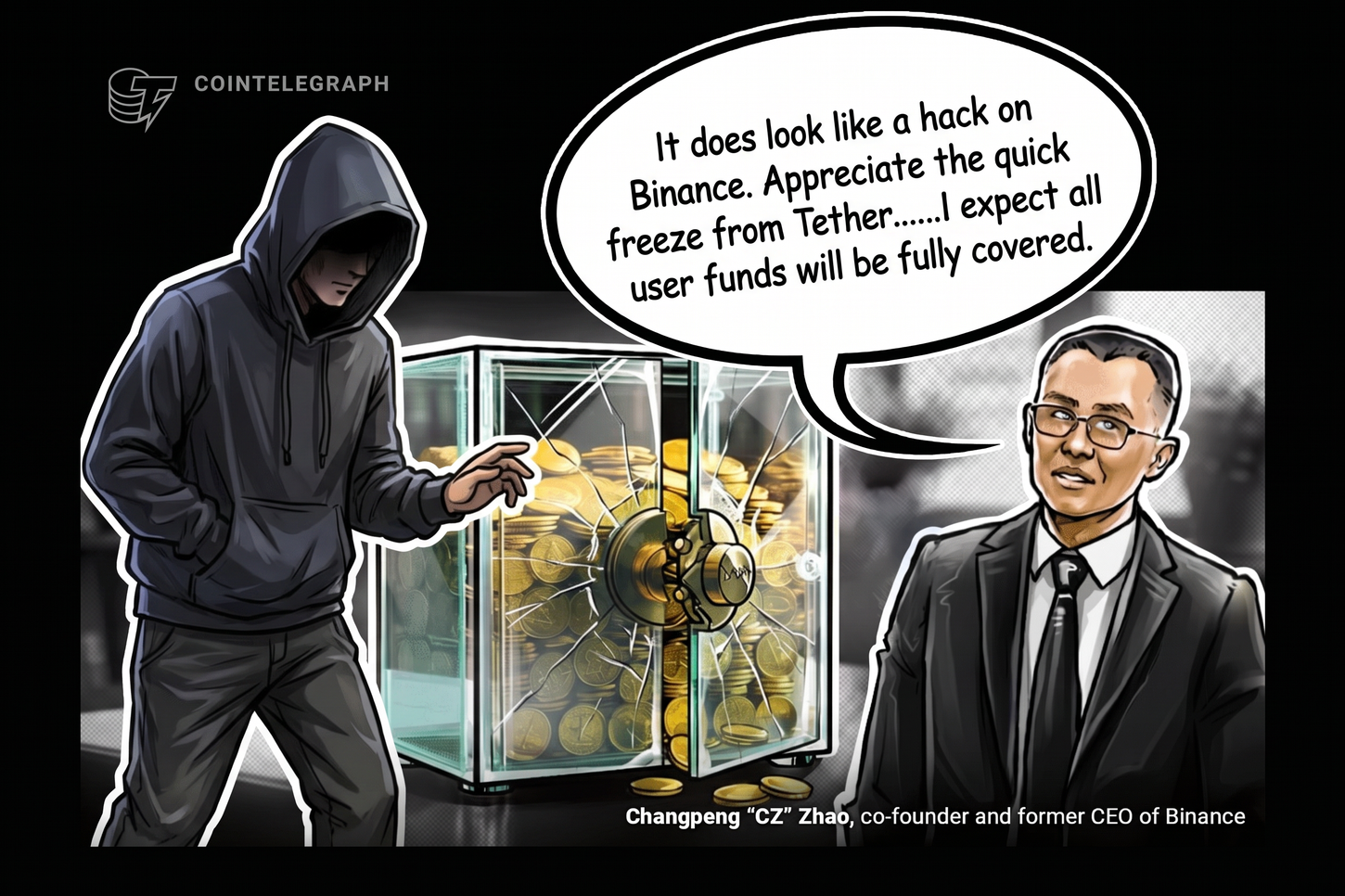
According to updates shared by Binance, the platform processed approximately $4.65 billion in user withdrawals after reopening, while simultaneously pulling in $1 billion in incoming deposits. Founder Changpeng Zhao noted that during the first 12 hours of reopened activity, the platform recorded only a 2.1% net outflow, emphasizing that the vast majority of clients maintained their trust in the exchange. "98% choose to stay," Zhao stated on social media.
Furthermore, Binance moved swiftly to mitigate the financial damage, confirming that approximately 95% of the stolen cryptocurrency has already been replenished. The recovery effort was funded through a combination of the exchange’s corporate reserves, insurance policies, and drawing upon 50% of the funds held in the Secure Asset Fund for Users (SAFU).
The security breach, now recognized as the largest hack in digital asset history, occurred on Thursday when North Korea’s notorious TraderTraitor group managed to compromise delegated wallet permissions via an infected laptop. Ido Ben-Natan, CEO of blockchain security firm Blockaid, explained that while the attackers could have executed the theft without relying on EIP-7702 account abstraction, the protocol feature likely streamlined their efforts, allowing them to bypass crucial safeguards and drain massive assets in a single, sweeping motion.

However, Binance co-CEO Richard Teng strongly rejected the narrative that the breach stemmed from a single point of failure or an isolated engineer’s compromised workstation. "To be clear: the attacker did not simply use one engineer’s permissions, and this was not a single ‘one-click’ action," Teng said, adding that ongoing internal investigations have not attributed direct responsibility to any individual employee.
FBI and Secret Service Step In to Recover Billions
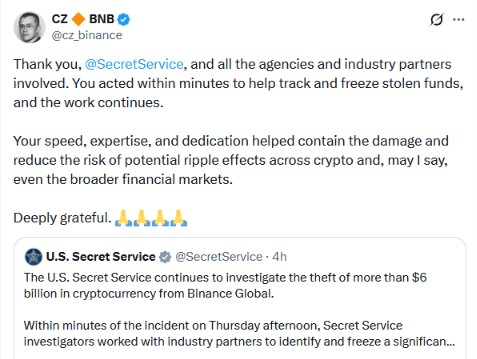
As the crisis unfolded, United States federal law enforcement agencies mobilized rapidly to assist the cryptocurrency exchange. Zhao publicly expressed gratitude to the United States Secret Service, thanking them for acting within minutes to help track and freeze stolen funds. "Your speed, expertise, and dedication helped contain the damage," Zhao noted.
Blockchain analytics firm Elliptic estimated that approximately $2.84 billion of the stolen assets—predominantly stablecoins such as USDC and USDT—were successfully frozen on-chain before the hackers could liquidate them. In a desperate race against time to evade these unprecedented stablecoin blockades, the attackers borrowed roughly $44.6 million worth of Ethereum against stablecoins on the decentralized finance lending protocol Aave.
The Federal Bureau of Investigation formally attributed the cyberattack to the TraderTraitor collective, a subgroup of North Korea’s Lazarus Group that has previously been linked to multibillion-dollar exploits targeting platforms like Bybit and Bitget. Addressing the geopolitical dimensions of the attack, President Donald Trump indicated that the administration intends to discuss the incident directly with North Korea.
In tandem with its attribution, the FBI published a comprehensive list of illicit addresses connected to the hack. The agency issued direct warnings to THORnode operators, RPC node operators, instant exchanges, decentralized finance services, and blockchain analytics firms, instructing them to block any transactions interacting with or derived from the flagged addresses.
THORChain Operators Face Tough Choice Over Freeze Requests
The North Korean hackers have historically utilized decentralized protocols like THORChain to execute permissionlessly cross-chain swaps following major exploits. Anticipation of heavy transaction fee generation even caused the price of THORChain’s native token, RUNE, to jump 13% immediately following the news of the Binance hack.
However, the perpetrators faced immediate operational hurdles. Nine major chains supported by THORChain, including Bitcoin, Ethereum, and Tron, were already temporarily halted due to unrelated automated system pauses triggered shortly after the breach occurred.
Chad Barraford, a core THORChain developer, noted on the Unchained podcast that the protocol relies on roughly 50 individuals operating approximately 100 THORChain nodes. Given the unprecedented scale of the theft and the active involvement of agencies like the FBI and Secret Service, node operators who refuse to halt the protocol or block the hacker’s addresses could potentially face regulatory scrutiny or legal pressure.
Conversely, THORChain founder JP Thor—who has maintained that he is no longer operationally involved with the protocol—argued passionately that node operators must resist calls for cooperation to preserve the core tenets of decentralization and permissionlessness. "IMO if THORNodes decided to take the protocol offline next week then the experiment is over," Thor said, warning that doing so would spell the end for the last bastion of unencumbered and neutral settlement.
Despite the debate, THORnode operators retain the technical capability to vote with a two-thirds majority to halt the network or simply disconnect if they object to processing illicit funds, as the protocol can technically function with as few as four active nodes. Meanwhile, blockchain tracking firm Lookonchain reported that the attackers have also leveraged the cross-chain platform Relay to convert roughly $95.9 million of stolen Solana into Bitcoin.
Broader Market Fallout and Legislative Pressures
The fallout from the historic hack extended far beyond Binance, triggering a sharp sell-off in crypto-related equities including Coinbase, Circle, and MicroStrategy, while broader digital asset markets experienced a temporary downturn. Nevertheless, some industry executives urged calm, with Strive CEO Matt Cole noting that Bitcoin demonstrated remarkable resilience under pressure. "I do have conviction that over any reasonable time frame, this does not change the investment thesis on Bitcoin," Cole remarked. Bitcoin ultimately found a price floor around $76,500 before recovering to trade near $77,745.
Amid the market turbulence, Nasdaq-listed Next Technology Holding announced that its board of directors approved the liquidation of its entire Bitcoin treasury, consisting of 5,833 BTC valued at approximately $450 million. With the hackers currently controlling an estimated 18,000 Bitcoin and 430,000 Ether—with some external tallies placing the figures even higher—market analysts remain wary of the potential downward price pressure should those assets eventually flood the open market.

The magnitude of the breach also breathed new life into regulatory discussions. Senator Cynthia Lummis and advocacy group The Digital Chamber renewed their pushes for comprehensive cryptocurrency legislation aimed at bolstering security standards, preventing future systemic exploits, and mitigating the fallout from large-scale cyberattacks.
Tampered Trezor Wallets Linked to Reseller Probe
In an unrelated security development that compounded industry anxieties, hardware wallet manufacturer Trezor urged customers who purchased devices from former authorized reseller CryptoBilis since March to immediately secure their funds following the discovery of a suspected physical tampering incident.
Trezor reported that a customer in Indonesia identified an unauthorized circuit board inside a Trezor Safe 5 device purchased via Tokopedia in August. While Trezor noted it had not yet physically examined the compromised device or received reports of direct financial losses, the warning follows similar disclosures from competitor Ledger regarding compromised hardware units originating from the same reseller network.
Market Performance and Expert Outlooks
By the end of the week, major digital assets remained under downward pressure. Bitcoin registered a 3% weekly decline to trade at $77,745, Ethereum dropped 3.5% to $2,260, and XRP slid 3.9% to settle at $1.02, bringing the total cryptocurrency market capitalization to $2.21 trillion. Outperforming the broader market, top altcoin gainers for the week included Hyperliquid, Midnight, and Pepe, while Curve DAO, VeChain, and Worldcoin faced the steepest losses.

Looking ahead, industry analysts suggest the incident could permanently alter the competitive landscape between centralized and decentralized trading venues. Standard Chartered analyst Geoffrey Kendrick argued that the Binance breach will likely accelerate a structural migration toward decentralized exchanges, reiterating his long-term price target for Uniswap and its UNI token. "The decentralized exchange has never had any exploits, and the hack of the largest centralized exchange should see the ratio of DEX to CEX trading continue to increase," Kendrick said.
At the same time, regulatory bodies continue grappling with emerging technological threats. Commodity Futures Trading Commission Chairman Mike Selig warned during a recent address that autonomous artificial intelligence agents could soon challenge financial regulatory frameworks traditionally designed around human traders. Selig noted that while advanced AI systems can drastically improve risk management and information processing for smaller participants, autonomous trading speeds and correlated algorithmic behaviors introduce unprecedented market surveillance and stability risks.
Compounding the week’s security concerns, blockchain analytics firm Chainalysis confirmed it was targeted in a cybersecurity incident, echoing similar breaches experienced by other tech platforms. The company stated that an internal investigation found no unauthorized access to core investigation data, authentication credentials, or session tokens, though limited non-sensitive customer information, including user IDs, names, and email addresses, was exposed. Chainalysis emphasized that the incident was entirely unrelated to the ongoing Binance hack investigations.
On the legal front, federal authorities secured significant convictions related to targeted cryptocurrency crimes. Raymond Christian Garcia and Isiah Angelo Garcia of Waller, Texas, were sentenced to 180 and 186 months in federal prison, respectively, for their roles in an armed cryptocurrency robbery and the kidnapping of a family in Grant, Minnesota. Court documents revealed that the brothers held the family captive at gunpoint for over nine hours, using zip ties to coerce the primary victim into granting access to valuable digital asset accounts.
 Nana Muazin
 Nana