
 By Basiran
Google announced today that it has successfully worked alongside a coalition of industry partners to dismantle a sprawling botnet consisting of more than 1.3 million Android TV set-top boxes. These devices are shipped directly from manufacturers with pre-installed malicious software designed to secretly rent out users’ residential internet connections to anonymous third parties while simultaneously conducting widespread advertising fraud.
Cybersecurity experts involved in the complex operation indicate that this coordinated action will likely sever the botnet’s access to more than 10 million additional compromised systems. These secondary targets include a wide array of Internet of Things (IoT) products, ranging from Android-based healthcare and telehealth devices to commercial karaoke machines and digital signage systems.
A comprehensive report published by the Google Threat Intelligence Group (GTIG) revealed that Google has officially severed all business ties with Videostrong Technology Co., a prominent TV box manufacturer based in China. GTIG and other independent industry experts concluded that Videostrong was directly responsible for embedding the malicious code that automatically enrolled more than 1.3 million set-top boxes into a dangerous botnet dubbed “XCPE,” a name derived from one of the malware’s core functional components.
The GTIG report details how the XCPE botnet automatically populates an infected user’s device with proxy software that makes their unique internet protocol address available for resale by multiple commercial “residential proxy” services. These services allow external customers to rent consumer internet addresses as a mechanism to anonymize their web traffic, obscure their digital footprints, or spoof their true geographic locations.
As documented extensively by cybersecurity researchers over the past several years, residential proxy services have emerged as a major vector for unwanted and illicit traffic. This abuse routinely facilitates account takeover attacks, sophisticated advertising fraud, and massive automated web scraping operations executed to feed resource-hungry artificial intelligence projects.
According to the GTIG analysis, Videostrong actively monetized the hardware backdoor built into its products by selling access to various criminal affiliates and loading those affiliates’ distinct malware modules directly onto unsuspecting users’ devices. To counteract this threat, Google pursued legal action to successfully seize the control domains and backend infrastructure that Videostrong utilized to manage the botnet and push further malicious payloads.

Google’s security team emphasized the gravity of the situation, noting that a hardware manufacturer intentionally infecting its own consumer base with malware represents an extraordinary and unacceptable breach of trust. Without the knowledge, awareness, or consent of the consumer, these compromised devices were systematically transformed into distribution nodes for a diverse ecosystem of criminal actors.
While standard TV streaming boxes comprised the overwhelming majority of the botnet’s footprint, researchers discovered that the exact same XCPE malware variant was embedded in a variety of other Android-based IoT hardware. This expansive reach included specialized telehealth and medical monitoring devices, commercial karaoke machines, and complex digital display networks found in public spaces.
Google maintains strict requirements that all hardware manufacturers building devices powered by Android must successfully pass rigorous compatibility and security evaluations to ensure their products do not pose risks to consumers. However, investigators discovered that Videostrong managed to circumvent these safeguards by engineering its software to load the malicious payload immediately upon a user booting up the device for the first time. Google confirmed that it has since updated its verification and security protocols to address and close this specific vulnerability.
The GTIG report explicitly calls out several residential proxy providers whose software development kits were routinely downloaded and executed by devices trapped within the XCPE botnet. Among those named is AppSalt, also widely known as Honeygain, which is owned by Oxylabs, a prominent proxy and data-gathering firm based in Vilnius, Lithuania. Oxylabs was recently relaunched under a new corporate brand called Source following a substantial $130 million funding injection from private equity firm Warburg Pincus, a transaction that reportedly valued the enterprise at approximately $3.6 billion. Oxylabs did not respond to requests for comment regarding its inclusion in the security reports.
Another major proxy provider linked directly to the botnet infrastructure is NetNut, a sprawling residential proxy enterprise formerly operated by Alarum Technologies, a publicly traded firm in Israel. In July of this year, the Federal Bureau of Investigation collaborated with industry cybersecurity partners to seize hundreds of internet domains associated with NetNut. At the time, law enforcement and security analysts stated that the company was responsible for operating a separate, parallel botnet called Popa, which similarly enslaved standard consumer TV boxes to serve as residential proxies. Additional proxy vendors identified in the GTIG report include EarnFM, Traffmonetizer, Jaguar, LINKFOG, BMW/IPWeb, and GaGaNode.
Google’s formal announcement credits a wide network of industry collaborators, including Synthient, a specialized cybersecurity startup that tracks the operations of proxy providers. Earlier this year, Synthient published groundbreaking research tracking the explosive and rapid spread of the Kimwolf botnet, which at the time was bombarding global networks with record-breaking distributed denial-of-service attacks. Synthient documented how Kimwolf managed to infect millions of Android set-top boxes almost overnight by exploiting widespread security vulnerabilities within residential proxy services, allowing the malware to jump across local home networks and compromise secondary connected devices.
The fallout from Synthient’s research forced dozens of residential proxy providers to rapidly patch their networks. This intervention fragmented the Kimwolf botnet into smaller, isolated clusters, rendering its relentless DDoS attacks significantly easier for network operators and internet service providers to mitigate. The research also attracted the attention of the Motion Picture Association, a major trade organization representing Hollywood film studios. The MPA partnered with Synthient to acquire and physically tear apart popular Android TV set-top boxes, uncovering deep hardware-level infections tied to Kimwolf and other criminal IoT botnets.

In a companion technical report published concurrently with Google’s announcement, Synthient examined a popular, pre-infected streaming device sold under the brand name MECOOL by Skyworth Technology, a publicly traded company based in China. Synthient concluded that MECOOL hardware similarly bundled the malicious firmware originating from Videostrong Technology Co., which quietly installed AppSalt, Honeygain, and other auxiliary proxy components without user awareness.
Ben Brundage, founder of Synthient, told investigators that Videostrong’s backdoor distribution network also actively distributed software for another prominent proxy service known as Grass. Previous security investigations into similar streaming hardware revealed that popular devices like the Superbox streaming box also bundled Grass residential proxy software, though representatives for Grass consistently denied any formal business affiliation with the hardware manufacturers.
Market analysis revealed that brands like Superbox and MECOOL achieved explosive commercial popularity primarily by leveraging online influencers across social media platforms such as TikTok and YouTube. These influencers frequently praised the devices for offering hundreds of premium pay-TV streaming channels and live sports broadcasts for a single, low upfront fee, circumventing traditional subscription models through unauthorized pirated feeds.
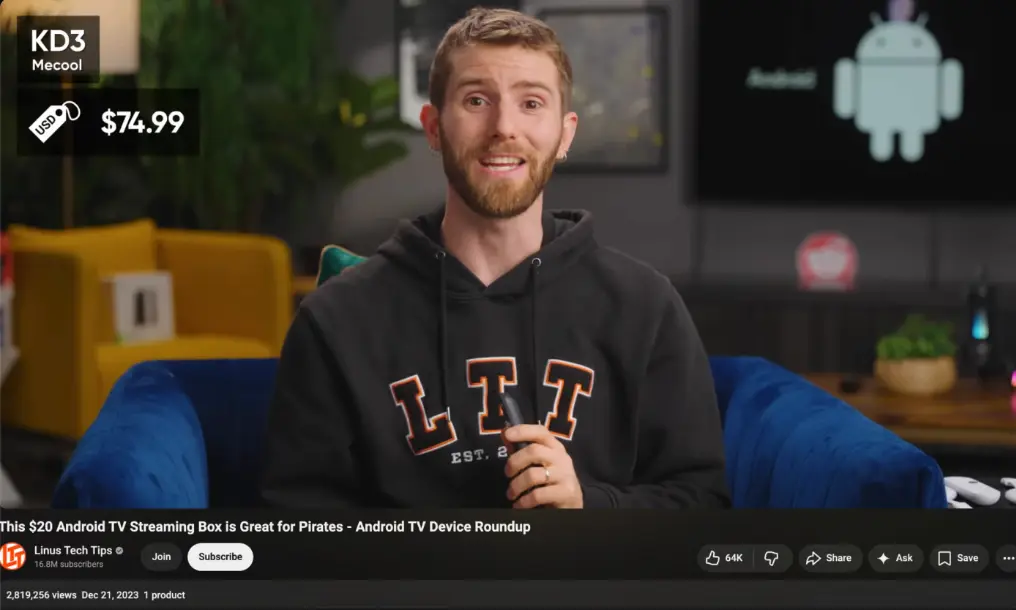
For instance, MECOOL set-top boxes experienced a massive surge in sales after being featured in a video produced by the popular technology channel Linus Tech Tips, which commands an audience of nearly 17 million subscribers. Representatives for Linus Tech Tips shared a statement with researchers indicating that the channel has since updated the historical video to explicitly frame the product as a security risk and scam, while removing all associated affiliate purchase links.
While Google’s confirmed disruption successfully severed the primary command-and-control infrastructure for 1.3 million active devices, the GTIG report emphasizes that the total impact is far more expansive. The various proxy and ad fraud affiliates tied to Videostrong each maintain diversified distribution channels for their respective software modules that extend well beyond the XCPE framework.
Synthient’s Brundage echoed this assessment, characterizing the official 1.3 million device figure as a highly conservative estimate of the true operational scope. Given the pervasive nature of pre-installed supply chain infections across the consumer streaming market, security experts agree that this coordinated takedown represents one of the largest and most significant enforcement actions launched against backdoored consumer TV hardware to date.
 Asro
 Ammar Sabilarrohman
 Laily UPN