
 By Suro Senen
The United Kingdom has levied severe economic sanctions against Cryptomus, a chameleon-like digital asset platform that blockchain intelligence experts identify as a critical conduit for ransomware payments, narcotics trafficking, darknet markets, and cybercrime services allegedly helping Russia bypass international financial restrictions.
Announced on October 8, the U.K. government measures target Cryptomus—which has previously operated under the corporate monikers Certa Payments and Xeltox Enterprises—for processing high-volume transactions that directly benefit the Russian government and its financial institutions. The sweeping sanctions immediately freeze any assets held by Cryptomus within British financial institutions and legally prohibit U.K. companies from engaging in any business dealings with the platform, whether virtual or traditional. In addition to Cryptomus, the U.K. government targeted several associated virtual payment platforms in the coordinated action, including VexPay, TokenSpot, and the Tsunami Payments service.
The crackdown underscores the growing international scrutiny facing unregulated and semi-regulated cryptocurrency processors that act as financial bridges between global cybercriminal underworlds and traditional banking systems. As detailed in a December 2024 investigative report titled “How Cryptocurrency Turns to Cash in Russian Banks,” Cryptomus has long served as a primary payment infrastructure provider for dozens of Russian cryptocurrency exchanges and underground websites hawking illicit cybercrime tools and services.
Operating with a high degree of fluidity, the platform has repeatedly rebranded since emerging in 2022. Most recently, it spawned a parallel service known as “Heleket” last year, a move triggered after Canadian regulatory authorities levied a record-shattering CAD $176 million fine against Cryptomus for severe anti-money laundering violations.
Major blockchain analytics firms have emphasized the systemic importance of the U.K.’s latest regulatory intervention. According to Chainalysis, the sanctions strike directly at the complex digital infrastructure supporting Russia’s wartime economy and broader illicit transnational networks.

In an October 8 blog post analyzing the move, Chainalysis noted that Cryptomus and its offshoot Heleket have evolved into paramount payment hubs for illicit digital currency transactions. The blockchain data firm reported that, combined, these linked services received a higher volume of illicit funds across tracked categories than traditional cryptocurrency mixers in their dataset, with the number of unique illicit counterparties surging past 900 in a single month during late 2025.
Parallel findings from TRM Labs in April 2026 revealed that Cryptomus had processed more than $7 billion in overall transactions since its inception four years prior. This staggering cumulative volume included substantial financial flows associated with vendors trading child sexual abuse material, international terrorist financing networks, and clandestine human trafficking operations.
TRM Labs further observed that while Cryptomus experienced a temporary slump in transaction volumes after instituting stricter "Know Your Customer" (KYC) verification rules, the platform deftly circumvented regulatory pressure. Rather than complying with global financial transparency standards, the enterprise responded to Canada’s historic fine by launching Heleket as a parallel operational entity, ensuring that illicit actors could continue executing transactions without submitting to identity checks.
Richard Sanders, an experienced blockchain analyst and investigator who spent months mapping the intricate contours of Cryptomus’s payment infrastructure and interacting directly with its clientele, pointed out that the U.K. sanctions carry far more weight than previous financial penalties. Specifically, Sanders noted that Canada’s massive monetary fine against the platform ultimately proved unenforceable and uncollectible in practice.
Writing on LinkedIn following the U.K. announcement, Sanders explained the strategic distinction between financial penalties and asset freezes. A fine, he noted, does not inherently stop a determined cryptocurrency payment processor from continuing to process transactions, whereas targeted sanctions fundamentally cripple the underlying operation.
Echoing findings from earlier investigative journalism, Sanders highlighted that Cryptomus initially shared a registered Vancouver address with dozens of other foreign currency dealers and money transfer businesses—none of which maintained a physical presence at the location. Following the imposition of Canada’s CAD $176 million penalty for alleged money laundering violations, the platform’s operators appealed the decision, spun up the Heleket platform to maintain business continuity, and continued processing large volumes of high-risk transactions.

Furthermore, Sanders emphasized that the U.K. action marks a historic milestone in international law enforcement, representing the first known instance of a "Five Eyes" intelligence-sharing nation—comprising Australia, Canada, New Zealand, the United Kingdom, and the United States—formally sanctioning a cryptocurrency operation incorporated within the jurisdiction of another Five Eyes partner.
The sprawling corporate lineage of Cryptomus and Heleket raises fundamental questions regarding how obscure entities manage to secure official authorization to offer international financial services. Investigators have found that the authority behind these platforms relies heavily on fabricated financial institutions overseen by a phony regulatory body positioned within a territory that lacks widespread recognition as a sovereign nation.
An earlier investigation revealed that the sole shareholder of Certa Payments, the parent company of Cryptomus, was a 25-year-old Ukrainian woman who simultaneously served as the head of several other corporate entities. Among these was the WS Management and Advisory Corporation, an organization that markets itself as an exclusive regulatory body overseeing licensing for cryptocurrency exchanges, foreign exchange brokers, and online gaming businesses supposedly incorporated within the disputed northwest African region known as Western Sahara.
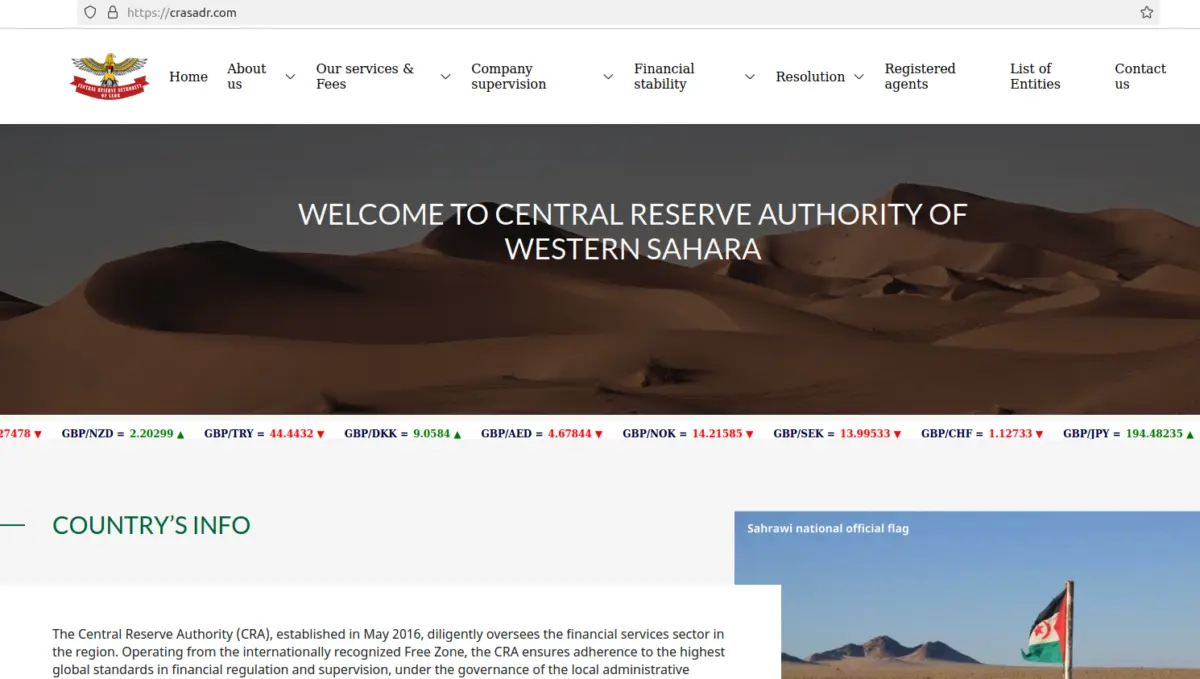
The digital footprint of this regulatory facade points toward a web of dubious administrative structures. The official website of this self-styled authority, operating under the domain crasadr.com, explicitly claims to assist applicants with corporate bank setup, formation, online gaming permits, and the establishment of foreign exchange brokerages. Furthermore, historical infrastructure linked to Certa Payments—including a former site registered as certa[.]website—shared a server hosting environment with twelve distinct domains, notably featuring rasd-state[.]ws, which serves as the designated web portal for the purported Central Reserve Authority of the Western Sahara.
 Pevita Pearce
 Asro
 Jia Lissa