
 By Laily UPN

Decentralized finance (DeFi) protocols could soon have a powerful new tool in their defense arsenal against exploits, malicious actors, and state-sponsored hackers. Unveiled in November, a security system developed by Phylax introduces a block-level interception mechanism designed to stop harmful transactions before they can officially settle on the blockchain.
While the technology promises to mitigate massive financial losses from exploits—such as those linked to North Korean hackers and United States-sanctioned entities—it has simultaneously ignited a fierce debate across the crypto community. Critics warn that the infrastructure could introduce unintended freeze risks and exacerbate existing centralization pressures within Ethereum’s block-building market, raising critical questions about where robust security ends and harmful censorship begins.
The core tension centers on the delicate balance between protecting user capital from increasingly sophisticated attacks and preserving the core decentralized tenets of public blockchain networks. As security researchers, legal experts, and protocol developers weigh the pros and cons, the debate underscores the difficult compromises the industry faces as it matures.
A Security Mechanism with a Potential Freeze Risk
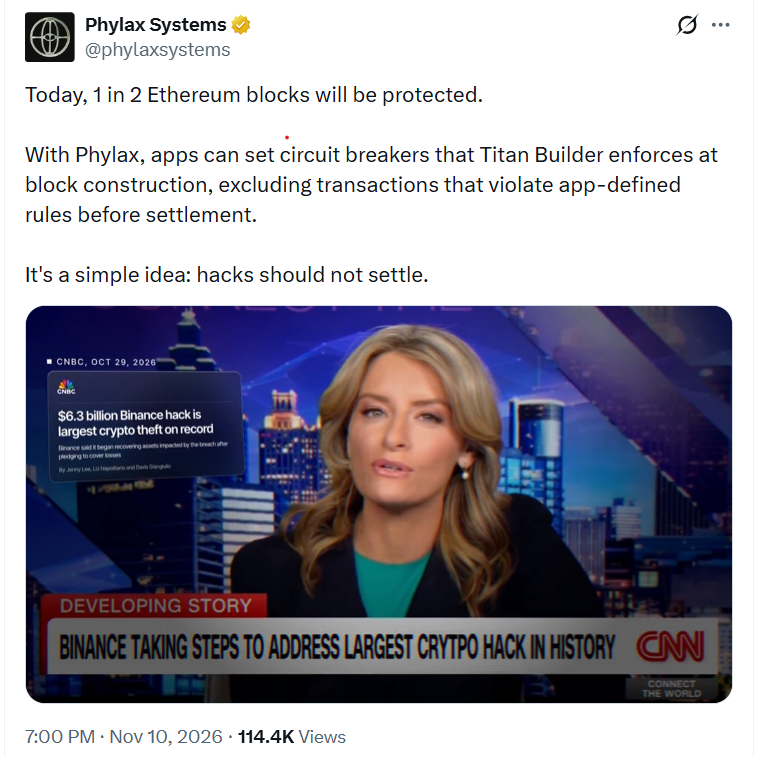
Announced on Nov. 10, the integration between Phylax and major block builder Titan Builder allows Ethereum-based applications to define custom rules that automatically exclude transactions with potentially harmful outcomes during the block construction phase. Titan Builder, which according to Phylax processes roughly half of all Ethereum blocks, evaluates incoming transactions against these pre-defined security parameters before packaging them into blocks.
The overarching philosophy of the system is to prevent exploits from settling on-chain rather than relying on reactive monitoring systems or emergency governance interventions after an attack has already begun. The team behind the project stated that their primary mission is to stop
users from losing money to hacks and errors in the fast-paced DeFi ecosystem.
To illustrate how the system functions in practice, Phylax outlined a scenario involving a vulnerable smart contract vault that might mistakenly release $1 million to a user whose deposited shares are worth only $1.000. With the circuit breaker operational, a rule could be triggered to cap the amount leaving the vault in a single transaction, thereby halting the exploit and protecting protocol liquidity.
Similar proactive safeguards could theoretically limit the devastating impact of major historical hacks, such as the massive Binance exploit or the Bitget incident, where malicious actors drained exchange wallets and attempted to launder enormous sums through decentralized liquidity pools and protocols.

However, this proactive approach comes with potential structural vulnerabilities. Digital assets lawyer Gabriel Shapiro warned in public commentary that applications utilizing the system could become effectively freezable if block builders suddenly stopped providing the required cryptographic attestations.
According to Shapiro, smart contracts can be configured to reject transactions unless they are included in blocks produced by builders that have performed the necessary security validations. If those builders halt their attestations, the protected functions within the smart contract could persistently reject legitimate and illegitimate transactions alike until normal operations resume.
Odysseas Lamtzidis, the founder and chief executive officer of Phylax, countered that protocols can easily mitigate this risk by designing their systems to allow transactions to proceed even when the security checks are temporarily unavailable. He explained that the sane default provided and suggested to protocols is a fail-open behavior.
Even so, Lamtzidis noted that this safeguard remains optional, leaving individual protocols to decide how much priority they wish to assign to security versus continuous availability. Some protocols might deliberately choose to prioritize strict safety over liveness, while others may opt for a more permissive stance. Furthermore, protocols retain the autonomy to determine whether their smart contracts are completely immutable or subject to modification via decentralized governance.
Shapiro has argued that fail-open protections should ideally be mandatory, and any modifications to these critical safeguards should be subjected to mandatory time delays to prevent protocols from removing them hastily during a crisis.
Ethereum’s Builder Concentration Problem
Beyond the immediate mechanics of circuit breakers and smart contract availability, the Phylax system has also cast a spotlight on broader structural concerns regarding Ethereum’s heavily concentrated block-building market.
Fan Zhang, an Ethereum researcher, noted that technology like Phylax is only becoming practically feasible because of the existing centralization within Ethereum’s builder ecosystem. While acknowledging that the approach offers appealing security benefits—particularly in an era where artificial intelligence bots can discover smart contract bugs faster and more efficiently than ever before—Zhang cautioned that introducing additional code at such a critical juncture in transaction processing creates new potential failure modes. These include subtle implementation errors, as well as the risk of builder signing-key theft, loss, or impersonation.
Zhang expressed concern that the broader community is actively working to address the risks of centralized builders, and introducing systems that rely heavily on a small subset of dominant builders might inadvertently undermine those mitigation efforts.
Another Ethereum researcher, Sen Yang, echoed these sentiments, pointing out that if major DeFi protocols begin relying heavily on a small, select group of builders for security enforcement, it could grant those builders an unfair competitive advantage. This dynamic could further entrench market concentration rather than alleviating it.
Yang noted that while Ethereum’s proposed enshrined proposer-builder separation (ePBS) upgrade—slated for inclusion in the upcoming Glamsterdam network upgrade—may reduce reliance on third-party relays, it does not directly solve the underlying issue of builder market concentration. Nevertheless, he suggested that transactions excluded by a dominant builder could theoretically still be included by non-censoring builders, resulting in temporary transaction delays rather than permanent exclusion from the ledger.
Where Does Security Become Censorship?
The debate over the Phylax system inevitably circles back to the foundational question of whether automated transaction filtering crosses the line into censorship.
Proponents of the technology argue that it does not introduce a new governing authority or centralized censor over Ethereum transactions because the applications themselves voluntarily define the rules. Lamtzidis emphasized that the technology is explicitly opt-in, comparing the automated checks to conditional logic already embedded within smart contract code. He noted that it functions no differently than a standard require statement, and that true censorship implies arbitrary decision-making or external coercion.
Zhang drew a similar philosophical distinction between applications willingly choosing to filter transactions and external entities forcing censorship upon an unwilling network. As long as applications voluntarily sign up for filtering, users retain the freedom to walk away and use alternative platforms. The problem arises when censorship is externally forced upon the ecosystem.
Stefanie Boss, co-author of academic research focusing on censorship resistance and compliance behavior within Ethereum’s consensus mechanism, offered a pragmatic perspective on the trade-offs involved. She noted that rules targeting the specific outcome of a transaction are generally considered less risky than rules targeting the identity of the person making the transaction.
While Boss acknowledged that the question is not just whether there is risk, but whether it is an acceptable risk, she ultimately leaned toward acceptance given the magnitude of the problem. She argued that the overarching goal is to make the network safer and more closely aligned with the values of the applications built upon it, especially since the financial and systemic harm caused by major hacks far outweighs the inconvenience of this type of transaction exclusion.
However, Boss also issued a cautionary note, warning that rules designed for security could theoretically be repurposed down the line to enforce regulatory sanctions or politically motivated exclusions. Because of this potential slippery slope, she stressed the importance of establishing robust governance safeguards to ensure that such rules remain fair, transparent, and strictly dedicated to network security.
 Pevita Pearce
 Nana Muazin
 Nana Wu