
 By Asep Darmawan

For a long time, the prevailing vision for onchain foreign exchange (FX) began at the very top of the traditional financial hierarchy. The assumption was straightforward: major global banks would tokenize sovereign currencies, large financial institutions would migrate their massive foreign exchange operations onto public or private blockchain rails, and institutional liquidity would naturally follow in their wake.
The ultimate destination of this top-down approach was thought to be a blockchain-based FX ecosystem that eventually scaled large enough to mirror its traditional, multi-trillion-dollar counterpart. However, according to Curve Finance and Yield Basis founder Michael Egorov, that is not necessarily how the market is going to evolve. In a new analysis, Egorov argues that there are growing signs pointing in the exact opposite direction, suggesting that onchain foreign exchange is developing organically from the bottom up.
This grass-roots development is already visible across various decentralized finance ecosystems. Regional stablecoins—such as the Brazilian Digital token (BRZ) or Monerium’s euro-backed EURe—can be rapidly redeemed onchain and seamlessly moved between digital non-custodial wallets and traditional bank accounts. These assets generate healthy, consistent trading activity as everyday DeFi users actively swap them within decentralized exchange (DEX) liquidity pools.
Rather than waiting for top-down mandates from legacy institutions, these digital markets are developing in real time around a very practical, everyday user need: the ability to move funds directly and efficiently between digital currencies and local fiat money. While this phenomenon remains an early-stage example of blockchain adoption, the underlying use cases and economic demand are entirely genuine.
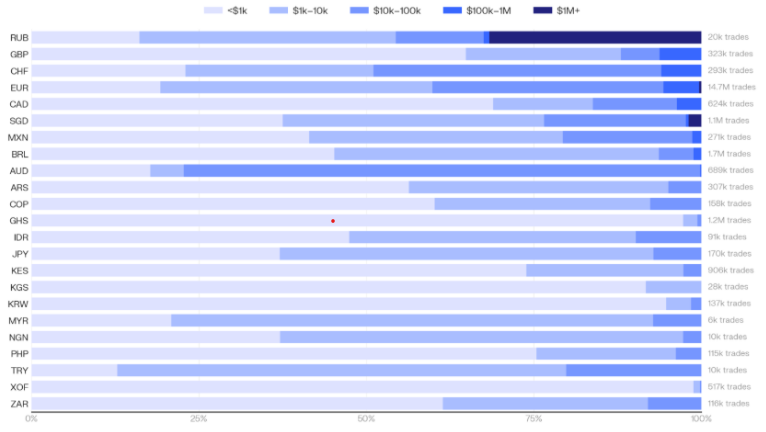
Recent data from market-making and digital asset firm Keyrock indicates that the vast majority of onchain stablecoin trades tied to emerging market currencies fall comfortably into the $1,000 to $10,000 range. While these sums are undeniably modest when compared to institutional-scale transactions, that is precisely the point. The data demonstrates how the market is building outward in the general direction of onchain FX to satisfy immediate, practical payment needs, rather than waiting exclusively for institutional whales and high-frequency corporate traders.
‘Small’ Is Not the Same as ‘Useless’
Individuals and modern businesses constantly need to move their capital across international borders and between different national currencies. Evidently, these market participants are no longer content to sit idly by while waiting for major traditional finance (TradFi) institutions to slowly migrate their legacy foreign exchange operations onto modern blockchain rails.
A common misconception persists regarding onchain FX: the belief that a market requires immense, institutional-grade liquidity before it can become genuinely useful to the broader public. In practice, however, that assumption is entirely false. If there is genuine, organic demand from an individual who needs to exchange US dollars into euros, Swiss francs, or any other regional currency, even a relatively modest liquidity pool can successfully process those transactions and serve a profoundly real economic purpose.
Onchain foreign exchange does not need to achieve massive global scale before it becomes useful. Instead, it can grow organically precisely because people are actively using it to solve real-world problems.

As a matter of fact, this trajectory mirrors the historical evolution of stablecoins themselves. They initially began as a relatively niche, crypto-native use case designed primarily for traders wanting to park funds outside of volatile assets. Today, however, those same stablecoins are recognized as foundational components of a much broader, highly resilient global financial infrastructure.
Recent data published by blockchain analytics firm Chainalysis illustrates the staggering velocity of this adoption, revealing that global cross-border stablecoin activity surged to over $220 billion by mid-2026. This milestone represented an astonishing growth rate of nearly 80% over the course of a single year, offering definitive proof that economic demand and transactional activity are continuously on the rise. There is little reason to doubt that onchain foreign exchange can follow a remarkably similar, organic path to widespread adoption.
The User Does Not Care How Big the Market Is
Examining the issue from a purely practical perspective highlights the core utility of these systems. Onchain FX will not realistically be able to compete with the sheer volume of the entire global foreign exchange market anytime soon—that milestone remains years away. But a much more compelling question is what immediate problems decentralized exchange rails can solve for someone who already maintains capital onchain.
Today, users can seamlessly exchange a USD-backed stablecoin into a EUR-backed stablecoin—or another supported alternative—directly onchain, utilizing those funds for everyday payments with minimal friction. In practice, executing transactions in this manner is frequently much faster and noticeably cheaper than relying on classic international bank wire transfers.
The exact same operational logic applies to broader onchain FX applications. A modern fintech platform or crypto-card issuer does not need to recreate the entire institutional foreign exchange market from scratch; what they fundamentally require is an efficient mechanism to move their customers’ funds smoothly between different currencies.
When a consumer attempts to make a purchase in a foreign currency using traditional payment rails, the conversion process often introduces significant overhead costs. Traditional card networks like Visa or Mastercard typically tack on cross-border and currency conversion fees that hover around 1% per transaction.
Onchain exchanges present a far superior option for these operational bottlenecks. When user funds already reside natively on blockchain rails, swapping USD stablecoins into EUR stablecoins can be accomplished directly, bypassing the need to involve traditional intermediary payment processors. This peer-to-peer approach is both significantly faster and substantially less expensive.
Traditional commercial banks will most likely remain vital entry and exit points where digital money must interact with the physical, legacy world. Issuing and redeeming local fiat currencies, maintaining traditional bank accounts, and handling stringent regulatory compliance are areas where banking institutions will continue to take the lead.
However, once capital has successfully transitioned onto the blockchain, many of the traditional, expensive in-between steps can be discarded entirely in pursuit of greater operational efficiency. From the vantage point of an everyday user who simply wants to conduct a financial transfer with minimal complications and delays, this represents a major qualitative improvement. How large or small the overarching global FX market happens to be matters very little in such scenarios.
Demand Is Only Half the Problem
Realizing this vision is not without its hurdles, as organic demand represents only half of the equation. While genuine commercial demand is absolutely crucial, it does not magically solve the complex engineering and economic problem of maintaining deep liquidity. The primary challenge is not merely spinning up a EUR/USD or CHF/USD liquidity pool, but rather structuring those pools in a way that makes them economically sustainable for participants over the long term.
This is precisely where automated market makers (AMMs) can fundamentally shift the dynamics. Traditional institutional market-making firms may find it commercially unappealing to provide liquidity for smaller, niche FX pairs, as there may simply not be enough daily trading volume to justify the substantial operational and capital costs.
Automated liquidity alters that financial calculation because specialized software can provide continuous, programmatic liquidity without requiring a centralized market-making firm to manually manage every individual trade around the clock.
Consider two dollar-pegged stablecoins, such as USDC and Tether. From the analytical perspective of a traditional, legacy foreign exchange desk, moving capital from one dollar stablecoin into another might appear to be a remarkably mundane and unrewarding business. Both assets are explicitly designed to maintain a stable value of roughly one US dollar, meaning there is very little price volatility or spread to trade around for profit.
Nevertheless, if there remains a genuine, everyday need for market participants to switch between different stablecoins of ostensibly equal value, an automated market maker can easily establish a pool where users can execute that swap directly. Every individual trade generates a modest fee distributed to liquidity providers, and when a sufficient number of market participants require the exact same conversion, a viable market can thrive even if it looks unexciting to traditional institutional market makers.
This style of adoption cannot accurately be described as explosive, but there is also inherent merit in slow, organic growth. Frequently, emerging financial markets require nothing more than a dedicated core group of users who share a persistent problem that legacy financial infrastructure fails to solve efficiently. If those users can render the market economically viable through their steady activity, deeper liquidity can organically blossom from there.
 Laily UPN
 Sagoh
 Suro Senen