
 By Pevita Pearce
Decentralized liquidity protocol THORChain is currently navigating a critical recovery phase following a security breach that resulted in the theft of approximately $10.7 million. The exploit, which was first brought to public attention by prominent blockchain investigator ZachXBT, targeted one of the protocol’s primary vaults by exploiting a vulnerability within its GG20 threshold signature scheme (TSS). The incident has reignited broader industry conversations regarding the security assumptions of cryptographic frameworks used across decentralized finance (DeFi), coming amid what data indicates is a resurgence in crypto exploits throughout the sector.
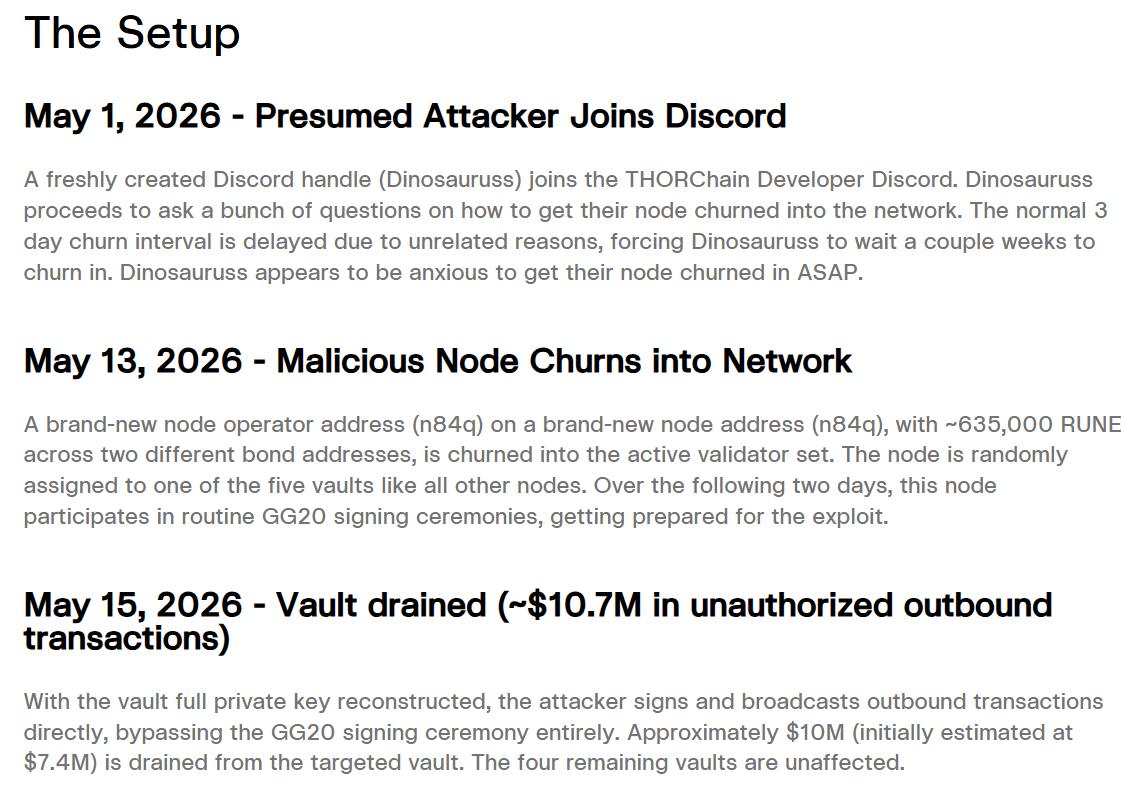
According to a detailed post-mortem report released by THORChain on Wednesday, the security breach was orchestrated by a malicious node operator. The attacker took advantage of a vulnerability in the GG20 threshold signature scheme—a cryptographic system designed to secure THORChain vaults by splitting key control across multiple independent node operators. Under normal operating conditions, this multi-party computation ensures that no single node ever holds the full private key, thereby decentralizing trust and safeguarding user assets.
However, the protocol explained that the exploit allowed the malicious participant to reconstruct a full private key for a targeted vault through a process known as "progressive key material leakage." Despite the severity of the attack, THORChain’s incident response mechanics demonstrated structural resilience. The protocol’s automated solvency checks triggered within minutes of the anomalous activity, halting signing and trading across multiple connected chains without requiring human intervention. Promptly following the automated safeguards, node operators coordinated via Discord to achieve a full network halt within two hours of the initial detection, after which a patch was deployed to address the vulnerability.
The post-mortem report confirms that these automatic solvency mechanisms successfully functioned as intended, preventing the exploiter from draining additional funds from the protocol. The incident arrived shortly after blockchain investigator ZachXBT flagged the $10 million exploit on social media, which immediately preceded THORChain’s official announcement freezing all cross-chain trading and signing operations. The breach contributes to a broader wave of security incidents impacting the digital asset landscape, adding to figures compiled by DefiLlama showing that more than $634 million was stolen across various exploits.
THORChain weighs recovery path without RUNE sales
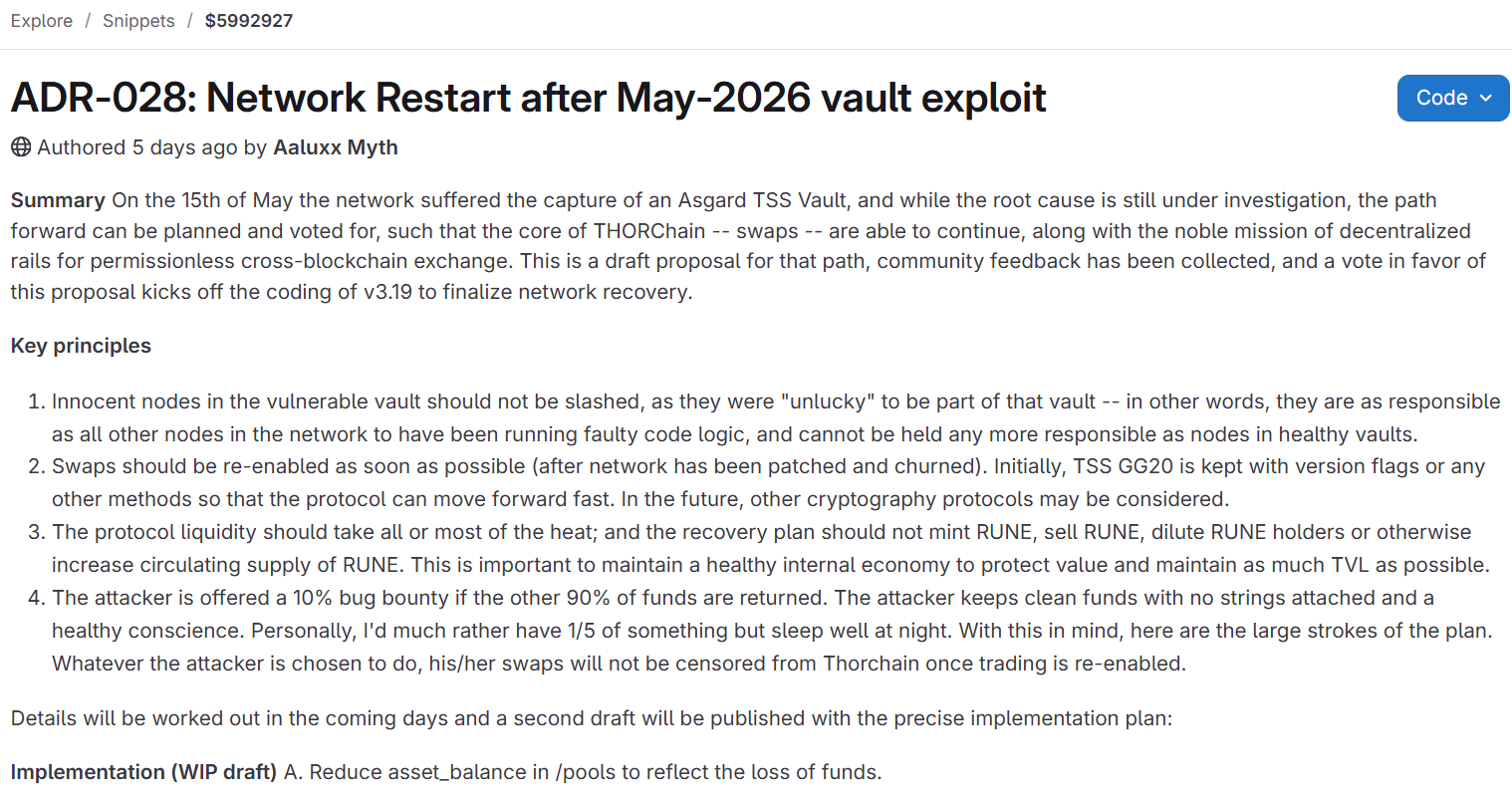
As the protocol works to move past the security incident, THORChain announced on Friday that its post-exploit recovery path will be determined entirely by community consensus. To formalize this approach, the protocol published governance proposal ADR-028, with voting currently open for node operators to decide the financial remedy for the protocol.
The governance proposal outlines a multi-layered absorption strategy. Under ADR-028, THORChain would absorb the financial losses first through its protocol-owned liquidity, while spreading any remaining deficit across synthetic asset holders. This mechanism would deplete the existing protocol-owned liquidity pools; however, it would simultaneously redirect a portion of ongoing protocol income to replenish those reserves over time. Crucially, the proposed recovery path achieves this without the need to mint or sell additional THORChain (RUNE) tokens into the open market, thereby avoiding direct downward pressure on the native asset.
In tandem with the governance vote, THORChain offered a recovery bounty aimed at incentivizing the return of the stolen funds. The protocol also confirmed that it would aggressively slash the stake of the malicious node involved in the exploit while taking measures to protect innocent nodes that happened to be placed in the same vault as the attacker.
ADR-028 proposes maintaining the existing GG20 threshold signature scheme framework, albeit in an upgraded and patched version, with cross-chain trading slated to resume only after the underlying vulnerability is fully resolved. Explaining the reasoning behind sticking with the current cryptographic standard, THORChain co-founder Chad Barraford noted in an interview that moving to an entirely new standard carries its own set of unproven risks. Barraford stated that while transitioning to the DKLS threshold signature scheme had been on the protocol’s roadmap for the year and temporarily pushed aside due to other competing priorities, the team is now taking a much closer look at DKLS and other alternatives.
The decision to retain an upgraded version of the GG20 framework has elicited mixed reactions from security researchers and market observers. Pseudonymous crypto project analyst Bird noted that the nature of the initial vulnerability points toward a potential flaw in randomness generation or local signing isolation within the GG20 stacking infrastructure. At the same time, the analyst praised THORChain’s automated safeguards for effectively limiting the overall magnitude of the damage.
Other industry participants adopted a more critical stance regarding the long-term viability of the cryptographic scheme. Expressing skepticism on social media, crypto investor JP argued that the GG20 framework relies on brittle assumptions that make it difficult to secure permanently, characterizing ongoing patches as a temporary fix for a complex architectural black box.
Market data reflects the immediate impact of the security breach on investor sentiment, even as the protocol charts its course toward recovery. The price of the native RUNE token experienced a 15.5% decline over the week following the exploit. However, subsequent market activity showed signs of stabilization, with the token staging a 4% recovery in the 24 hours leading up to Friday morning, according to figures from CoinMarketCap.
 Ali Ikhwan
 Neng Nana
 Suro Senen