
 By Iffa Jayyana

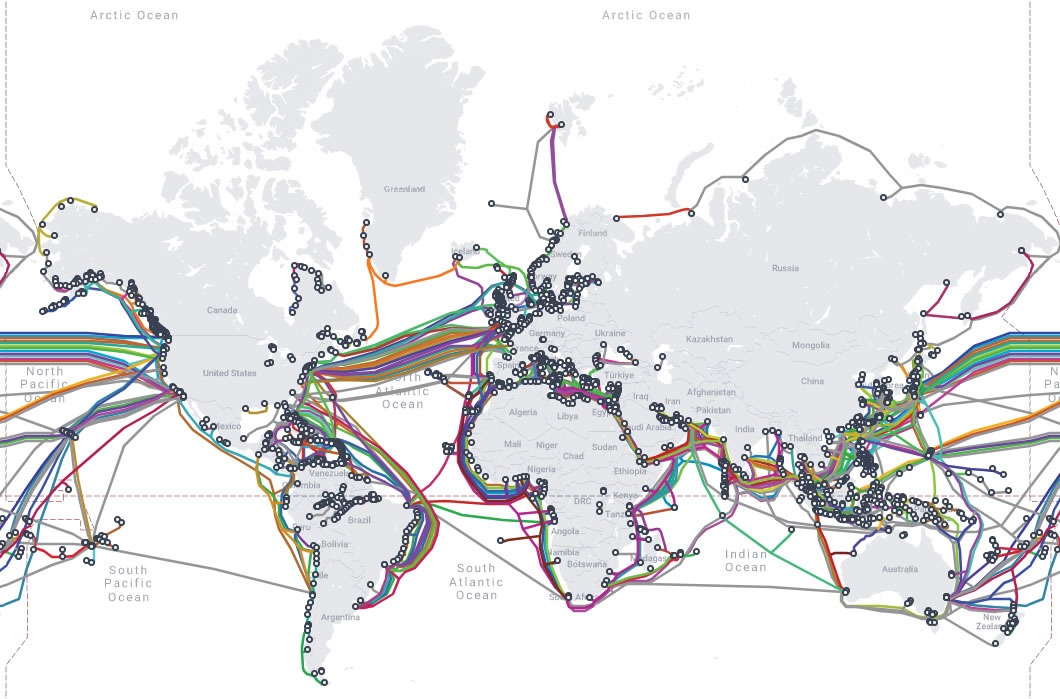
Nearly three-quarters of all undersea fiber-optic internet cables—the vital marine conduits that carry approximately 99% of all international internet traffic—would need to experience catastrophic failures before the Bitcoin network suffered any significant operational disruption. This striking conclusion comes from a comprehensive academic study released earlier this year, shedding new light on how decentralized digital currencies interact with the physical architecture of global telecommunications.
In research first published in February and most recently revised on March 12, researchers Wenbin Wu and Alexander Neumueller from the Cambridge Centre for Alternative Finance undertook a rigorous examination of Bitcoin’s physical infrastructure resilience. To evaluate how the decentralized peer-to-peer network would weather severe telecommunications blackouts, the researchers utilized extensive P2P network data spanning from 2014 to 2025. By pairing this historical dataset with 68 verified historical submarine cable fault events, they applied a sophisticated country-level cascade model to simulate wide-scale network stress.
The study marks the first longitudinal examination of Bitcoin’s structural robustness against submarine cable failures. For years, industry analysts, critics, and enthusiasts alike have debated a lingering, fundamental question: What would happen to Bitcoin and its globally distributed ledger if the internet experienced a massive, widespread physical disruption? By systematically analyzing historical data and simulating systemic failures, the Cambridge researchers have provided concrete empirical answers to this long-standing question, offering a reassuring picture of the cryptocurrency’s underlying infrastructure.
Random Failures Versus Targeted Chokepoints
To measure the breaking point of the network, the researchers evaluated two distinct scenarios: random cable disruptions and targeted attacks against critical physical infrastructure. Their findings revealed a stark contrast between how the decentralized network handles diffuse damage versus concentrated sabotage.

When simulating random cable removal, the researchers found that the critical failure threshold sits between 0.72 and 0.92. This means that a staggering 72% to 92% of all inter-country submarine cables across the globe would need to fail simultaneously before more than 10% of the network’s active nodes became disconnected from one another. Because Bitcoin nodes are distributed across numerous continents, overlapping internet pathways, and diverse regional networks, the system exhibits remarkable fault tolerance against accidental, widespread infrastructure damage.
However, the Cambridge study also identified a notable vulnerability: the network is significantly more susceptible to targeted attacks directed at specific, highly concentrated subsea cable chokepoints. According to the research paper, targeted disruptions are an order of magnitude more effective at damaging network connectivity, with a much lower critical failure threshold ranging from 0.05 to 0.20. This indicates that while the global architecture is brilliantly decentralized, certain geographic bottlenecks still represent areas where deliberate sabotage could theoretically exert disproportionate pressure on international data flows.
Tor Routing Provides Greater Resilience
Beyond evaluating raw physical cable connections, the research team investigated the role of Tor, or The Onion Router, in shaping the network’s overall vulnerability profile. The study revealed that Tor routing creates a powerful compound barrier to disruption, largely due to the current geographic concentration of relay infrastructure within well-connected European nations.
Tor functions in a manner conceptually similar to virtual private networks, commonly known as VPNs. The software routes web traffic through a shifting chain of volunteer-run servers distributed across the globe, wrapping each relay hop in a distinct layer of encryption to preserve user privacy, much like the layers of an onion.
Within the Bitcoin ecosystem, the network frequently utilizes Tor to obfuscate the precise identities and physical locations of its nodes. The Cambridge paper revealed that an estimated 64% of all Bitcoin nodes remain essentially invisible to outside researchers, shielding them from targeted surveillance or physical enumeration.
Rather than introducing hidden structural fragility, Tor adoption actively increases network resilience under the current geography of its relay infrastructure. This resilience exists because the vast majority of Tor relay servers are heavily concentrated in countries such as Germany, France, and the Netherlands. These specific European nations boast exceptionally robust, extensive, and highly redundant submarine cable connectivity, meaning that isolated cable faults rarely take down the underlying relay capacity required to keep hidden nodes communicating.
Near-Zero Correlation Between Cable Events and BTC Price
To bridge the gap between physical infrastructure resilience and financial market performance, the researchers also examined whether historical subsea cable faults had any measurable impact on the market value of the digital asset.
The findings demonstrated that physical connectivity disruptions rarely translate into immediate market panics. Specifically, the researchers concluded that 87% of the 68 verified historical cable fault events analyzed in the study resulted in less than a 5% node impact globally. Furthermore, when cross-referencing these physical telecommunications failures with historical market data, the team found essentially zero correlation between cable events and Bitcoin prices, yielding a statistically insignificant correlation coefficient of minus 0.02.
 Ali Ikhwan
 Neng Nana
 Suro Senen