
 By Basiran
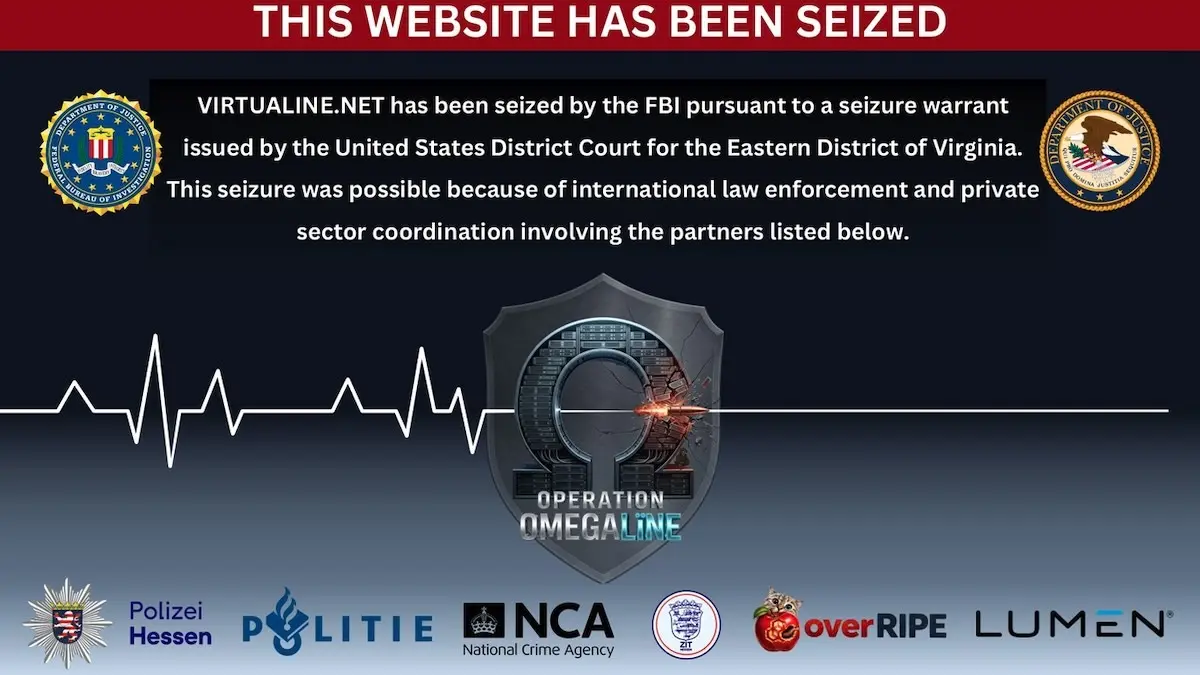
The Federal Bureau of Investigation has seized the domain virtualine.net, taking down the online storefront of a prominent Russian-speaking bulletproof hosting provider that has spent years supplying infrastructure to a wide range of cybercriminal operations.
According to federal court documents, Virtualine—which has operated under several aliases including Secury, Massgod, Spamhouse, Lanedo, and Omegatech—functioned as a dedicated haven for threat actors. The provider specialized in hosting illicit customer services while actively helping malicious operators evade law enforcement takedown attempts, bypassing traditional abuse complaints, and ensuring continuous uptime for illegal digital enterprises.
Operating within the shadows of the cybercrime underground, Virtualine heavily advertised its services on prominent underground forums. In its promotional posts, the provider explicitly marketed its support for a diverse array of malicious operations, including large-scale phishing campaigns, spam dissemination, carding schemes, and malware distribution. Furthermore, Virtualine actively advertised its technical capacity to seamlessly migrate customer services to unaffiliated infrastructure if a specific server was compromised or flagged, boasting that it intentionally and systematically ignored all abuse reports.
Beyond traditional financial crimes and malware operations, the hosting provider facilitated severe forms of online exploitation. Court records and investigative findings reveal that Virtualine permitted users to host, post, and commercialize explicit images and videos of both minors and adults without consent. The provider explicitly supported at least one high-profile customer that operated a hack-for-hire service specifically designed to infiltrate and steal sexually explicit content from private online accounts.
Despite receiving numerous formal takedown requests and warnings from law enforcement agencies across multiple international jurisdictions, Virtualine refused to sever ties with the malicious actor. Instead, the hosting provider actively assisted the customer in establishing a brand-new website dedicated to uploading and distributing the illicitly obtained content, continuing to host the replacement platform even as scrutiny intensified.
According to comprehensive blockchain intelligence gathered by TRM Labs, Virtualine’s infrastructure was leveraged by a variety of high-threat cybercrime collectives, including notable ransomware gangs and aggressive infostealer operators.
In an analysis of the provider’s financial inflows, TRM Labs noted that Virtualine managed to attract a massive volume of illicit cryptocurrency. "Virtualine received more illicit-attributed cryptocurrency than any other TRM-labeled bulletproof hosting provider, despite receiving less total value than several peers," the intelligence firm reported, highlighting the concentrated illicit nature of its revenue streams.
The bulletproof hosting provider first surfaced publicly on the Russian-language cybercrime forum Exploit in 2024, though its operators claimed to have been active since 2019. Expanding its footprint aggressively over the years, Virtualine boasted that by 2025 it possessed one of the largest collections of autonomous system numbers dedicated specifically to malware and botnet hosting within the cybercrime ecosystem.
An analysis of the Bitcoin addresses labeled by blockchain investigators as belonging to Virtualine provides a clear picture of its primary clientele and funding sources. The vast majority of these cryptocurrency payments originated from a prominent Russian drug marketplace, which accounted for 44 percent of the tracked inflows. A large-scale sextortion scheme represented the second-largest funding source at 17 percent, while transactions routed through a cryptocurrency mixer accounted for 13 percent of the payments. Ransomware operations made up 5 percent of the inflows, and by 2026, the provider was actively receiving payments directly from the operators of the StealC infostealer malware.
While the domain seizure represents a significant disruption to the criminal enterprise, cybersecurity experts caution that it is rarely a silver bullet for completely neutralizing sophisticated hosting networks. TRM Labs noted in its assessment that while a domain seizure effectively disrupts how customers find and access a service, it does not by itself establish that the underlying operators have permanently ceased their activities, nor does it guarantee that customers have instantly lost access to all underlying infrastructure.
The takedown of virtualine.net adds to a growing series of international law enforcement actions targeting the vital infrastructure that underpins the modern cybercrime economy, disrupting the networks that allow malicious actors to operate with perceived impunity.
 Nana
 Ammar Sabilarrohman
 Pevita Pearce