
 By Layla Zulfa

Prominent Bitcoin developer and advocate Jimmy Song has launched a scathing critique against Bitcoin Core developers for their decision to eliminate the OP_Return data limit in the upcoming Bitcoin Core 30 upgrade. Song condemned the move as emblematic of a "fiat" mentality, arguing that developers are deflecting legitimate concerns raised by the broader Bitcoin community and network node operators regarding the embedding of non-monetary data onto the blockchain.
The controversial decision centers on the OP_Return opcode, which is currently capped at 80 bytes in size. By deciding to lift this limit entirely for non-monetary data, Bitcoin Core developers have ignited a fierce debate that has been brewing for nearly six months. The dispute bears a striking resemblance to the contentious Bitcoin block size wars of 2015 to 2017, a historical period of internal friction that ultimately resulted in a hard fork of the protocol and the creation of Bitcoin Cash. This parallel has left some members of the community whispering about whether the current friction over data storage could eventually threaten a similar network split.
Song did not mince words when addressing the arguments put forth by the developers who supported the pull request. He directed sharp criticism at the rationale that defining "spam" is inherently difficult and that the software should therefore avoid making distinctions altogether.
"The idea that spam is difficult to define, and because of this ambiguity, we shouldn’t be making any distinctions at all in the software, is a time-wasting argument from fiat politics where you pretend not to know the obvious, so the actual debate can never get off the ground — the non-monetary uses of Bitcoin are spam," Song stated in a public post.

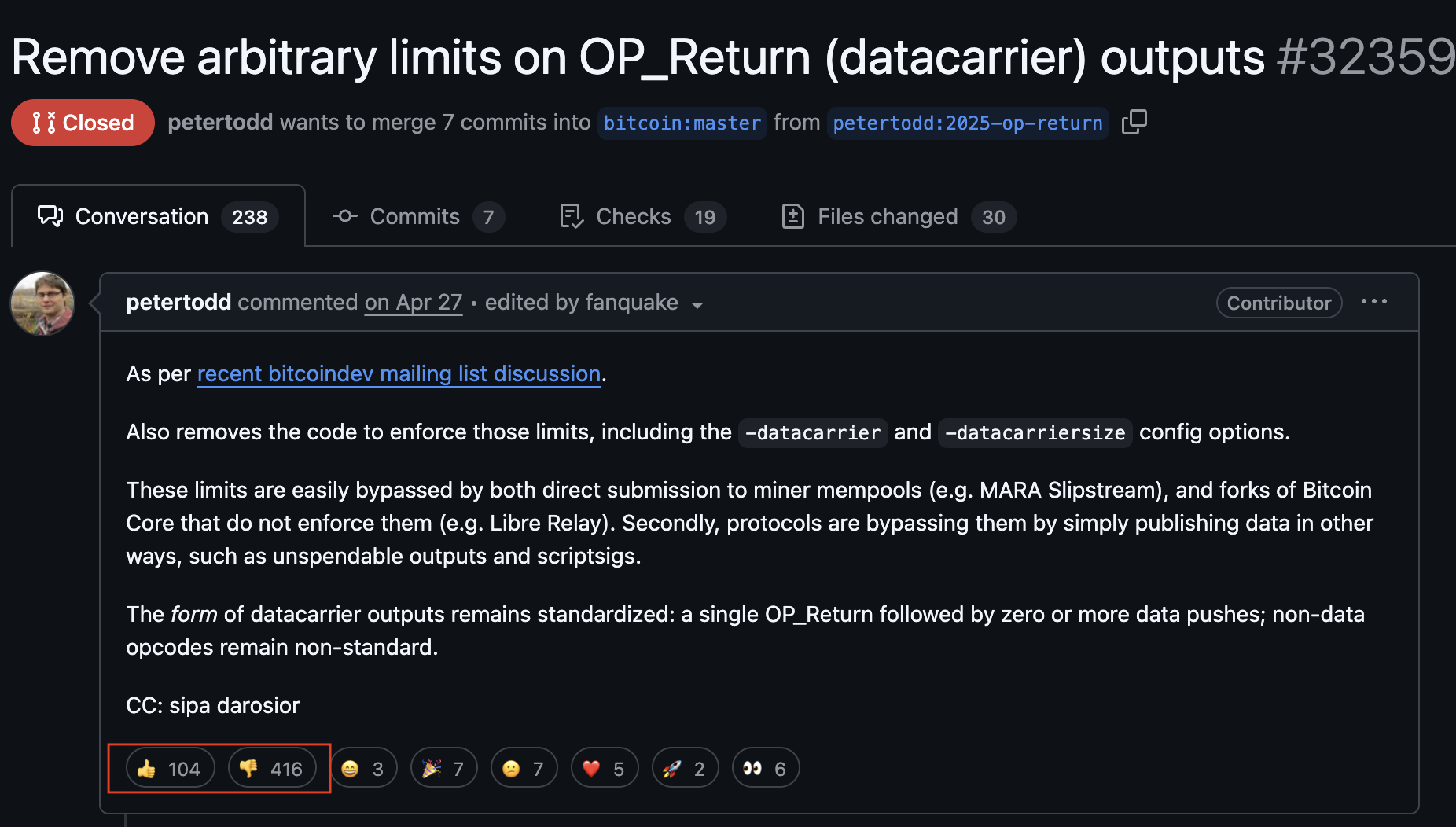
He continued by emphasizing that while people can debate whether non-monetary usage is desirable, claiming that spam is undefinable serves primarily as a stalling tactic. According to Song, this rhetorical strategy is designed to avoid confronting the real and long-term implications that such a structural modification will have on the network. Despite substantial pushback from community members, developers, and node runners, the pull request to remove the limit was pushed through on GitHub, cementing the impending update and deepening the ideological rift within the ecosystem.
Node Runners Vote with Their Feet in Historic Exodus to Bitcoin Knots
The unilateral choice by Bitcoin Core developers to expand the OP_Return parameters has fractured community consensus and triggered a remarkable migration among network participants. Frustrated by the direction of the flagship software, a rapidly growing number of Bitcoin node operators have chosen to vote with their feet, abandoning Bitcoin Core in favor of Bitcoin Knots, an alternative implementation of the Bitcoin node software.
This trend is reflected in network statistics. Nodes running Bitcoin Knots now account for approximately 20% of the entire Bitcoin network. This marks a staggering, near-vertical leap from a mere 1% market share in early 2024, representing a massive shift in network composition over the span of just nine months.
Bitcoin Knots appeals to dissenting node runners because it permits operators to enforce strict data size limits. Proponents of this alternative software argue that maintaining these constraints is paramount to preserving the core decentralization tenets of the Bitcoin protocol.
Since the inception of the decentralized protocol in 2009, the Bitcoin ledger has accumulated roughly 680 gigabytes of data. This relatively modest size is directly attributable to the simple, focused architecture of Bitcoin and its historically rigorous data limits. Because Bitcoin’s data storage requirements remain remarkably low, everyday participants can run a fully validating node on standard retail computer hardware for as little as $300. This low barrier to entry successfully democratizes access to the network and ensures maximum decentralization by allowing individuals worldwide to independently verify consensus rules.
By contrast, higher-throughput blockchain networks and complex smart contract platforms routinely generate vastly greater quantities of data. Running a validating node on those networks often demands specialized, high-end commercial hardware and can cost tens of thousands of dollars. Consequently, participation in those ecosystems is frequently restricted to wealthy investors and large corporate entities capable of absorbing the heavy infrastructure costs.
As experts frequently note, burdensome hardware requirements invariably translate into increased centralization for a blockchain protocol. This concentration of power introduces a heightened risk that a small cohort of powerful nodes could eventually collude to alter consensus rules or reverse transactions, a vulnerability that the Bitcoin community has historically sought to avoid at all costs.
 Ali Ikhwan
 Neng Nana
 Suro Senen