 By Lina Hope
The Polygon Foundation, the primary organization overseeing the development and growth of the prominent Ethereum layer-2 scaling network, announced on Wednesday that its consensus and finality functions have been fully restored. This operational recovery follows a recent software bug that caused a number of network nodes to fall out of sync with the underlying blockchain, prompting immediate technical intervention from the core development team.
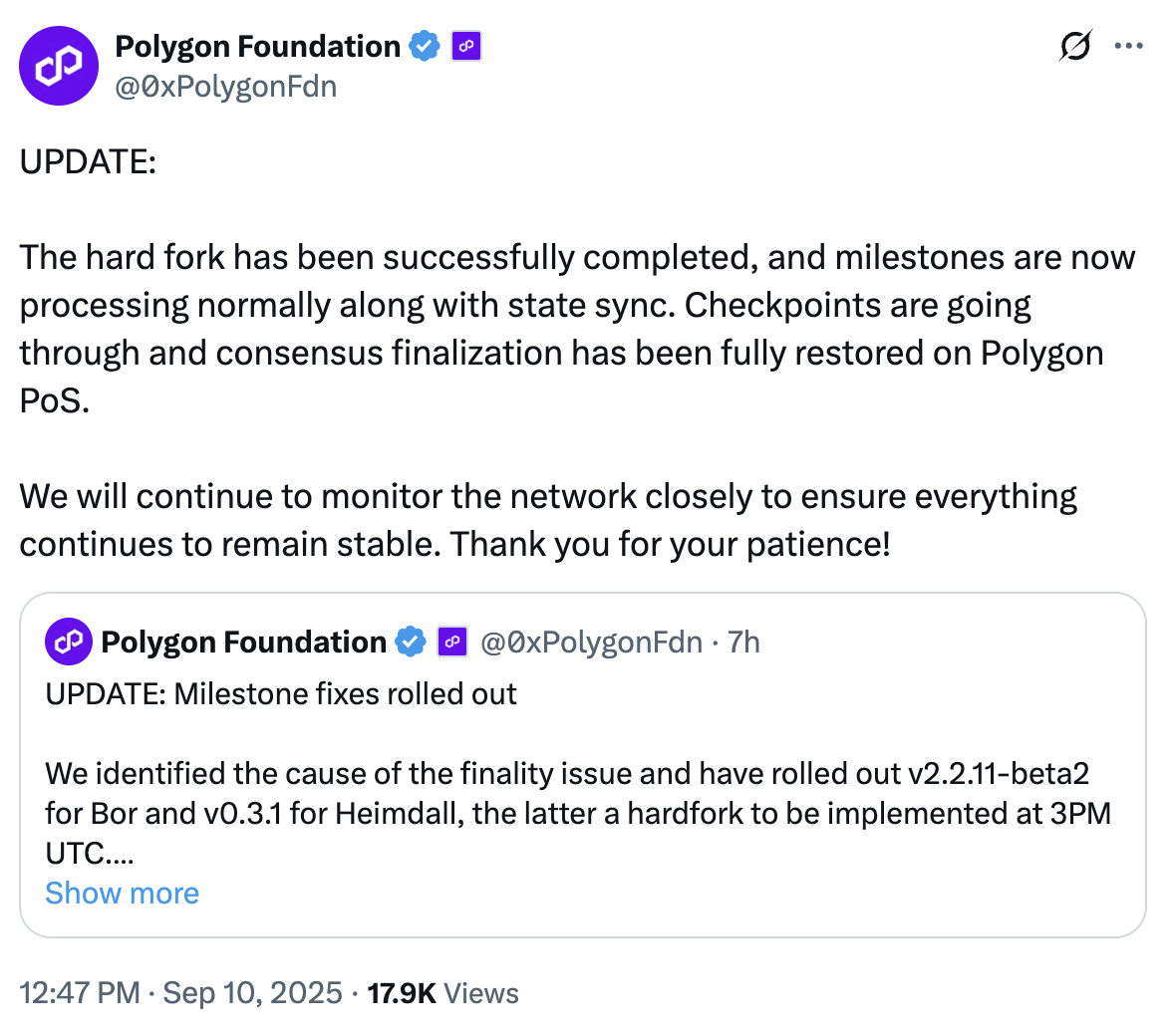
To address the disruption, Polygon successfully executed a hard fork shortly after the software bug surfaced. The incident had primarily impacted various remote procedure call (RPC) nodes, which play a critical role in the network infrastructure by relaying vital information and transaction data between decentralized applications and the blockchain layer. The Polygon team confirmed the successful deployment of the hard fork in an official update published on Wednesday, signaling that core network operations were returning to normal parameters.
The root cause of the technical disruption was traced back to a faulty proposal submitted by a network validator. According to Polygon co-founder Sandeep Nailwal, this erroneous proposal pushed several Bor nodes—which are specifically utilized for transaction ordering and block production—onto divergent network forks, creating a synchronization gap across the ecosystem.

Detailing the technical remediation steps taken by the engineering team, Nailwal explained that fixes were rolled out simultaneously across multiple client implementations. These included Heimdall v0.3.1, a new version featuring a hard fork designed to delete the identified milestone, and Bor 2.2.11 beta2, which systematically purged the problematic milestone from the underlying database. With these critical fixes now fully live and operational across the network, nodes are no longer stuck, and both checkpoints and milestones are once again finalizing normally.
The incident highlights a broader, ongoing challenge within the fast-evolving blockchain industry. As cryptographic protocols and scaling solutions become increasingly complex to accommodate sophisticated smart contract functionality, decentralized file storage, and seamless cross-chain interoperability, software bugs continue to cause occasional network outages. These technical hurdles can temporarily disrupt the overall onchain user experience, emphasizing the delicate balance between rapid protocol innovation and robust infrastructure reliability. Despite the disruption, block explorers such as Polyscan demonstrated that regular transactions on the network quickly returned to displaying properly as the fixes propagated.
Polygon Experiences Second Software Bug Since July
Wednesday’s software bug did not actually halt block production on the Polygon network; instead, the issue specifically impacted node communication and alignment. This created a notable discrepancy between ongoing block production and the specific data that the impacted nodes were relaying to external applications and users, necessitating a coordinated network-wide synchronization effort.
This week’s event marks the second time Polygon has faced a notable software-related disruption since July, when the Heimdall mainnet experienced a temporary outage. Heimdall serves as the crucial consensus client that handles communication between nodes for Polygon’s proof-of-stake (PoS) consensus mechanism. During the July incident, the consensus layer was halted for approximately an hour before engineers could stabilize the environment.
Similar to Wednesday’s incident, block production on the network never entirely ceased during the July event, and new blocks continued to be added to the chain continuously via the Bor mainnet. At the time, Polygon spokespeople clarified to industry reporters that the consensus layer’s partial outage was triggered by a single validator abruptly exiting the network. Following that unnamed validator’s exit, several RPC nodes were forced to resynchronize with the blockchain and reestablish proper communication channels to resume fully normal functionality across the layer-2 architecture.
As the Polygon Foundation and its developer community continue to refine and harden the network’s underlying architecture, incidents like these underscore the complex operational dynamics inherent in scaling Ethereum. With consensus mechanisms and finality functions now fully restored, the ecosystem moves forward with its ongoing network enhancements and expanding suite of decentralized financial applications.
 Ali Ikhwan
 Neng Nana
 Suro Senen