
 By Ammar Sabilarrohman

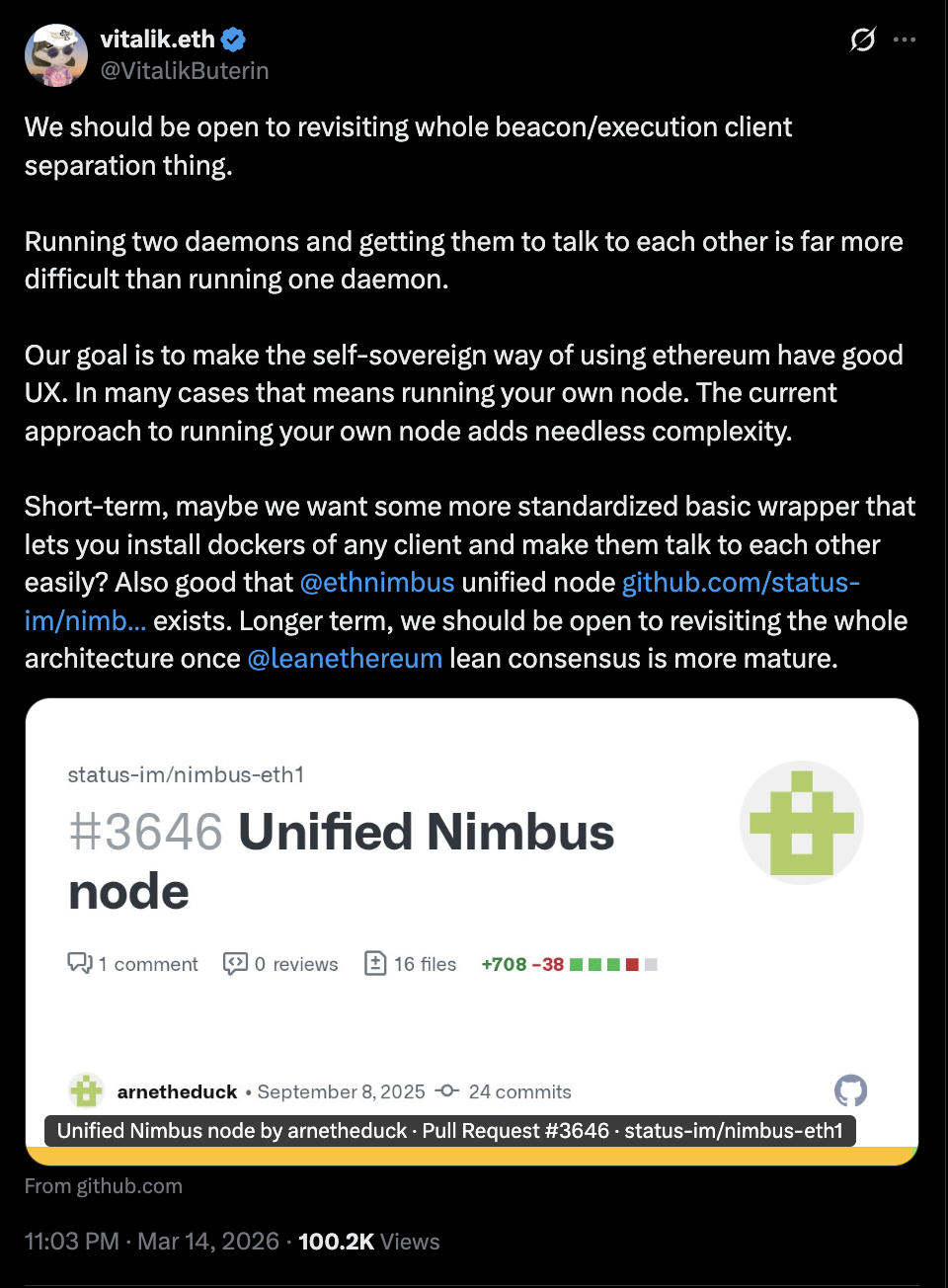
Ethereum co-founder Vitalik Buterin has introduced a new proposal aimed at significantly simplifying the process of running an Ethereum node, moving to merge backend programs in a bid to combat growing centralization concerns across the network.
In a pull request shared on Saturday, Buterin outlined a technical update designed to combine the separate backend programs utilized by nodes to interact with Ethereum’s Beacon Chain—which oversees consensus and staking—and the protocol’s execution layer. Under the current architecture, these two components operate as distinct programs that require individual setup and continuous synchronization to effectively coordinate and communicate the data produced by Ethereum’s consensus and execution layers.
This current structural requirement substantially elevates the technical complexity associated with running a node or providing validation services for the broader Ethereum network. As a result, ordinary users are frequently discouraged from hosting their own local infrastructure, forcing a heavy reliance on third-party service providers and remote infrastructure coordinators.
Addressing this barrier in a post on the social media platform X, Buterin expressed strong criticism of the status quo.
"I feel like at every level, we have implicitly made this decision that running a node is this oh so scary DevOps task that it is ok to leave to professionals," Buterin wrote. "It is not. We need to reverse this. Running your own Ethereum infrastructure should be the basic right of every individual and household. ‘The hardware requirement is high, therefore it’s okay for the DevOps skill and time requirements to also be high,’ is not an excuse."

Even for individuals who possess the financial means to purchase high-end computing hardware and hold the necessary technical expertise, Buterin noted that the sheer time investment required to establish and maintain these setups remains a major hurdle, reinforcing his stance that running nodes should be a straightforward and accessible endeavor.
The broader Ethereum network, alongside various other smart contract-focused blockchains, has faced persistent criticism regarding the heavy technical demands and specialized hardware required to operate a node. Critics and developers alike have repeatedly warned that these barriers directly contribute to centralization pressures, as fewer participants are able to independently verify the network.
Buterin Proposes Partially Stateless Nodes to Further Decentralize the Network
The push for a unified code structure follows a series of architectural proposals from Buterin aimed at alleviating node burdens. In May 2025, Buterin introduced the concept of partially stateless nodes, a design intended to free node operators from maintaining the full historical weight of the blockchain. Instead of storing every historical block, these nodes would retain only the specific data required by the individual node runner.
This approach is designed to meaningfully lower hardware costs and reduce data storage requirements for everyday users who wish to run nodes for personal purposes, such as broadcasting transactions and independently verifying the blockchain.
Disk space has long remained the primary bottleneck for node operators, according to documentation from Go-Ethereum (GETH). Because smart contract blockchain networks like Ethereum continuously generate vast quantities of data, they demand ever-increasing storage capacity, cementing the need for specialized hardware under the current framework.
However, this reliance on centralized infrastructure presents profound risks to the censorship-resistant ethos of decentralized public networks.
"A market structure dominated by a few remote procedure call (RPC) providers is one that will face strong pressure to deplatform or censor users. Many RPC providers already exclude entire countries," Buterin wrote in an extensive post on Ethereum Research.
The latest technical proposals arrive as Buterin actively reallocates personal resources to support foundational improvements to network infrastructure. In late January, Buterin revealed that he had set aside 16,384 Ether—valued at approximately $45 million from his personal holdings—to fund privacy-preserving technologies, open-source hardware, and secure, verifiable software development.
He explained that these funds would be distributed gradually over the coming years, coinciding with a period of what he characterized as "mild austerity" for the Ethereum Foundation, even as the organization continues to aggressively pursue its long-term technical scaling and decentralization roadmap.
 Ali Ikhwan
 Neng Nana
 Suro Senen