
 By Evan Lee Salim

The Bitcoin network requires a dedicated "conservative" client node software implementation to safeguard its fundamental monetary properties and reinforce its underlying decentralization, according to Jimmy Song, co-founder of ProductionReady. ProductionReady operates as a non-profit organization dedicated to funding open-source Bitcoin node software development alongside educational initiatives within the broader cryptocurrency ecosystem.
Speaking directly on the philosophy guiding the organization, Song emphasized that ProductionReady maintains a strict institutional "bias" against implementing significant code changes unless there is an "overwhelming" level of community support for the modification. This deliberate friction is designed to protect the integrity of the reference system from hasty adjustments that could inadvertently compromise long-term stability.
"The general principle is: if you’re not sure a change makes the money better, don’t make it," Song explained.
This perspective comes at a critical juncture for the cryptocurrency ecosystem, where debates over protocol updates, data limits, and the administrative trajectory of reference software implementations have taken center stage among developers, node runners, and community stakeholders alike.

Preserving Self-Sovereignty and Keeping Storage Costs Low
As part of its broader mission, ProductionReady expects to actively support and restore the traditional 83-byte OP_RETURN data limit for arbitrary, non-monetary information embedded within Bitcoin transactions. Song pointed out that keeping node storage and bandwidth costs down by strictly limiting arbitrary data utilization is an essential prerequisite for maintaining robust network decentralization over the long term.
"The more self-sovereign Bitcoin users are, the more decentralized and resilient the network becomes," Song stated, elaborating on the core mechanics of blockchain verification. "That means keeping the cost of running a node low enough for ordinary people to do it."
When hardware requirements related to storage and bandwidth grow exponentially, fewer everyday participants are able to independently verify transactions for themselves. Under such conditions, the network inevitably centralizes by default, shifting power away from individual users toward heavily resourced entities. A truly conservative client node implementation, Song argued, takes this vital tradeoff very seriously.
Maximizing the sheer number of active nodes and ensuring they remain fully accessible to the average, everyday user effectively hardens the entire Bitcoin network. This widespread distribution significantly reduces the probability of malicious actors successfully cheating the system by submitting false transactions or a small cartel of powerful entities colluding to centralize network governance and validation.
Bitcoin Core 30 Removes the OP_RETURN Data Limit, Sparking Major Pushback
The broader conversation surrounding node storage demands and on-chain transaction data bloat transformed into a major hot-button issue throughout the cryptocurrency landscape following a contentious decision by core developers. Specifically, developers unilaterally altered the long-standing 83-byte data limit in Bitcoin Core version 30, which serves as the latest major upgrade to the primary reference implementation for Bitcoin node software.
Despite widespread and vocal pushback from the global Bitcoin community, the arbitrary data limit was radically expanded to 100,000 bytes. Context surrounding the proposal highlights the depth of the community division: the pull request submitted on GitHub to alter the limit received approximately four times as many downvotes as it did upvotes, signaling a profound disconnect between the core development group and a substantial portion of node operators.
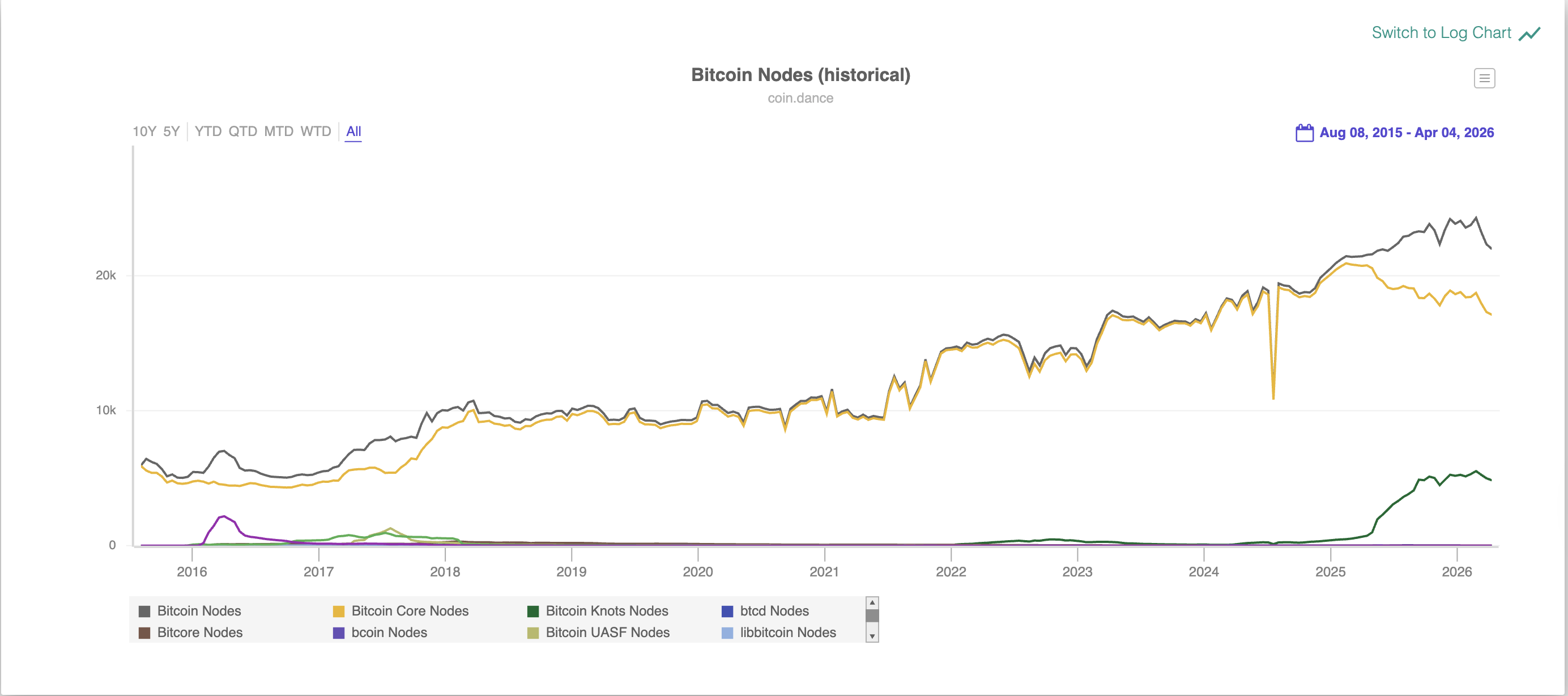
Bitcoin Core version 30 officially went live in October 2025. The rollout immediately triggered a historic, unprecedented surge in the adoption of Bitcoin Knots, an alternative implementation of the node client software that maintains stricter policies regarding transaction data limits and network spam.
Data from ecosystem monitors such as Coin Dance illustrates the profound shift in the software distribution landscape. Bitcoin Core historically continues to be the dominant software of choice for node runners, with the vast majority of the network—approximately 77.8%—running some version of the Core software. However, the release of version 30 catalyzed a dramatic migration toward alternatives.
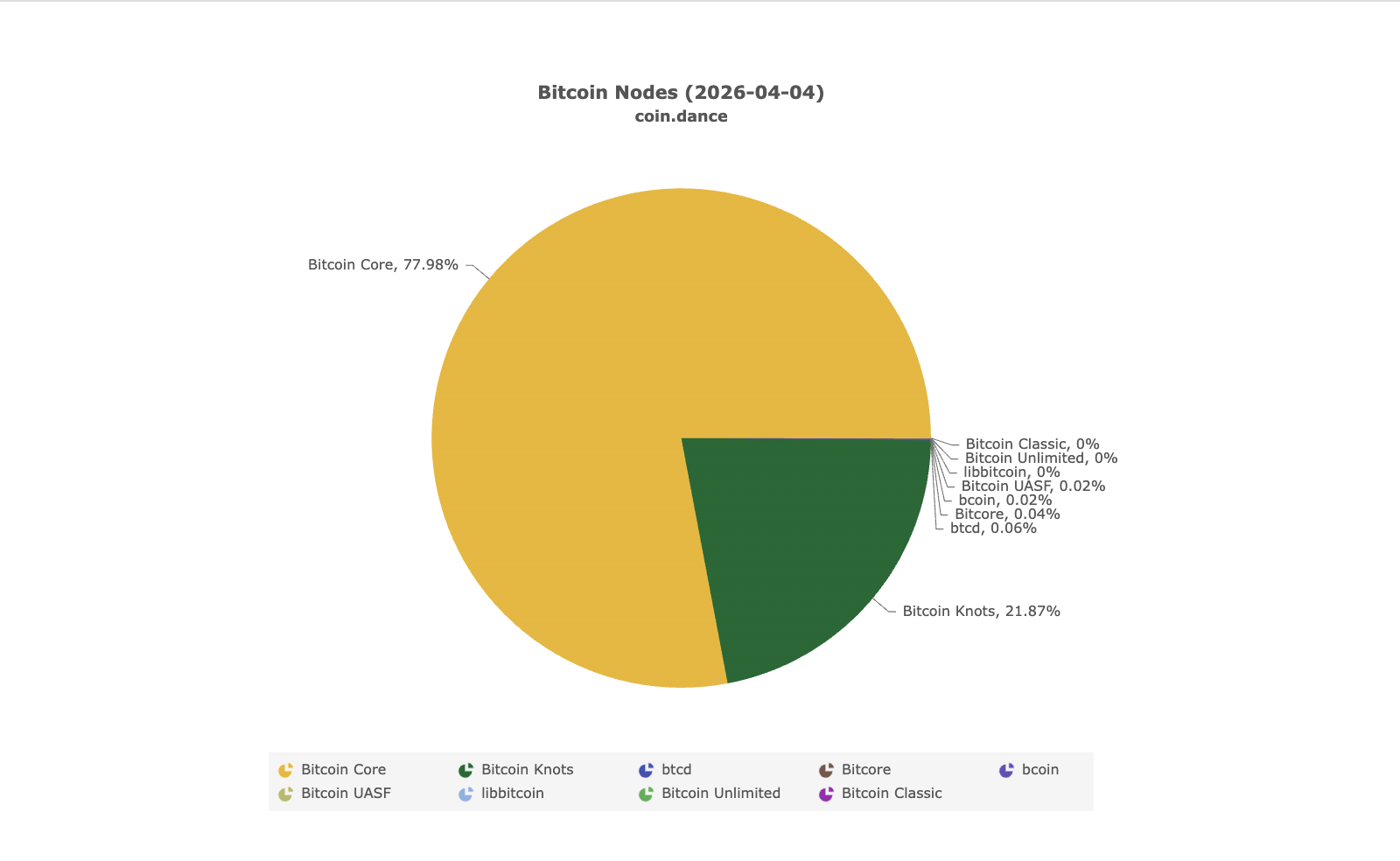
Prior to the decision to remove the traditional OP_RETURN function, only about 1% of the entire Bitcoin network ran the Knots software during 2024. In the wake of the upgrade, the number of nodes running Bitcoin Knots surged to record highs. Recent network metrics indicate that there are now 4,746 active Bitcoin Knots nodes operating worldwide, representing over 21.7% of all reachable nodes on the network. Meanwhile, approximately 21.8% of the network runs various configurations of Bitcoin Knots alongside other iterations, underscoring a growing appetite for software diversity and conservative governance within the global node-running community.
 Nana Muazin
 Ali Ikhwan
 Neng Nana