
 By Nana Muazin

Nearly three-quarters of all undersea fiber-optic internet cables—the vital arteries that carry approximately 99% of international internet traffic—would need to experience catastrophic failure before causing a significant operational impact on the Bitcoin network. That is the key finding of a new academic study that sheds light on the physical infrastructure resilience of the world’s leading cryptocurrency.
In research originally published in February and revised on March 12, researchers Wenbin Wu and Alexander Neumueller from the Cambridge Centre for Alternative Finance examined peer-to-peer network data spanning an eleven-year period from 2014 to 2025. By analyzing 68 verified historical submarine cable fault events alongside this network data, the researchers applied a country-level cascade model to evaluate precisely how resilient Bitcoin’s underlying physical infrastructure truly is against widespread telecommunications disruptions.
The authors claim their work represents the first longitudinal study of Bitcoin’s resilience to submarine cable failures. For years, industry analysts, technologists, and enthusiasts have debated a long-standing question: what would happen to the decentralized Bitcoin network if major portions of the global internet infrastructure were suddenly severed or disrupted? This study provides the first empirical framework to answer that theoretical dilemma.
According to the findings, the critical failure threshold for random cable removal sits between 0.72 and 0.92. This means that a staggering 72% to 92% of all inter-country submarine cables would need to fail simultaneously before more than 10% of the network’s nodes would be forced to disconnect.

However, the research uncovered a notable vulnerability. The Bitcoin network proved to be significantly more susceptible to targeted attacks directed at specific subsea cable chokepoints. The researchers noted that calculated, strategic disruptions of critical maritime pathways are an order of magnitude more effective at damaging network connectivity, carrying a much lower critical failure threshold of 0.05 to 0.20.
Tor Routing Provides Greater Resilience
Beyond examining raw cable connectivity, the study also explored the role of privacy-enhancing technologies like Tor, or The Onion Router. The researchers found that Tor creates a compound barrier to disruption, particularly given the current geographic concentration of relay infrastructure within well-connected European nations.
Tor functions in a manner conceptually similar to virtual private networks, or VPNs. It bounces internet traffic through a decentralized chain of volunteer-run servers distributed across the globe, wrapping each relay hop in a distinct layer of encryption to preserve user privacy, much like the layers of an onion.
Within the Bitcoin ecosystem, the network utilizes Tor to obfuscate node addresses, effectively hiding their precise physical locations from public view. The Cambridge Centre for Alternative Finance paper revealed that an estimated 64% of all Bitcoin nodes operate in this manner, rendering them essentially invisible to outside researchers and potential adversaries.
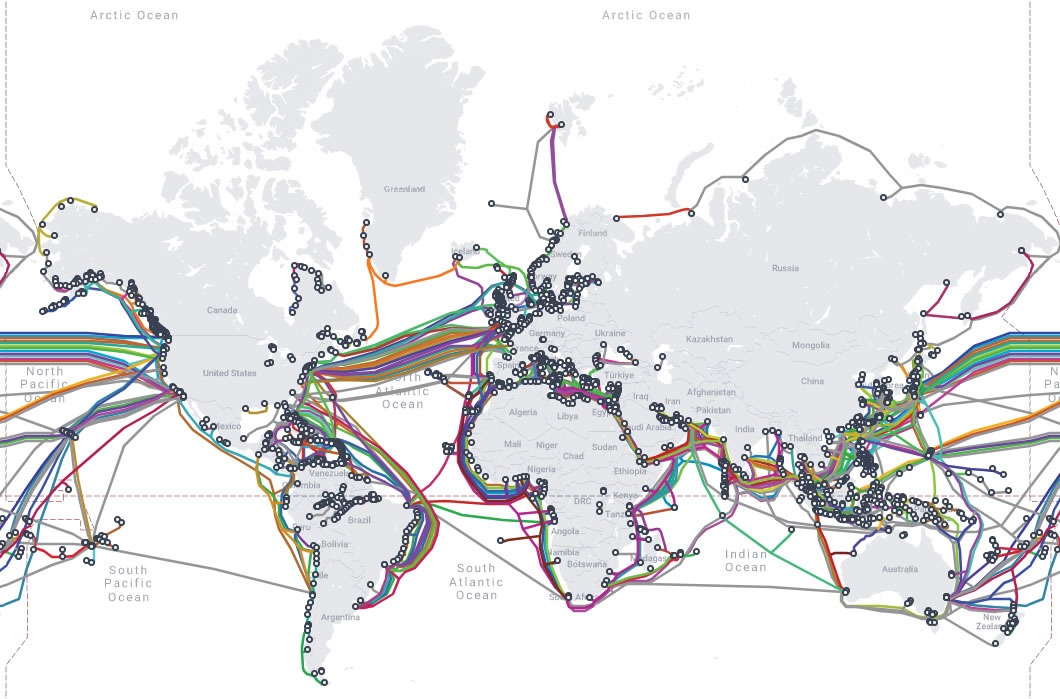
The study stated that Tor adoption actually increases overall network resilience under the current geography of relay infrastructure, rather than introducing hidden structural fragility. This occurs largely because Tor relay infrastructure is heavily concentrated in countries such as Germany, France, and the Netherlands. Because these nations boast exceptionally robust, extensive, and redundant submarine cable connectivity, localized or broad international cable failures rarely succeed in taking down core relay capacity. Over time, the continuous integration of Tor routing has steadily bolstered the defensive posture of the global decentralized network.
Near-Zero Correlation Between Cable Events and BTC Price
In addition to modeling network topology and physical node connectivity, the researchers cross-referenced historical data to determine whether physical infrastructure breakdowns ripple directly into financial markets.
Their analysis concluded that 87% of the 68 verified historical cable fault events documented over the study period caused less than a 5% disruption to overall node connectivity. More importantly, the researchers found that historical cable failure events showed essentially zero correlation with Bitcoin market prices. Statistical analysis yielded an insignificant correlation coefficient of minus 0.02, indicating that physical internet disruptions of this scale have historically failed to rattle investor markets or dictate asset valuations.
 Evan Lee Salim
 Ali Ikhwan
 Neng Nana