
 By Nana Muazin
Juan Ricardo Palacio Escobar, a 52-year-old executive splitting his time between Miami and Medellin, Colombia, faces wire fraud charges outlined in an indictment filed in Rhode Island. For six years, Palacio operated ransomwarehelp.com, a business that aggressively marketed itself to cyberattack victims under the reassuring banner of "Do not pay the ransom!" The company promised that its sophisticated, proprietary cryptographic tools could restore compromised servers and locked data files with absolute perfection, eliminating any need to surrender to cybercriminal extortion.
According to promotional materials preserved from the defunct website, the firm claimed to house a massive team of 80 experts specializing in cryptography, digital forensics, and reverse engineering, backed by nearly three decades of combined experience. The site boasted a staggering success rate of over 99 percent, assuring prospective clients that its engineers deployed advanced algorithms to achieve complete data recovery. "We never promote, intermediate or pay ransom to threat actors on behalf of our clients," the website prominently declared.
However, a sweeping federal investigation dismantled those claims. The indictment reveals that Palacio routinely did the exact opposite of what the company advertised. Instead of relying on advanced decryption science or proprietary tools, Palacio quietly contacted ransomware groups behind the scenes, negotiated a price for a decryption key, and then billed victimized companies massive, inflated sums that dwarfed his actual acquisition costs.
The scheme came to light largely due to an undercover sting operation orchestrated by the Federal Bureau of Investigation. Posing simultaneously as a corporate ransomware victim and as a fictitious threat actor group, federal investigators initiated contact with RansomwareHelp after supplying the firm with a copy of a fabricated extortion note. True to form, RansomwareHelp representatives responded by reiterating their strict policy against negotiating with cybercriminals or paying ransoms.
Shortly after this initial contact, Palacio allegedly reached out to the FBI’s fake ransomware group, posing as an interested third party to secure the lowest possible price for a decryption key. Federal agents quoted a baseline price of 0.2 bitcoin, which equated to roughly $13,000 at the time. Less than 48 hours later, Palacio turned back to the undercover agents posing as the victimized company, reporting that the diagnostic assessment had been a success and quoting a total decryption cost of $13,260.

The sting operation captured the mechanics of the double-dealing in real time. The day after quoting the victim, Palacio messaged the fictitious ransomware group operated by the feds, attempting to negotiate the ransom demand down to $4,000. Ultimately, an agreement was struck at approximately $6,000 worth of bitcoin. Palacio then billed the FBI’s mock victim firm a total of $16,010, which included an upfront $2,750 diagnostic fee stacked on top of the inflated $13,260 decryption charge.
Security professionals who encountered RansomwareHelp in the wild say the federal indictment validates suspicions they have harbored for years regarding the firm’s deceptive practices. Paul Ihme, co-founder of the security firm Soteria, recalled being contacted in 2024 by a small, distressed accounting firm that had already paid RansomwareHelp a substantial diagnostic fee following a devastating Lockbit ransomware infection that crippled both internal and client data.
According to Ihme, RansomwareHelp presented the victim firm with a staggering recovery proposal totaling $438,880. The proposal justified the exorbitant fee by claiming it covered the "professional configuration of forensic servers," specialized engineering hours dedicated to programming bespoke decryption algorithms, and multiple intensive processing cycles required for deep cryptographic analysis.
The proposal further claimed that the recovery process involved reverse engineering the ransomware encryption using 510 preconfigured forensic servers of maximum quantitative capacity distributed across different locations worldwide. "Our programmers will inject randomly the encryption codes extracted during the forensic and cryptographic analysis using brute force processes," the proposal asserted to the unsuspecting business owners.
Ihme noted that RansomwareHelp routinely demanded unrestricted remote access to a victim’s internal network under the guise of running diagnostic checks, utilizing remote desktop tools like AnyDesk. Investigators and security experts believe this remote access served a dual purpose: gathering preliminary data while secretly purging the network of all copies of the actual ransom notes left behind by the attackers.
A standard ransomware note is a plain text file generated by hackers that details their demands and provides communication channels, such as a darknet chat URL or a designated email address. Attackers typically populate these notes across multiple systems within a compromised network. When Ihme’s team audited the accounting firm’s network, they found only a single copy of the ransom note buried deep within an old backup snapshot.

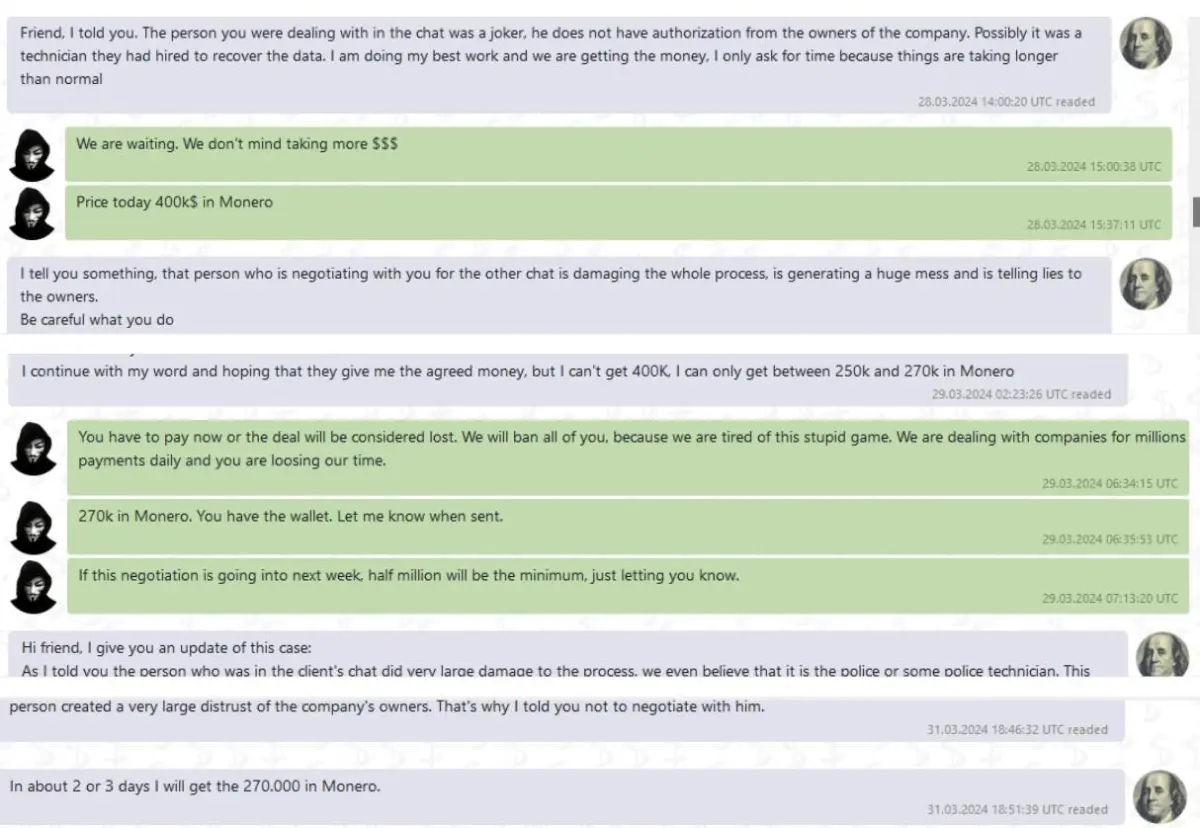
Upon using the contact details from that recovered note to connect directly to the Lockbit chat server, Soteria discovered that someone had already been actively negotiating with the extortionists for several days under the user ID associated with RansomwareHelp.
"The charitable view would be to say that they were using AnyDesk so they could grab the stuff they needed without having to walk the client through downloading and uploading a bunch of stuff," Ihme explained. "A legitimate firm would say, ‘Hey, send us a copy of the ransom note,’ which will have a link or URL to go to and chat with the threat actors. What they were doing is using that access to delete ransomware notes off the systems. The only reason they would do that is to prevent the victim from jumping into that chat itself."
Internal chat logs recovered during subsequent investigations showed RansomwareHelp repeatedly pleading with Lockbit not to reveal the ongoing negotiations to the victim organization. However, the ransomware operators quickly grew frustrated with the protracted communications. Lockbit representatives eventually warned that the victims had delayed too long and announced that the ransom demand would escalate by $100,000 for every single day the talks dragged on.
Facing impending financial ruin, the accounting firm heeded Soteria’s advice, cut ties with RansomwareHelp, and engaged a reputable incident response firm. With professional assistance, the company successfully negotiated a settlement directly with Lockbit for roughly half of what RansomwareHelp had originally attempted to charge them.
Throughout the process, chat records demonstrated that RansomwareHelp continued pestering the hackers even after realizing a legitimate third-party negotiator had stepped in on the victim’s behalf. In one message to the extortionists, a RansomwareHelp representative complained, "I tell you something, that person who is negotiating with you for the other chat is damaging the whole process. Please do not change the price. I am doing my best to achieve it."
Industry experts point out that firms like RansomwareHelp deliberately preyed upon small to medium-sized businesses lacking internal cybersecurity sophistication. Many of the technical claims embedded in the company’s proposals were technically nonsensical. For instance, the proposal sent to the accounting firm claimed an ability to break six distinct types of encryption, yet bizarrely listed irrelevant password hashing algorithms such as SHA-256 among them.

"If it were really true these guys could decrypt any ransomware out there, this guy would be a billionaire," Ihme remarked. "They were going after people who don’t have any technical knowledge, are desperate, and don’t have anyone advising them about how any of this stuff works."
The federal case against Palacio represents the latest high-profile action in an aggressive crackdown by the U.S. Department of Justice targeting dishonest remediation firms that exploit corporate cyber victims. In early October, federal authorities charged 54-year-old Edward Dubrovsky, an executive at Canadian cybersecurity firm Cybersteward, under a sealed case involving cyber extortion and conspiracy.
Around the same time, the Department of Justice announced charges against Zohar Pinhasi, the 50-year-old CEO of MonsterCloud, a Florida-based ransomware remediation company. Pinhasi was indicted on wire fraud and conspiracy charges for allegedly billing customers massive sums to remediate ransomware attacks while secretly paying hackers behind the scenes. According to federal court documents, Pinhasi funneled approximately $8 million to ransomware groups while collecting roughly $19 million from his clients.
Earlier in the year, federal courts handed down a 70-month prison sentence to Angelo Martino, a 41-year-old ransomware negotiator based in Land O’Lakes, Florida. Martino was convicted of conspiring with the notorious Blackcat/ALPHV ransomware collective to extort multiple victims. Prosecutors demonstrated that Martino accepted payments from the threat actors in exchange for leaking confidential strategic and negotiating positions held by his employer’s clients, directly enabling the criminal syndicate to maximize their extortion payouts.
 Sagoh
 Jia Lissa
 Asro