
 By Muslim

StarkWare, a prominent software development firm specializing in zero-knowledge (ZK) cryptography—a cryptographic method that allows one party to prove to another that a statement is true without revealing any information beyond the statement’s validity—has announced a major technical milestone for the world’s largest cryptocurrency. The company has successfully created a zero-knowledge verification of the Bitcoin blockchain capable of running smoothly on standard mobile devices.
This breakthrough proof encompasses all Bitcoin block headers stretching from the genesis block all the way to the present day. Crucially, it achieves this without demanding the storage of the full and detailed Bitcoin blockchain history, which has ballooned to over 680 gigabytes in size. By condensing historical ledger validation into a trustless cryptographic proof, the development opens up fresh possibilities for lightweight verification across resource-constrained hardware.
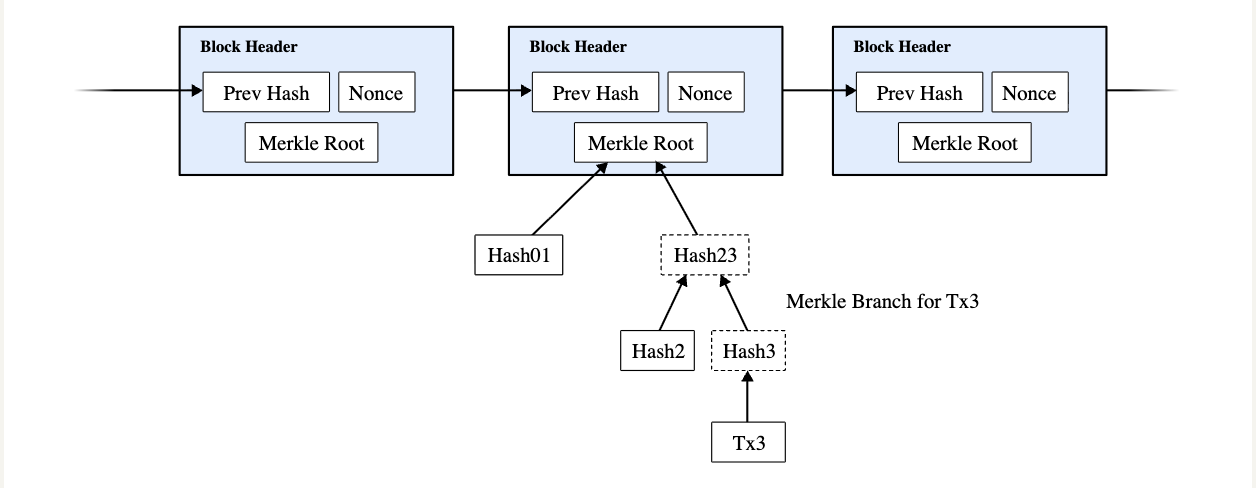
To understand the scale of the reduction, one must look at the anatomy of a Bitcoin block header. Every block header includes several critical pieces of data: the software version number utilized to mine the specific block, a cryptographic reference linking back to the previous block in the chain, an exact timestamp, the overall block size, and the nonce—the random number miners must discover and submit to successfully add a block to the immutable ledger.
Despite tracking this vast chronological chain of headers, StarkWare’s newly developed Bitcoin ledger proof comes in at a remarkably compact 1 megabyte in size. According to Abdelhamid Bakhta, head of ecosystem at StarkWare, this streamlined cryptographic proof empowers everyday users to verify transactions in under 100 milliseconds directly from their personal devices.

This innovative lightweight client architecture directly builds upon the foundational concept of Simplified Payment Verification (SPV). First outlined in Satoshi Nakamoto’s original Bitcoin white paper, SPV provides smaller, lightweight nodes with a standardized method to verify payments without requiring the user to download or store the entire transaction-heavy ledger.
StarkWare’s latest announcement holds profound significance for the broader adoption landscape because it effectively allows any individual user to verify Bitcoin payments independently. Traditionally, achieving this level of trustless verification required setting up a full Bitcoin node. However, running a dedicated full node typically incurs hardware and setup costs ranging between $300 and $1,000, alongside technical complexities that can easily overwhelm the average cryptocurrency user. By compressing the verification mechanism down to a lightweight 1-megabyte footprint, the technology bridges a longstanding usability gap between absolute decentralization and consumer accessibility.
Node Storage Requirements and Ledger Size Become Points of Contention in the BTC Community
While setting up a Bitcoin node demands an upfront financial and technical investment, the hardware requirements to maintain a BTC node are still relatively modest when compared to other prominent blockchain networks, some of which may demand enterprise-grade infrastructure costing tens of thousands of dollars.
Thanks to the relative simplicity of the core Bitcoin protocol, Bitcoin nodes can operate efficiently on standard retail personal computers. This accessibility has been vital given that the network has only accumulated roughly 680 gigabytes of data since its inception in January 2009.
This low barrier to entry and accessible hardware requirement are widely regarded as the cornerstone of preserving the protocol’s decentralization. They ensure that Bitcoin’s consensus mechanism remains robust, decentralized, and strictly enforced by independent node runners scattered across the globe.
If operating a node ever becomes prohibitively expensive due to mounting hardware requirements, the network faces the severe threat of centralization. Under such a scenario, control could concentrate heavily among large service providers possessing the capital and engineering resources required to maintain massive hardware footprints—a trajectory that directly contradicts Bitcoin’s core value proposition as a censorship-resistant, peer-to-peer monetary system.
In recent times, critics within the community have argued that the proliferation of inscriptions, ordinals, and other non-monetary data storage methods inscribed directly onto the blockchain exacerbates this centralization risk. By expanding the physical size of the ledger, these data-heavy additions require node operators to store and process significant quantities of non-monetary files, sparking heated debates over storage bloat.
Adding fuel to these ongoing architectural discussions, Bitcoin Core developers announced in May that the upcoming Bitcoin Core 30 update, slated for release in October, will unilaterally remove the long-standing OP_Return limit. This particular limit currently caps the amount of non-monetary data that can be embedded directly into standard Bitcoin transactions at 80 bytes—a threshold historically deemed too small to house the majority of modern images, inscriptions, and multimedia content.
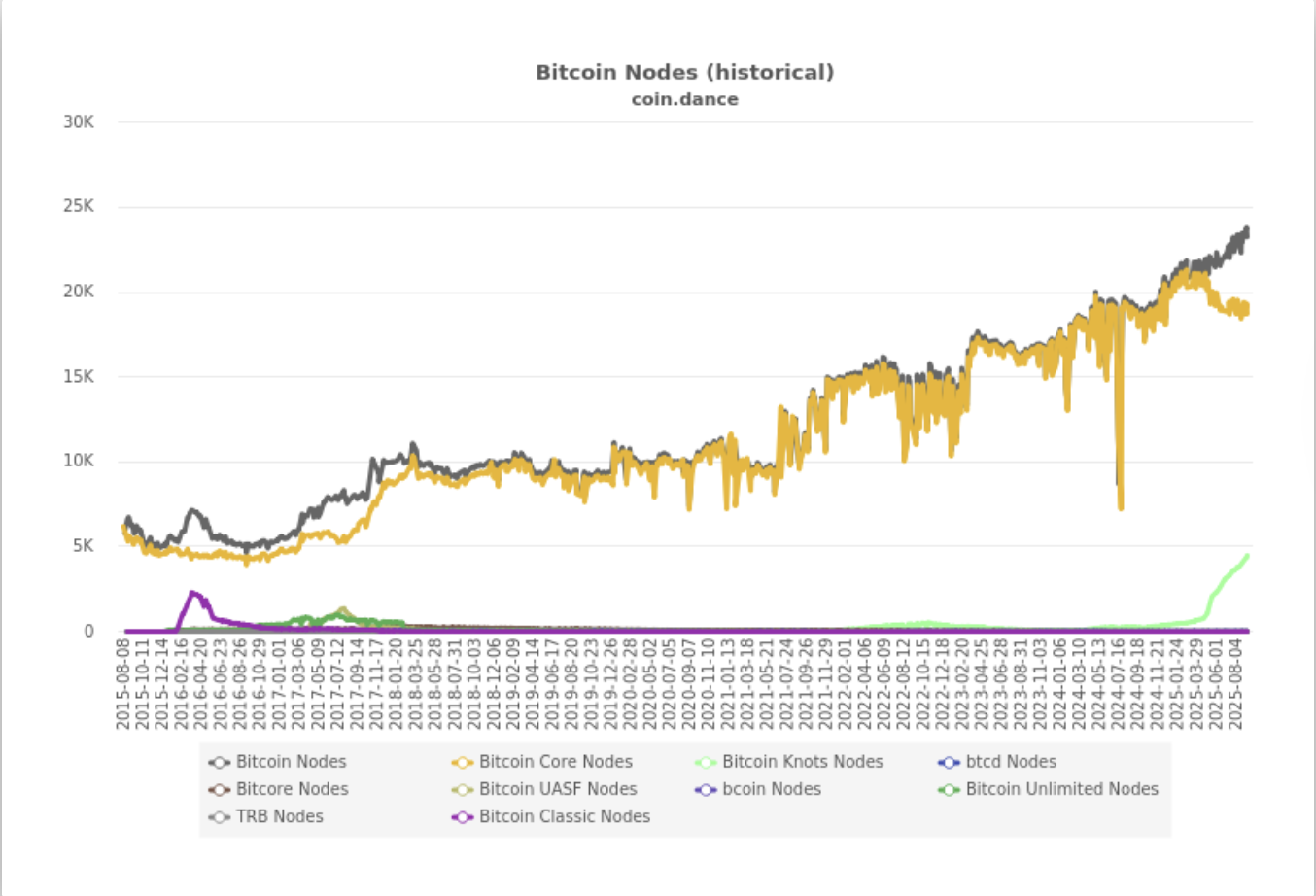
The planned structural change has already triggered a historic shift in user behavior across the ecosystem, marked by a surge in users migrating to and running Bitcoin Knots nodes. Bitcoin Knots represents an alternative Bitcoin node software implementation that offers a higher degree of customizable parameters. Among its features, Knots provides node operators with precise options to limit the amount of OP_Return data they are willing to store in their local memory pools and relay across the peer-to-peer network to other nodes.
Market data indicates that Knots nodes now account for nearly 20% of the entire network by 2025. This represents an almost vertical increase from late 2024, when Knots nodes hovered at roughly 1% of the total software market share, highlighting a deepening community-wide ideological divide over storage limits, network bloat, and the long-term maintenance of the Bitcoin blockchain.
 Ali Ikhwan
 Neng Nana
 Suro Senen