
 By Jia Lissa

Ethereum co-founder Vitalik Buterin has introduced a new proposal aimed at significantly
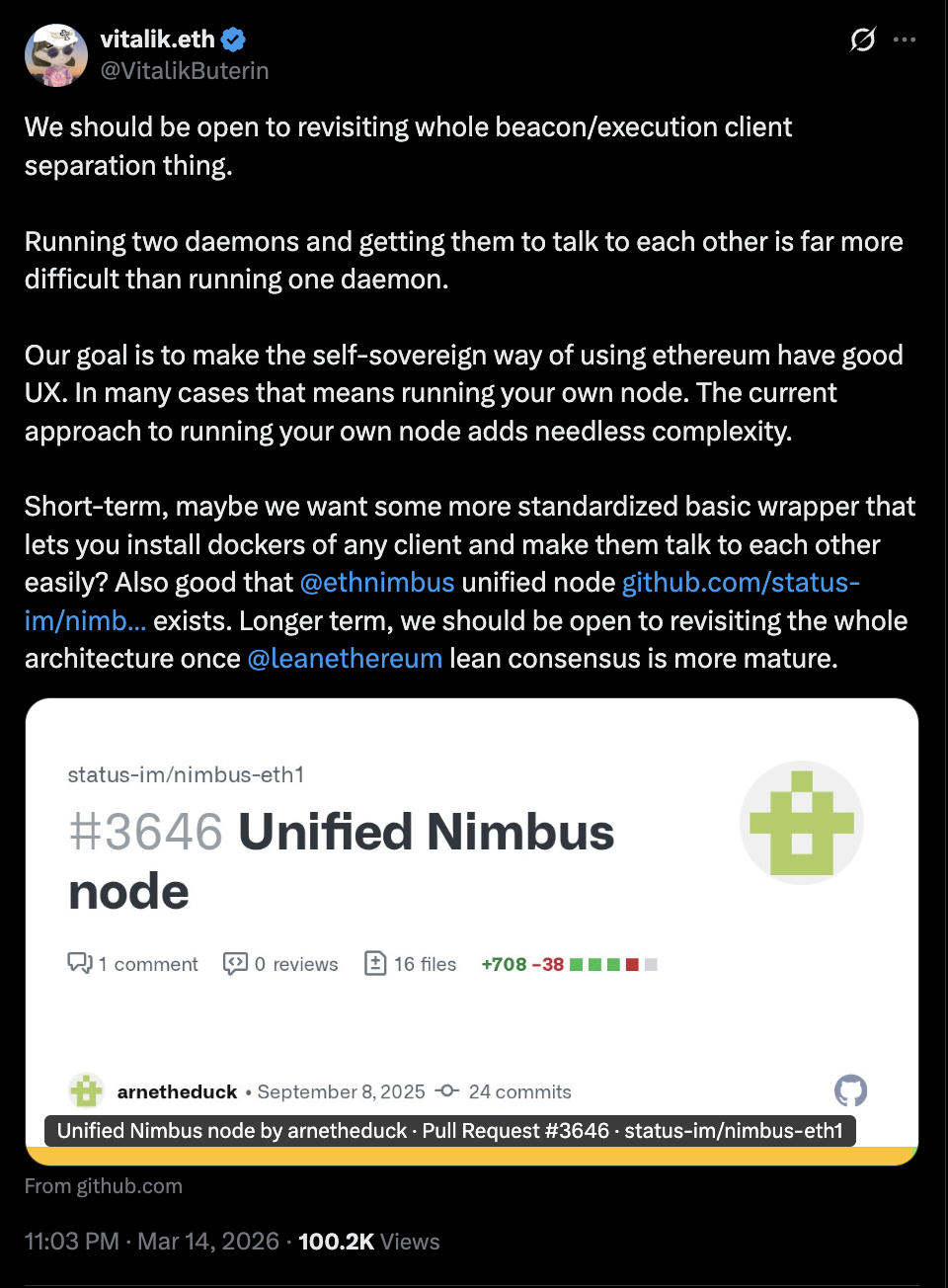
simplifying the process of running a node on the Ethereum network. In a pull request submitted on Saturday, Buterin outlined a technical blueprint designed to merge the backend programs currently used by validators to interact with Ethereum’s consensus layer and execution layer into a single, unified code structure.
The initiative targets a long-standing structural hurdle in the Ethereum ecosystem. At present, Ethereum node runners, often referred to as validators, must operate two distinct programs simultaneously. Each of these applications requires independent setup, maintenance, and synchronization to coordinate and communicate the complex data produced by Ethereum’s consensus and execution layers. This dual-client requirement substantially raises the technical barriers associated with running a node or providing validation services for the decentralized network.
According to Buterin, this inherent complexity discourages ordinary users from maintaining their own independent infrastructure. Instead, it forces a heavy reliance on centralized third-party service providers and remote procedure call (RPC) infrastructure, which introduces critical vulnerabilities related to censorship and platform centralization.

Addressing the issue on social media, Buterin expressed frustration with how the ecosystem has normalized the difficulty of node operation. He noted that the community has implicitly accepted a reality where running a node is treated as an intimidating DevOps task that should be left strictly to industry professionals. Emphasizing that this status quo must change, he argued that operating personal Ethereum infrastructure should be a fundamental right for every individual and household rather than an exclusive privilege for those with advanced systems administration skills.
Buterin explicitly rejected the common justification that high hardware requirements naturally excuse similarly high technical and time barriers for node operators. Even individuals who possess the financial resources to purchase high-end computing hardware frequently lack the necessary free time or specialized technical expertise to properly configure and maintain the software. In his view, participating directly in the network should be straightforward and accessible.
The broader blockchain industry has long faced intense criticism regarding the steep hardware demands and technical hurdles required to operate nodes for smart contract platforms. These compounding factors have continually fueled centralization concerns across the Web3 space, as fewer independent entities possess the capacity to host their own secure validation architecture.
Buterin Proposes Partially Stateless Nodes to Further Decentralize the Network
The latest proposal follows a series of architectural ideas introduced by Buterin to alleviate the burdens placed on node operators. In May 2025, Buterin proposed the integration of partially stateless nodes. Unlike traditional architectures, these nodes would not maintain the full historical record of blocks, retaining only the specific data required by the individual node runner to verify transactions and interact with the blockchain.
By eliminating the necessity to store historical bloat, this approach aims to drastically reduce hardware costs and storage capacity requirements for everyday users who wish to run nodes for personal purposes, such as sending transactions and verifying ledger integrity. Disk space limitations have historically served as the primary bottleneck for node operators across the network. Go-Ethereum documentation and other network resources have repeatedly highlighted that smart contract blockchains generate vast quantities of data that demand perpetually expanding storage volumes, ultimately driving the necessity for specialized hardware.
In accompanying research notes, Buterin highlighted the systemic risks associated with the current infrastructure market, warning that a market structure heavily dominated by a small number of RPC providers faces intense operational pressure to deplatform or censor users. He pointed out that many established RPC providers already exclude entire countries from their service availability, underscoring the urgency of restoring lightweight, independent local nodes.
The discussion surrounding decentralization and infrastructure accessibility comes at a time of broader strategic realignment within the Ethereum ecosystem. In late January, Buterin announced that he had set aside a personal holding of 16,384 Ether, valued at approximately $45 million, to directly support privacy-preserving technologies, open hardware initiatives, and secure, verifiable software development.
These dedicated personal funds are scheduled to be deployed gradually over the coming years. The move coincides with a transitional phase for the Ethereum Foundation, which has entered a period characterized internally as mild austerity while simultaneously maintaining steady progress on its core technical roadmap and scaling objectives.
 Nana Muazin
 Evan Lee Salim
 Ali Ikhwan